Trump Administration Proposes Major Overhaul of ATF Regulations
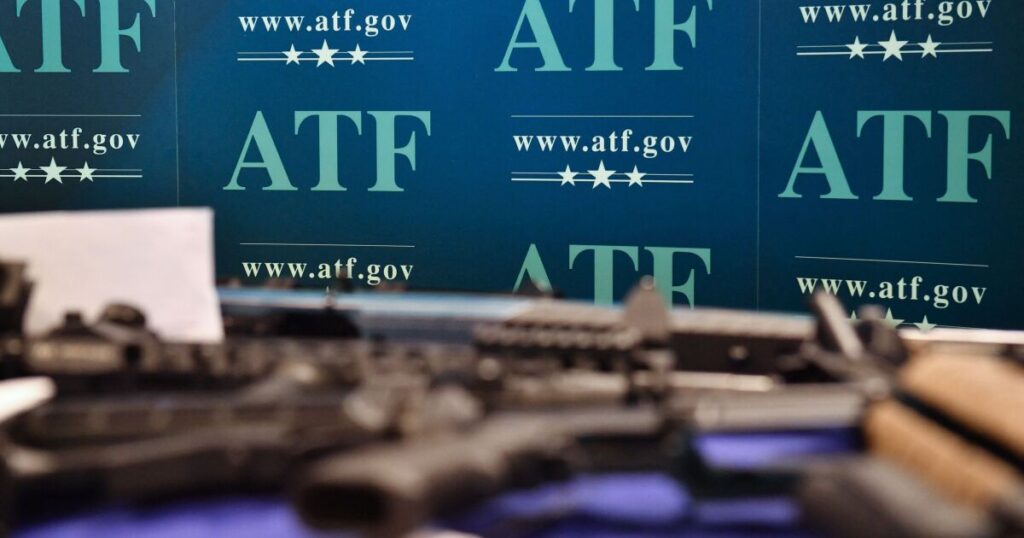
The Trump administration is pursuing significant changes to the Bureau of Alcohol, Tobacco, Firearms and Explosives (ATF) by proposing to ease gun regulations and drastically reduce its budget. This strategic move aims to reshape the agency responsible for overseeing the gun industry in the United States.
Recently, a team from the Department of Government Efficiency was dispatched to the ATF with the intention of swiftly reducing regulations. Individuals familiar with the situation, who requested anonymity to avoid backlash, revealed these plans to NPR. The ATF plays a vital role in controlling gun trafficking, inspecting gun dealers for compliance, and issuing penalties when necessary.
In collaboration with ATF officials, the Department of Government Efficiency is considering adjustments to approximately 50 regulations. Proposed changes include extending the validity of firearm purchase background checks from 30 to 60 days and allowing gun dealers to discard records after 20 years instead of maintaining them indefinitely. Although these modifications may appear minor individually, collectively, they signify a push towards deregulating the firearms sector.
Kris Brown, president of Brady, a nonprofit advocating for stricter gun control, emphasizes the importance of the ATF’s role: “The reality is that the ATF plays a critical role in ensuring that gun dealers can operate in a fully, legally compliant manner. We don’t want to take that sort of critical oversight role away from them because there is no one else out there.”
Part of a broader initiative to revamp the ATF, the Department of Justice has proposed a 25% budget reduction for fiscal year 2026, which includes cutting over 500 investigative positions. This cut could hinder the agency’s capacity to monitor the firearms and explosives industries by approximately 40%, according to the Department’s own analysis.
Despite declining NPR’s request for an interview, the ATF stated that it aims to lessen “unnecessary regulatory burdens” to focus on enforcement against violent criminals. Pamela Hicks, former chief counsel at the ATF, highlighted the importance of accurate record-keeping by gun dealers for crime solving, stating, “The reason why those [records] are kept is so that crime guns can be traced. And the reason why it’s critical that they be accurate is so that people who shouldn’t have guns don’t have guns.”
The ATF is unique in its ability to trace firearms used in crimes, maintaining a database of ballistic markings that serve as a “fingerprint” for guns. This information is crucial for police in solving violent crimes. Brandon del Pozo, former police chief of Burlington, Vt., stressed the need for a well-funded ATF for effective investigations.
Critics, including del Pozo, argue that the administration’s plan to slash the ATF’s budget contradicts its proclaimed tough-on-crime stance. The administration maintains that its transformation plans are ongoing, with further regulatory rollbacks in sight. For example, the recent tax and spending bill passed by the Senate includes a provision to remove taxes on gun silencers and certain firearms, a move opposed by gun-control advocates.
—
Read More Michigan News



![Jody White’s Unconventional Michigan Supreme Court Candidacy Explored[embed]https://www.youtube.com/watch?v=8NfxFIPE4ac[/embed]](https://www.kitchentablenews.org/wp-content/uploads/2026/10/Jody-Whites-Unconventional-Michigan-Supreme-Court-Candidacy-Exploredembedhttpswwwyoutubecomwatchv8NfxFIPE4acembed.com2F842F0e2Fc7223daa43c9876b36a4e00773a42Fme-supc.png "Jody White’s Unconventional Michigan Supreme Court Candidacy Explored[embed]https://www.youtube.com/watch?v=8NfxFIPE4ac[/embed]")