Updated July 7, 2025 at 6:16 PM EDT
As tensions rise in global trade, President Trump has announced his intention to levy new tariffs on 14 countries’ exports to the United States starting on August 1. This move follows an executive order extending the deadline for finalizing trade agreements from July 9 to August 1. Trump stated that negotiations with these nations are actively ongoing.
In a series of social media posts, Trump addressed the leaders of these countries, expressing a desire to continue discussions despite what he perceives as trade imbalances. “Our relationship has been, unfortunately, far from Reciprocal,” he noted, explaining the rationale behind the new tariffs.
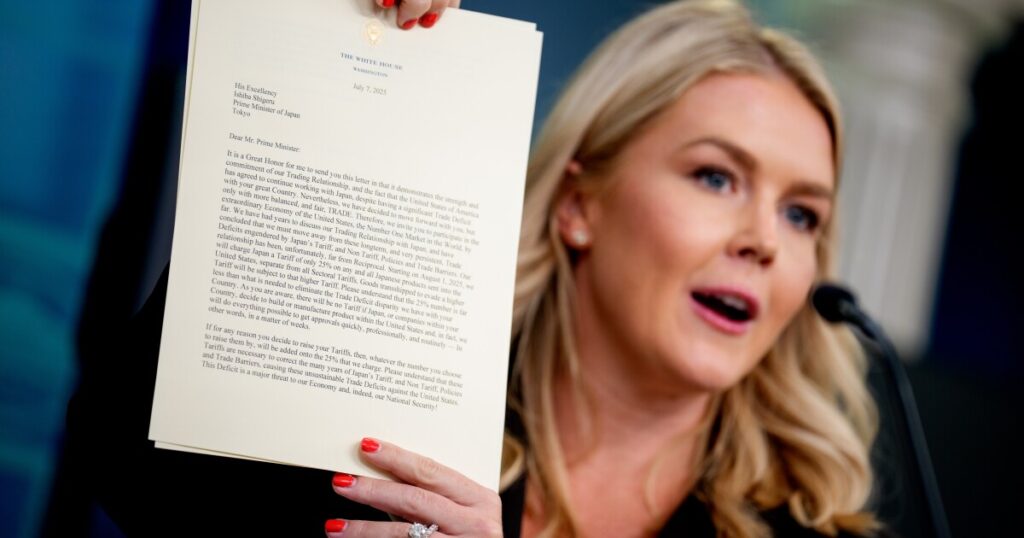
White House Press Secretary Karoline Leavitt has indicated that additional communications will be forthcoming. The initial letters reveal a consistent message across recipients, differing primarily in the specific tariff rates and country names.
Clarifying the scope of the new tariffs, the White House stated these will not add to existing tariffs on broad categories of goods. For instance, steel and aluminum from these countries will remain subject to the current 50% tariff.
While Trump has portrayed the tariffs as charges to other countries, it is important to note that tariffs are actually taxes paid by U.S. importers, often leading to increased prices for American consumers. The president frames these tariffs as countermeasures to foreign protectionism.
Additionally, Trump highlighted that goods transshipped through the affected countries will incur higher tariffs. Furthermore, any reciprocal tariffs imposed by these countries will result in an increase in U.S. tariffs by the same percentage. However, companies based in these countries can avoid the new tariffs by producing their goods in the U.S.
A Glimpse into Trump’s Tariff Strategy
These recent tariff announcements follow a pattern of abrupt policy shifts, beginning with an April 2 executive order that imposed tariffs globally. Dubbed “Liberation Day,” this policy introduced steep tariffs on goods from key trading partners like Vietnam and Japan.
Following significant market reactions and economic concerns, Trump temporarily reduced the tariffs to 10% for 90 days, promising to secure numerous trade deals before the reinstatement of higher tariffs on July 9. Despite aspirations for “90 deals in 90 days,” only agreements with the UK and Vietnam have been finalized.
While some tariff rates remain similar to those set in April, notable changes include a reduction for Cambodia from 49% to 36%.
Unconventional Tariff Tactics
Trump’s approach to tariffs diverges from traditional strategies, favoring swift bilateral agreements over multilateral negotiations like the Trans-Pacific Partnership, from which he withdrew the U.S. in 2017. This tactic leverages the U.S. economy’s heft to expedite deals, focusing on bilateral trade deficits—a metric many economists criticize as inaccurate.
While these agreements could potentially lower foreign trade barriers, U.S. companies and consumers face immediate costs, as exemplified by the deal with Vietnam. Despite a reduction from the April 2 rate of 46% to 20%, this is still substantially higher than the pre-Trump average of 3%, suggesting higher prices for U.S. consumers on Vietnamese goods such as machinery and apparel.
Experts remain skeptical about the efficiency of these bilateral deals in achieving Trump’s objectives. “U.S.-Vietnam trade restrictions would today be very, very low if Trump hadn’t walked away from TPP in 2017,” commented Scott Lincicome from the Cato Institute.
Copyright 2025 NPR
—
Read More Michigan News