The wildfire near the Navajo Nation capital rapidly grew from an initial 1,000 acres to 10,000 acres within a few days due to high temperatures, strong winds, and dry conditions, as reported by the Arizona Mirror. This rapid expansion occurred before any containment could be achieved.
July brought a slight change in weather, offering some relief with rain, allowing firefighters to report a 6% containment rate by July 3. By July 8, the fire had consumed 11,027 acres, according to the Bureau of Indian Affairs–Navajo Region. Firefighters’ persistent efforts helped secure uncontained areas.
Evacuation orders across all zones were lifted by the Navajo Nation Police Department, BIA–Navajo Region, and Southwest Complex Incident Management Team 2, allowing residents to return home. “No evacuations of any type are in effect,” stated the responding agencies.
Shondiin Silversmith
/
Arizona Mirror
Despite lifted evacuations, a public safety closure remains in place as active firefighting continues, with hazards like stump holes and ash pits persisting. The Burn Area Emergency Response Team is assessing post-fire recovery needs.
Evacuation centers have been closed, and donation distributions are planned. Livestock evacuated to the Navajo Nation fairground will be coordinated for pickup with the Navajo Nation Department of Agriculture.
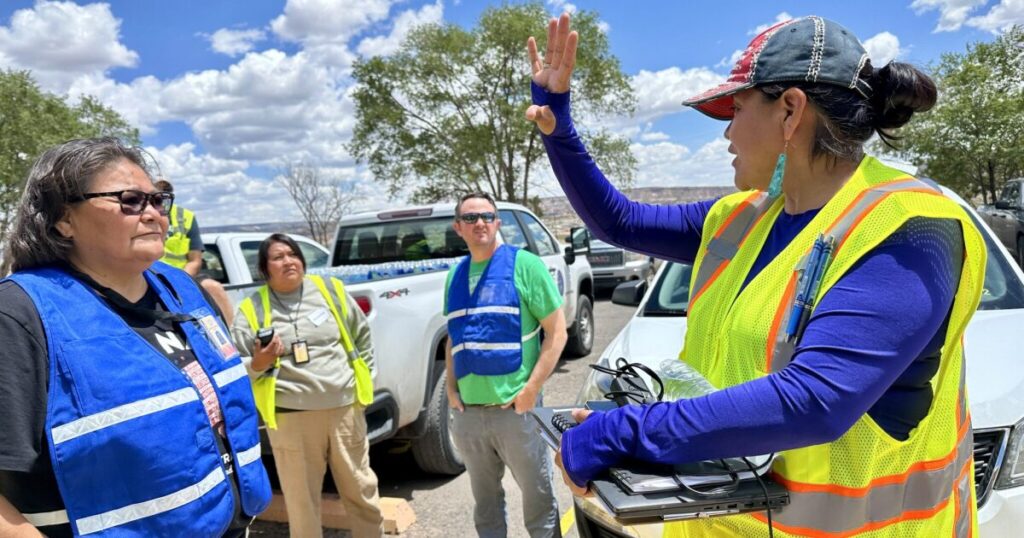
Community support was robust, from firefighting to donation drives, with a council delegate and volunteers actively distributing aid and helping displaced residents.

Shondiin Silversmith
/
Arizona Mirror
A Chapter’s Response
St. Michaels Chapter took swift action, activating its emergency response team immediately as the fire started. “It’s been tough,” said Vice President Craig Tsosie, who has been working on the ground since June 28.
Tsosie, acting as the chapter’s incident commander, coordinated evacuation efforts and worked with volunteers during the donation process. “We’ve been doing the best we can to assist them,” Tsosie explained.
President-elect Grabrial Arviso Freeland noted their emergency plan was drafted just in time. With a small official staff, volunteers played an essential role in distributing food and care packages.

Shondiin Silversmith
/
Arizona Mirror
Operations were divided into phases: immediate fire support, community access to resources, and recovery. Tsosie explained their proactive response reassured the community, with officials actively helping out.
Freeland emphasized their careful planning and coordination with agencies, including creating fire lines around homes and maintaining historical preservation.
The incident command operations were based at St. Michaels Senior Center, handling command, operations, kitchen, donations, and warehousing.
Freeland highlighted the accountability in tracking donations, ensuring they reached families directly impacted by the fire.
Donations came from various sources, including bales of hay, water, snacks, and hygiene products. Native Health also contributed significantly, sending multiple loads to the Navajo Nation.

Shondiin Silversmith
/
Arizona Mirror
Native Health, a Phoenix-based healthcare agency, provided substantial aid, with donations collected for those affected by the fire.
By July 3, the donation center had assisted 100 St. Michaels residents, 48 from Oak Spring, and 11 from Pine Springs. The chapter deactivated its emergency response team on July 6, shifting to recovery.
“As we transition from emergency response to recovery and mitigation, St. Michaels Chapter remains committed to supporting our community,” they posted on Facebook.
A Delegate’s Response
Navajo Nation Council Delegate Brenda Jesus, representing Oak Springs and St. Michaels, returned to her community upon hearing of the fire. “It’s been a rough couple of days,” Jesus said, noting no structures were impacted.
Jesus expressed frustration with the Navajo Nation government’s response, particularly in communication and support. “It’s sad to say that President Nygren and Vice President Montoya haven’t even visited St. Michaels or Oak Springs,” she noted.
Despite challenges, Jesus provided updates, directed families to resources, and responded to community concerns. She highlighted the need for an emergency response plan for her communities.

Shondiin Silversmith
/
Arizona Mirror
Volunteers and donations were crucial in supporting evacuees at the Window Rock Fighting Scouts Event Center. Despite denied media access on July 3, the center remained a key shelter for displaced families.
Jesus emphasized the importance of developing an emergency response plan, including updated maps and potential FEMA training for officials.
A Volunteer’s Response
Glenda Tsosie Wheeler, certified in community emergency response, traveled from Steamboat, Arizona, to volunteer. Along with her daughter, she supported various efforts at the shelter and worked closely with evacuees.
Wheeler recounted emotional scenes and challenges faced by displaced families, many arriving with little notice. She and her daughter often stayed overnight, sleeping in their truck to continue their volunteer work.
She stressed the need for more community members to engage in emergency training, highlighting that “emergencies don’t have boundaries” and require collective efforts.
This story was originally produced by Arizona Mirror, a nonprofit news network supported by grants and a coalition of donors as a 501c(3) public charity.
—
Read More Arizona News