Updated January 4, 2026 at 3:02 AM EST
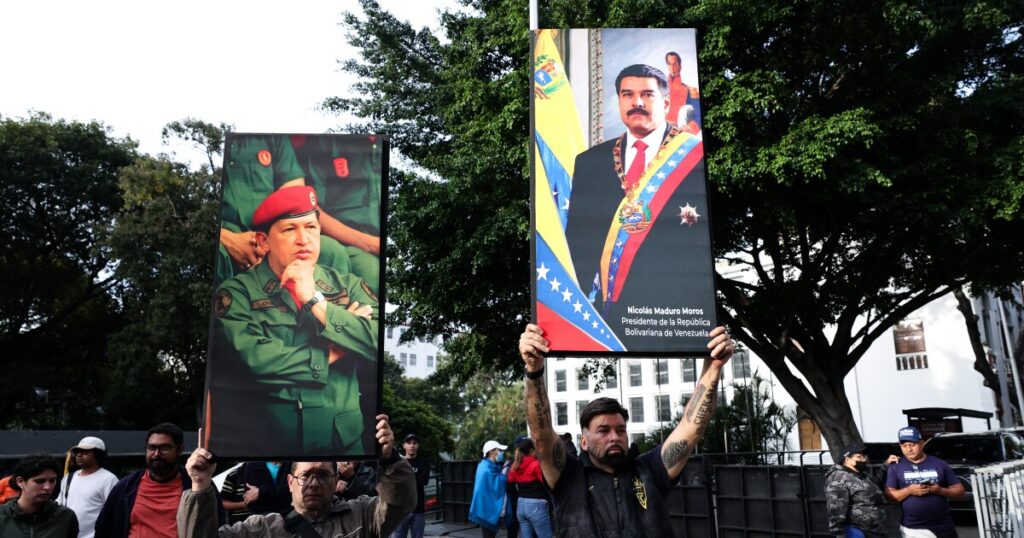
In a dramatic turn of events, the U.S. military has captured Venezuelan President Nicolás Maduro in an unexpected operation in Caracas, drawing widespread international attention and raising questions about the future leadership of the South American nation.
Following the operation, Maduro was transported to the United States, landing at New York’s Stewart Air National Guard Base on Saturday evening. A video shared on X from the White House’s rapid response account displayed Maduro at the Drug Enforcement Administration headquarters in Manhattan. He is anticipated to be held in a federal jail in Brooklyn while awaiting trial.
U.S. Attorney General Pam Bondi announced that both Maduro and his wife, Cilia Flores, face indictments in the Southern District of New York, describing them as “alleged international narco traffickers.”
“They will soon face the full wrath of American justice on American soil in American courts,” Bondi declared.
Meanwhile, President Donald Trump stated that Venezuela’s Vice President, Delcy Rodríguez, was “sworn in” as president on Saturday. However, Rodríguez, whose current whereabouts are unknown, asserted that Maduro remains Venezuela’s legitimate leader and the nation is prepared to defend its resources.
The legality of the U.S. military intervention and its implications for both countries are subjects of intense debate.
The nocturnal strikes
Explosions rocked Venezuela around 2 a.m. local time (1 a.m. ET), as reported by Gen. Dan Caine, chairman of the Joint Chiefs of Staff. Vanessa Silva, a journalist in Caracas, informed NPR about being awakened by two explosions at La Carlota military airbase. Silva witnessed fires on the runway, which were quickly extinguished, and noted low-flying planes over Caracas for about an hour.
The Venezuelan government reports that military sites in Miranda, Aragua, and La Guaira were targeted, with Defense Minister Vladimir Padrino López stating that civilian areas were also affected, leading to casualties.
President Trump confirmed some U.S. injuries during the operation, though no fatalities, and mentioned that additional troops were on standby but not deployed.
Trump shared an image on Truth Social allegedly showing Maduro in custody on the U.S.S. Iwo Jima, bound for New York.
The Trump administration’s allegations against Maduro
The United States, among other Western nations, views Maduro’s presidency as illegitimate, citing election fraud in 2024.
The Trump administration accuses Maduro of leading a narco-trafficking cartel, Cartel de los Soles, recognized by experts as a corruption network rather than a single entity. In November, the U.S. designated it as a foreign terrorist organization.
An indictment unveiled on Saturday by U.S. Attorney General Pam Bondi charges Maduro, Flores, and other Venezuelan officials with “drug trafficking and narco-terrorism conspiracies.” The indictment alleges collaboration with international drug traffickers to transport cocaine to the U.S. since 1999.
Maduro repeatedly denies these allegations, accusing the U.S. of attempting to oust him for access to Venezuela’s oil reserves. “They invented an accusation that the United States knows is as false as that accusation of weapons of mass destruction,” he said in an interview aired on state TV.
The Trump administration claims Venezuela “stole” oil and assets from the U.S. after nationalization in the late 1990s, a claim Maduro’s government refutes.
Recently, Trump imposed a blockade on Venezuelan oil and sanctioned tankers. Vice President JD Vance tweeted about Trump’s demand for an end to drug trafficking and the return of “stolen oil.”
The U.S. has increased pressure on Maduro’s regime, conducting strikes on drug-carrying boats and a CIA-led drone strike on a dock used by cartels.
Trump announced plans for U.S. oil companies to operate in Venezuela, though details remain vague. “We’re going to have our very large United States oil companies, the biggest anywhere in the world, go in, spend billions of dollars, fix the badly broken infrastructure, the oil infrastructure, and start making money for the country,” he stated, emphasizing benefits for Venezuelans.
The future leadership of Venezuela
Despite Trump’s declaration of Rodríguez’s presidency, the long-term leadership of Venezuela remains uncertain. “I’m not sure there’s going to be a power vacuum,” said Todd Robinson, former U.S. ambassador to Venezuela, to NPR.
Trump did not specify future steps but mentioned U.S. management of Venezuela pending a “proper transition.” “We’re going to run the country right. It’s going to be run very judiciously, very fairly,” he claimed.
Uncertainty surrounds the loyalty of Maduro’s allies and their potential actions. Opposition leaders, including those in exile, could emerge as contenders.
Venezuelan opposition leader María Corina Machado suggested Edmundo Gonzalez, considered the legitimate 2024 election winner, should assume the presidency.
Despite Trump’s skepticism about Machado’s leadership potential, he noted that Rubio had spoken with Rodríguez, who expressed willingness to cooperate with U.S. interests in Venezuela.
Global reactions
The international response to the U.S. intervention in Venezuela is divided. In the U.S., several Democrats criticized the operation as unconstitutional, arguing Trump bypassed Congress.
“The Constitution is clear that the U.S. doesn’t engage in military action or war without a vote of Congress except in cases of imminent self-defense,” stated Democratic Sen. Tim Kaine, D-Va.
Conversely, many Congressional Republicans support the operation, with Senate Majority Leader John Thune, R-S.D., anticipating a briefing upon Congress’ return.
Reactions from Latin American leaders are also mixed, with concerns about regional stability from Cuba, Chile, Mexico, and Columbia. Argentina’s President Javier Milei praised the action.
European leaders, such as Kaja Kallas and U.K. Prime Minister Keir Starmer, called for adherence to international law and maintained cautious stances.
Copyright 2026 NPR
—
Read More Michigan News