Critical Minerals: A Key Ingredient in Modern Technology and the Race to Secure Them
From the smartphones in our pockets to sophisticated MRI machines and precision-guided missiles, critical minerals are a fundamental component. These minerals are crucial to numerous technologies, and currently, China dominates the supply chain for these essential elements. However, the idea of recycling our outdated electronics to obtain these minerals is gaining traction, particularly in places like Michigan, though it presents its own set of challenges.
The Importance of Rare Earth Elements
In high school chemistry, you might remember the periodic table. The U.S. government identifies sixty of these elements as “critical minerals” with particular emphasis on “rare earth elements.” Abigail Hunter, who leads the Center for Strategy at Securing America’s Future Energy, highlights the significance of these minerals, noting their powerful magnetic properties crucial for electronics and defense equipment. “Modern technologies, the way we move around, the way our military is able to defend our country — [all of that] is based on, essentially, access to these minerals,” Hunter explained.
China’s Hold on the Supply Chain
China’s control over the mining, refining, and production of these minerals poses a significant risk to the U.S. economy and security, especially if exports are restricted. This has prompted action from U.S. lawmakers, including Michigan Congresswoman Haley Stevens. Stevens advocates for a strategy similar to the semiconductor initiative under the Biden administration, aiming to localize the critical minerals supply chain. “With critical minerals, we cannot and should not be at the mercy of China,” Stevens stated.
The Role of Recycling in Resource Strategy
Recycling could play a pivotal role in reducing reliance on foreign supplies. Stevens introduced legislation to enhance the U.S. critical mineral supply chain, promoting domestic production. However, recycling these minerals is complex. Stevens notes, “This isn’t necessarily 20th-century recyclability. These are more complex processes that take actual products and bring them back down to their mineral form.”
Recycling Operations and Challenges
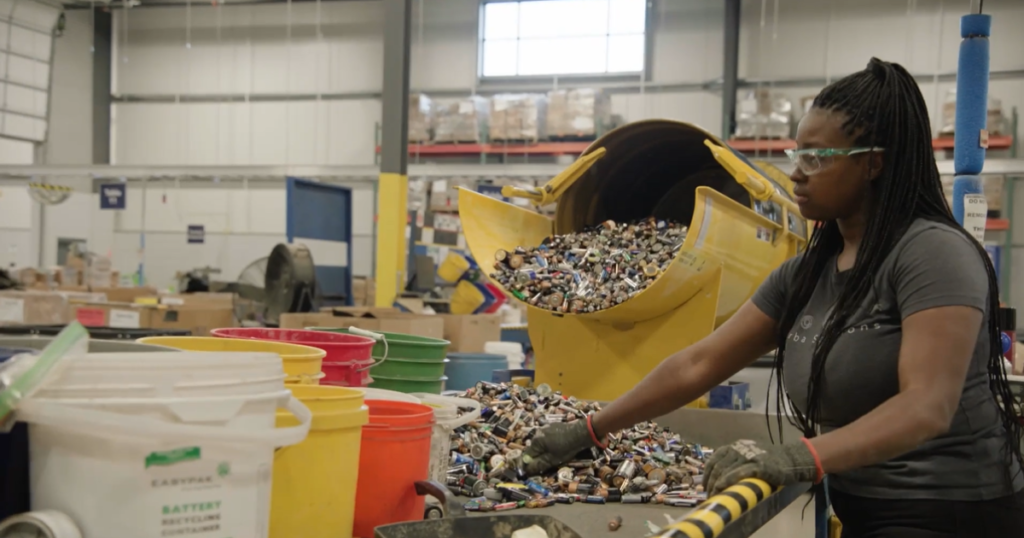
At Cirba Solutions in Wixom, workers sort household batteries, a practice the company has refined over decades. Spokesperson Danielle Spaulding describes the recycling process for lithium-ion batteries, which involves shredding and separating materials to extract “black mass” containing the critical minerals. Cirba, a leader in this field, has received significant support, including a $200 million grant for a new recycling plant.
Despite advancements, recycling cannot completely replace mining. However, Spaulding sees potential in creating “closed loop” systems, particularly for battery recycling, reducing the need for new imports. Yet, challenges remain as the small quantities and magnetic properties of rare earth elements complicate extraction, often deterring recyclers due to economic and technological constraints.
International Collaboration on Critical Minerals
This week, a Critical Minerals Summit hosted by Secretary of State Marco Rubio will gather international representatives in Washington, D.C., to discuss strategies for diversifying the supply chain and reducing dependency on China’s near-monopoly.
—
Read More Michigan News