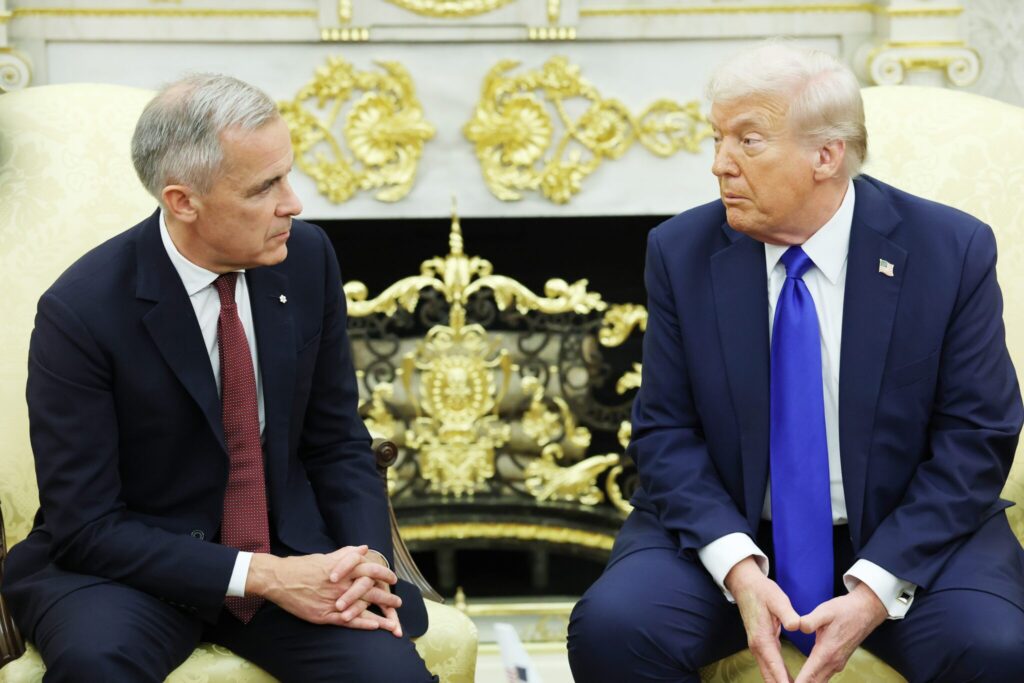
WASHINGTON — In a notable break from President Donald Trump’s trade policy, several House Republicans joined Democrats to terminate the national emergency at the northern border that triggered tariffs on Canada over a year ago.
The resolution, passed 219-211, revokes Trump’s Feb. 1, 2025, executive order imposing tariffs on Canada under the International Emergency Economic Powers Act (IEEPA). This law’s use for such tariffs is under review by the U.S. Supreme Court, with a decision anticipated soon.
Reps. Don Bacon, R-Neb., Brian Fitzpatrick, R-Pa., Jeff Hurd, R-Colo., Kevin Kiley, R-Calif., Thomas Massie, R-Ky., and Dan Newhouse, R-Wash., joined Democrats against Trump’s Canadian tariffs. Rep. Jared Golden, D-Maine, was the only Democrat opposing the resolution. Two Republicans abstained from voting.
The House vote followed three House Republicans’ move to block leadership’s attempt to extend a ban on resolutions that disapprove of the administration’s tariffs. Trump’s tariffs have faced criticism for inconsistency, affecting business and consumer costs. Just days earlier, Trump threatened to close a new bridge between Windsor, Ontario, and Detroit, Michigan, demanding a new trade deal with Canada.
‘Canada is our friend’
Rep. Gregory Meeks, D-N.Y., the resolution’s lead sponsor, criticized Trump’s “manufactured emergency” regarding Canada. “Canada isn’t a threat. Canada is our friend. Canada is our ally. Canadians have fought alongside Americans, whether it was in World War II or the war in Afghanistan,” Meeks said. Meeks noted that tariffs cost constituents up to $1,700 annually. Analyses from the Tax Foundation and Yale Budget Lab estimate average household costs from all tariffs at $1,300 to $1,750.
Fentanyl debate
Rep. Brian Mast, R-Fla., argued that the real cost was in drug overdose deaths linked to fentanyl. “Who will pay the price? It’s a very sad thing to have (been) asked by this colleague of mine … because it’s important to remember, what is this resolution? This resolution ends an emergency related to fentanyl,” Mast said. However, U.S. Customs and Border Protection data shows that most fentanyl is seized at the southwest border. The U.S. Drug Enforcement Agency identifies China as the start of the illicit fentanyl supply chain entering the U.S. through Mexico.
Senate action so far
Some Republican senators have also opposed Trump’s emergency tariffs. In late October, Sens. Mitch McConnell, Rand Paul, Lisa Murkowski, Susan Collins, and Thom Tillis supported a joint resolution in a 52-48 vote to end Trump’s 50% tariffs on Brazilian products, including coffee. The president imposed the tariffs on July 30 after accusing Brazil of “politically persecuting” former President Jair Bolsonaro for a 2022 coup plot. The Senate vote marks a shift following two earlier efforts to challenge Trump’s tariffs.
—
Read More Montana News

![Exploring Michigan’s Unique University Board Election System[embed]https://www.youtube.com/watch?v=[/embed]](https://www.kitchentablenews.org/wp-content/uploads/2026/09/Exploring-Michigans-Unique-University-Board-Election-Systemembedhttpswwwyoutubecomwatchvembed.com2F9b2Fbe2F9938d5fa43a2baa2cea44e05ad592Fmids-un.png "Exploring Michigan’s Unique University Board Election System[embed]https://www.youtube.com/watch?v=[/embed]")