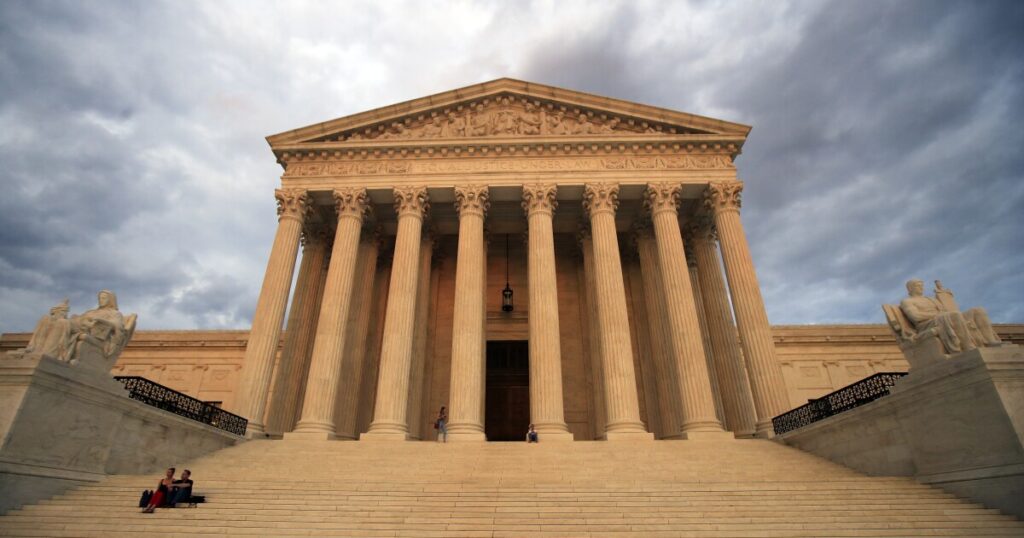
The U.S. Supreme Court’s recent decision has sparked reactions across Michigan, particularly among those affected by President Donald Trump’s tariff policies. The ruling, which concluded in a 6-3 vote, emphasizes that the power to levy taxes, including tariffs, is constitutionally vested in Congress, thus restricting the president’s authority in this domain.
Governor Gretchen Whitmer of Michigan welcomed the court’s decision, describing it as “a decisive and welcome step forward.” In her statement, Whitmer expressed hope for a collaborative effort between Congress and the president to establish a more balanced trade policy.
Congresswoman Haley Stevens, who is also a Democratic candidate for the U.S. Senate, criticized the tariffs, stating, “Michigan workers and businesses should not be forced to pay the price for Trump’s reckless, shoot-from-the-hip tariffs.” Her remarks highlight the ongoing debate on the impact of these tariffs on local industries.
The business community remains divided over the implications of the ruling. Some analysts caution that despite the setback, the Trump administration’s commitment to tariffs as a cornerstone of its trade policy is unlikely to waver.
Erik Gordon, an assistant professor of entrepreneurial studies at the University of Michigan, pointed out the adverse effects of fluctuating tariff policies on industries such as automotive, pharmaceutical, and health care. He noted, “Tariff changes should be based on long-term policy, using a legal process that isn’t controversial and won’t be overturned after companies make expensive changes in their supply chain or pay billions in tariffs.”
Despite the court’s decision, President Trump retains several methods to continue imposing tariffs, including leveraging powers from his first term and potentially invoking legislation dating back to the Great Depression. Trump has cautioned that an unfavorable Supreme Court outcome could render the U.S. vulnerable and economically weakened.
Michael Speigl, a marketing lecturer at the University of Michigan, suggests that the auto industry in Michigan is bracing for continued tariff measures. According to Speigl, “For the auto industry, the legal specifics of a ruling matter far less than the political reality: Automakers have effectively ‘priced in’ these tariffs and adjusted their supply chains months ago.”
In response to the Supreme Court ruling, President Trump announced plans to issue an executive order to introduce a new 10% global tariff, signaling his intent to persist with aggressive trade measures.
—
Read More Michigan News


![Jody White’s Unconventional Michigan Supreme Court Candidacy Explored[embed]https://www.youtube.com/watch?v=8NfxFIPE4ac[/embed]](https://www.kitchentablenews.org/wp-content/uploads/2026/10/Jody-Whites-Unconventional-Michigan-Supreme-Court-Candidacy-Exploredembedhttpswwwyoutubecomwatchv8NfxFIPE4acembed.com2F842F0e2Fc7223daa43c9876b36a4e00773a42Fme-supc.png "Jody White’s Unconventional Michigan Supreme Court Candidacy Explored[embed]https://www.youtube.com/watch?v=8NfxFIPE4ac[/embed]")