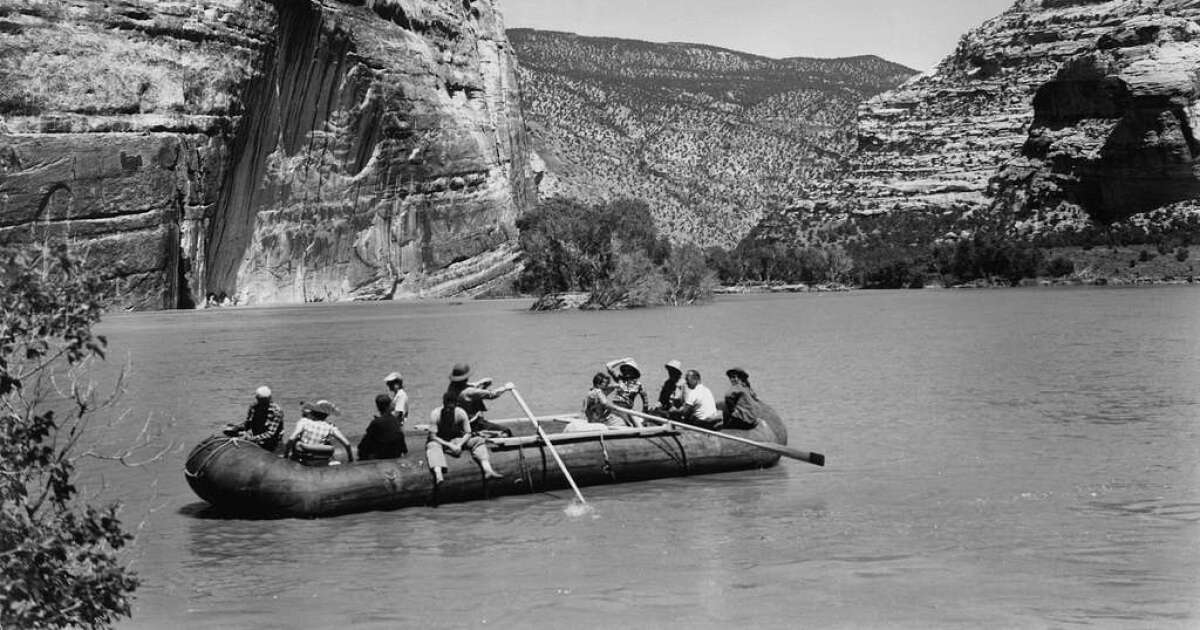
Intense debates over the management of the Colorado River have transitioned into a new stage of public discourse, marked by extensive letter exchanges. This development comes as stakeholders, including political figures, water authorities, and environmental groups, engage with the Interior Department’s proposed strategies for the river’s future.
The department’s five outlined strategies, introduced in January, offer a spectrum of possibilities, from drastic water use reductions in Lower Basin areas to encouraging conservation efforts. As the states of the river basin have failed to meet deadlines for a mutual agreement, it seems increasingly probable that the federal administration will step in with its own set of rules before the current guidelines lapse in August.
Public feedback on these strategies concluded on Monday, with leaders from both upper and lower basin states expressing significant opposition. In a comprehensive letter, Colorado’s water representative critiqued the federal proposals, asserting that the government lacks the legal authority to implement the suggested changes. The state advocates for a plan that necessitates greater water usage reductions from Lower Basin states, given the ongoing drought conditions.
“The Colorado River has changed dramatically over the last two decades, and our operating rules need to change with it,” Colorado River Commissioner Becky Mitchell stated. “The current rules have not done enough to protect Lake Powell and Lake Mead, and it’s clear that a future management framework must better respond to today’s reality.”
Arizona leaders have also voiced their disapproval, arguing that the proposed federal measures would disproportionately impact the Lower Basin states. Arizona’s Democratic congressional delegation expressed concerns that such cuts could jeopardize national security, stating, “Arizona’s agriculture, semiconductor and advanced manufacturing, aerospace and defense industries rely on the Colorado River.” They warned that the proposed reductions “would reverberate across rural communities and throughout the domestic food supply chain.”
While Lower Basin states, including California, Arizona, and Nevada, demand water cuts in Upper Basin states like Colorado, New Mexico, Wyoming, and Utah, the latter group argues they already practice conservation during droughts.
Environmental advocates, including The Nature Conservancy and Trout Unlimited, have also contributed their perspectives, emphasizing the need for proactive and flexible management strategies that preserve ecological integrity. They caution against frameworks that enforce rigid rules or delay action, as these tend to underperform in expected hydrologic scenarios.
The Interior Department is set to evaluate the public’s feedback and select a preferred management option for the reservoirs in the coming spring. Environmental organizations have advised states against resorting to legal battles, warning that such actions could stall essential conservation efforts needed to protect regions like the Grand Canyon’s ecosystem.
This report is part of a series on the Colorado River by KUNC, supported by the Walton Family Foundation. KUNC maintains full editorial control over its content.
A preliminary NTSB report points to a mechanical problem in the main rotor of a DPS helicopter that crashed in Flagstaff, killing two personnel. The final report could take over a year.
—
Read More Arizona News

![Jody White’s Unconventional Michigan Supreme Court Candidacy Explored[embed]https://www.youtube.com/watch?v=8NfxFIPE4ac[/embed]](https://www.kitchentablenews.org/wp-content/uploads/2026/10/Jody-Whites-Unconventional-Michigan-Supreme-Court-Candidacy-Exploredembedhttpswwwyoutubecomwatchv8NfxFIPE4acembed.com2F842F0e2Fc7223daa43c9876b36a4e00773a42Fme-supc.png "Jody White’s Unconventional Michigan Supreme Court Candidacy Explored[embed]https://www.youtube.com/watch?v=8NfxFIPE4ac[/embed]")