
BROOKLYN, N.Y. — At just 16, Khloe Watson-Barrett aims to become a lawyer. She’s aware of the formidable challenges of college admissions as she moves past her junior year. Her concerns mirror those of many students who lack personalized guidance from overworked college counselors, tasked with navigating standardized test schedules, deadlines, and financial aid applications.
Watson-Barrett’s school is among many exploring new AI technology designed for college counseling. This AI provides real-time advice on life post-high school, offering insights outside school hours. Unlike general-purpose AI, this system is built on expert knowledge and past applicant queries, providing accurate employment data, salary expectations, and credential costs.
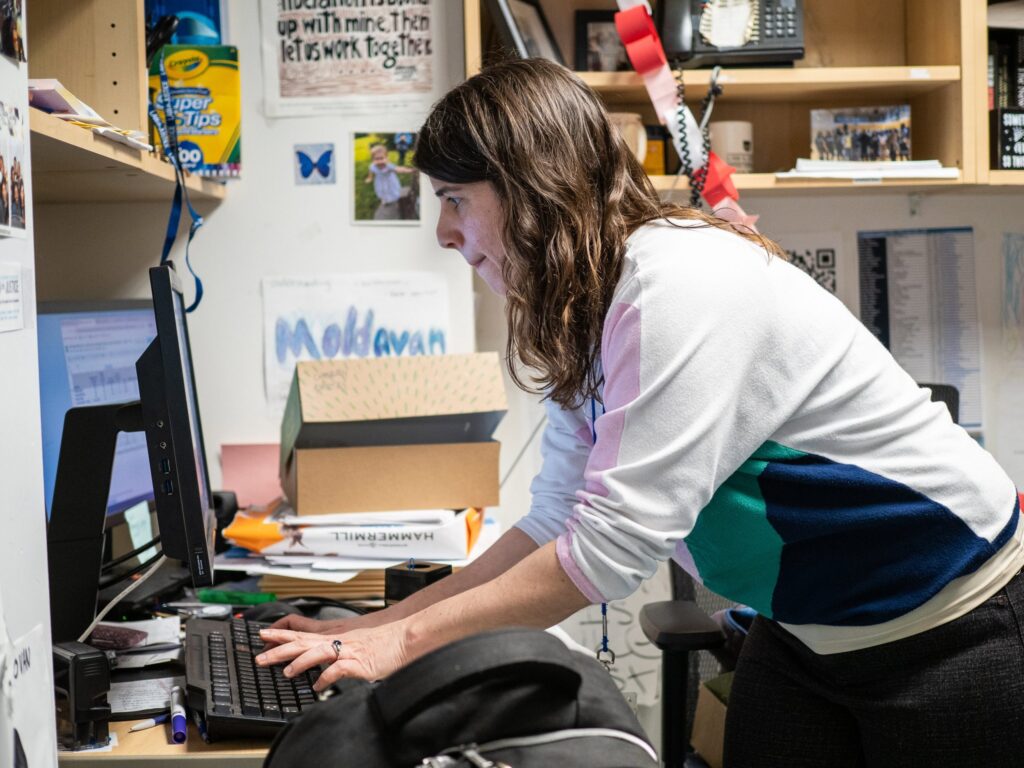
Even with AI, college counselors remain crucial for personalized student guidance, as highlighted by Diana Moldovan of the Urban Assembly School for Law and Justice. “You can’t replace the trust,” Moldovan stated. However, AI can alleviate counselors from routine tasks, allowing more focus on individual student goals.
Tools like CounselorGPT, specifically designed for college counseling, aim to enhance human interaction rather than replace it. This platform, to be tested at Watson-Barrett’s school, is part of a broader initiative to integrate AI in college admissions processes. Moldovan’s office, despite a smaller-than-average student-to-counselor ratio, still finds AI necessary to manage repetitive tasks, freeing counselors for more personal student interactions.
Nationally, the student-to-counselor ratio remains high, with states like Arizona and California facing particularly challenging numbers. College counselors often juggle numerous responsibilities, dedicating only a fraction of their time to admissions advice. AI could provide essential information outside school hours, addressing longstanding issues in the counseling system.
Angel Pérez, NACAC’s CEO, emphasizes that “as technology grows, counselors can outsource basic information and focus on the human aspects of these young people.” Nearly half of students already use AI in their college search, according to a February survey by EAB.
However, the rise of AI in college counseling raises concerns about misinformation. Many generative AI tools might be biased, prioritizing certain schools in search results. “I would not want a young person to be using these tools by themselves,” Pérez noted, stressing the need for human oversight in the college application process.
Several AI platforms are under development, including CounselorGPT, which uses real-time job data to inform students about career prospects. David Adams, CEO of Urban Assembly, stresses that students often lack information about labor markets, leading to misguided educational choices.
Another platform, the Expert Virtual Assistant (EVA), developed by the College Guidance Network, offers basic admissions guidance and directs students to additional resources. CEO Jon Carson, motivated by his son’s limited counselor access, highlights AI’s potential to save time on routine inquiries, enhancing the quality of counselor-student interactions.
While AI presents promising solutions, some counselors and students remain wary. A survey by the American School Counselor Association found less than 40% of counselors see AI as a direct service tool for students. Even students appreciate the personal touch in counseling, valuing the encouragement and personalized advice that AI may not fully replicate.

Contact writer Jon Marcus at 212-678-7556, jmarcus@hechingerreport.org or jpm.82 on Signal.
This story about AI in college counseling was produced by The Hechinger Report, a nonprofit, independent news organization focused on inequality and innovation in education. Sign up for our higher education newsletter.
The post On-demand college counseling, courtesy of AI appeared first on The Hechinger Report.
—
Read More Kitchen Table News

![Jody White’s Unconventional Michigan Supreme Court Candidacy Explored[embed]https://www.youtube.com/watch?v=8NfxFIPE4ac[/embed]](https://www.kitchentablenews.org/wp-content/uploads/2026/10/Jody-Whites-Unconventional-Michigan-Supreme-Court-Candidacy-Exploredembedhttpswwwyoutubecomwatchv8NfxFIPE4acembed.com2F842F0e2Fc7223daa43c9876b36a4e00773a42Fme-supc.png "Jody White’s Unconventional Michigan Supreme Court Candidacy Explored[embed]https://www.youtube.com/watch?v=8NfxFIPE4ac[/embed]")