Article Summary –
Michigan Governor Gretchen Whitmer is proposing revised tax rates to stabilize Medicaid funding and address rising healthcare costs, which includes $780 million in new taxes on tobacco, gambling, vaping, and digital advertising. The proposal comes in response to federal policy changes that threaten to weaken Michigan’s healthcare system, impacting 200,000 low-income residents by potentially causing loss of insurance coverage, increased premiums, and reduced services. Whitmer also aims to tackle medical debt through policies that cap interest rates, prevent debt from affecting credit scores, and ensure financial assistance, amidst Republican opposition concerned about tax hikes and budget deficits.
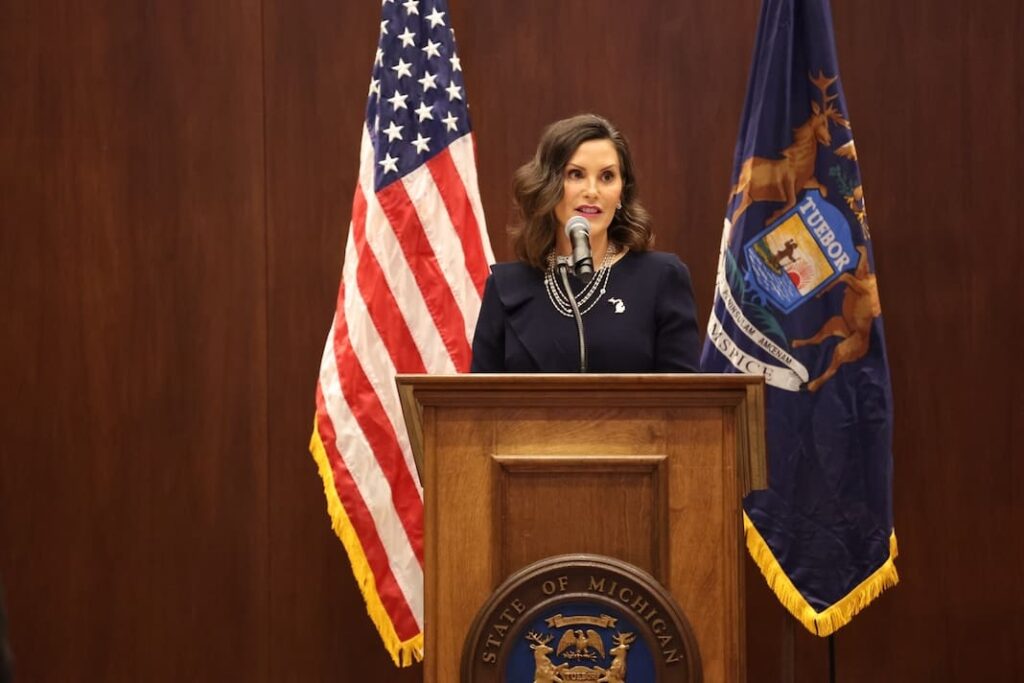
Term-limited Michigan Gov. Gretchen Whitmer is exploring ways to stabilize Michigan’s Medicaid program and offer relief from rising health care costs due to recent federal policy changes.
State budget projections suggest that the budget law signed by President Donald Trump last July could weaken Michigan’s health care system, costing billions in increased expenses and risking health insurance loss for about 200,000 low-income residents.
In response, Whitmer put forward around $780 million in revised tax rates on tobacco and gambling to stabilize Medicaid funding for the 2027 fiscal year and address medical debt challenges.
“Federal changes will make it harder for those eligible to get necessary care,” Whitmer noted in her Feb. 25 State of the State speech. “Even those not on Medicaid will feel the impact through higher premiums and reduced services.”
Approximately 2.5 million Michiganders, including children and those with disabilities, are enrolled in Medicaid.
Whitmer’s $88.1 billion budget proposal suggests revised tax rates to fund Medicaid, including $232 million from tobacco tax updates, $192.8 million from internet gaming taxes, $73.6 million from vaping taxes, and $282 million from a digital advertising tax.
State officials are also tasked with saving $150 million to maintain the Medicaid program.
Republican state House Speaker Matt Hall told Michigan Advance, “If Democrats insist on tax increases and depleting our rainy day fund, we face a prolonged budget battle.”
Republicans maintain a majority in the state House of Representatives.
“As the top deal maker, I aim to negotiate with Governor Whitmer to avoid tax hikes and rainy day fund use, striving for a balanced budget that aligns with revenue,” Hall stated.
Medicaid cuts will affect Michigan’s veterans, with 57,300 veterans relying on Medicaid in 2023, according to KFF.
Joel Rutherford, an Air Force veteran, emphasized the misconception that all veterans have VA health coverage, stating, “If you serve the country, the country should care for you.”
Rutherford criticized Republican Rep. John James for supporting H.R. 1, questioning his commitment to veterans’ welfare despite his military background.
The budget law also failed to renew enhanced tax credits under President Biden, raising ACA policy costs and reducing enrollment by at least 6% in Michigan, according to state data.
“The end of enhanced premium tax credits is leading to more uninsured people,” said Laura Appel of the Michigan Health and Hospital Association.
Diane Holland of Okemos, an ACA marketplace enrollee since 2017, now pays an extra $110 monthly due to expired credits.
As Michigan faces historic Medicaid cuts, state officials worry about rising medical debt.
Undue Medical Debt’s survey found 100 million Americans burdened with medical debt, with many avoiding treatment.
The state forgave $144 million in medical debt last year, impacting 210,000 residents, as part of a $4.5 million appropriation.
Whitmer proposed policies to address medical debt, including capping interest rates and banning foreclosure due to medical debt. A bipartisan legislative package was introduced and passed in the Michigan Senate.
Rutherford supports Whitmer’s Medicaid and medical debt relief goals, stating, “Those needing the most help are often the most affected.”
—
Read More Michigan News