Legal Battle Over Proposed Immigration Detention Facility in Michigan
Michigan’s legal and political landscape is heating up as Attorney General Dana Nessel leads a lawsuit to halt federal plans to repurpose a Romulus warehouse into an immigration detention facility. This move highlights the ongoing tension between state and federal authorities concerning immigration policies and infrastructure.
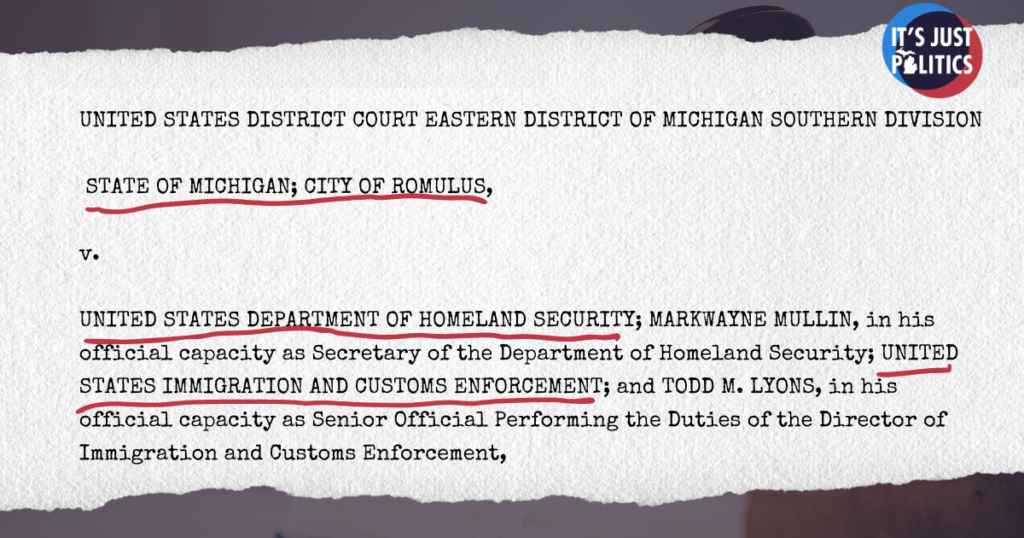
Attorney General Nessel, alongside local officials, has initiated legal proceedings in the U.S. District Court of Eastern Michigan. The lawsuit aims to prevent the U.S. Department of Homeland Security (DHS) from converting a warehouse into a center that could accommodate up to 500 immigrant detainees. According to the filed complaint, the facility is deemed unsuitable due to inadequate space, health, and sanitation infrastructure.
During a press briefing, Nessel stated, “As the state’s attorney general, I have a legal and moral authority to act if and when this administration behaves unlawfully and does so in a way that harms Michigan’s residents.” The lawsuit also highlights potential financial burdens on the city of Romulus, which would need to manage increased traffic and security demands.
Romulus Mayor Robert McCraight expressed concerns over the lack of consultation from DHS, noting the site’s industrial design, proximity to flood zones, and residential areas. He emphasized, “In addition, this site is located approximately one mile from elementary and middle schools. In my opinion, DHS could not have picked a worse location.”
Despite these objections, federal regulations do not obligate the government to adhere to local zoning laws. However, communities may still explore legal channels to contest such federal projects.
Resistance to ICE’s expansion of detention facilities is widespread, with similar legal challenges emerging nationwide. A recent case in Maryland resulted in a temporary halt to construction following a lawsuit over environmental and community impact assessments.
Political Developments in Michigan
In related political news, efforts to raise Michigan’s minimum wage have hit a roadblock. One Fair Wage, a campaign aiming to standardize the minimum wage for all workers, has suspended its 2026 ballot measure drive due to insufficient signatures, as reported by the Michigan Public Radio Network’s Colin Jackson. The group plans to regroup for future elections. More details can be found in the full report.
Additionally, Democratic State Representative Joe Tate has announced he will not seek reelection. Tate, who made history as the first Black Speaker of the House in Michigan, is uncertain about his future endeavors. His leadership saw significant legislative achievements, although recent sessions ended in discord. The Michigan Chronicle’s Sam Robinson provides further insights in their coverage.
Meanwhile, the Michigan Republican Party is preparing for its endorsement convention, where delegates will select candidates for key state positions. This practice, which differs from primary elections, has sparked debate over its effectiveness in reflecting voter preferences. Detailed analysis by Jordyn Hermani is available on Bridge Michigan here.
—
Read More Michigan News
![Jody White’s Unconventional Michigan Supreme Court Candidacy Explored[embed]https://www.youtube.com/watch?v=8NfxFIPE4ac[/embed]](https://www.kitchentablenews.org/wp-content/uploads/2026/10/Jody-Whites-Unconventional-Michigan-Supreme-Court-Candidacy-Exploredembedhttpswwwyoutubecomwatchv8NfxFIPE4acembed.com2F842F0e2Fc7223daa43c9876b36a4e00773a42Fme-supc.png "Jody White’s Unconventional Michigan Supreme Court Candidacy Explored[embed]https://www.youtube.com/watch?v=8NfxFIPE4ac[/embed]")