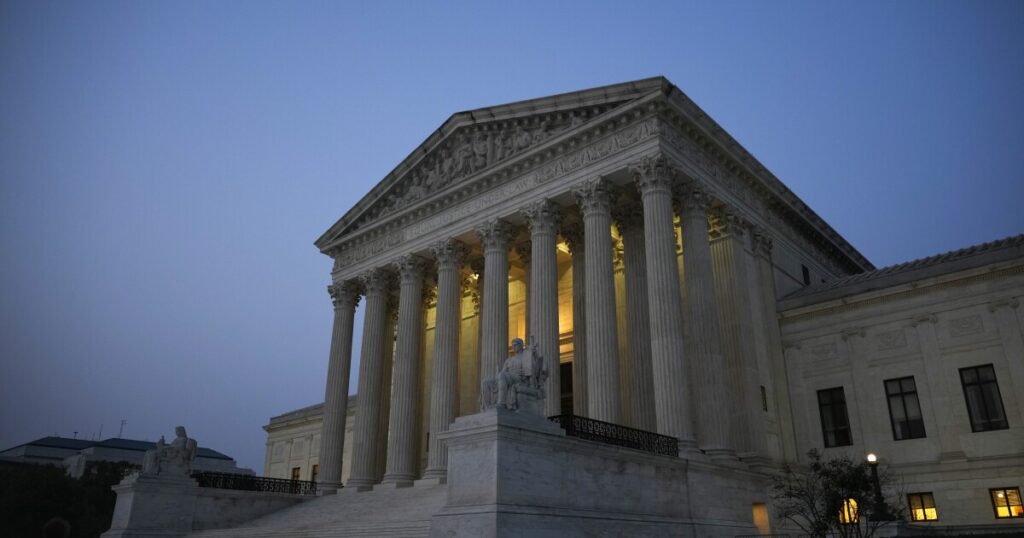
Supreme Court Upholds Birthright Citizenship in Landmark Ruling
In a pivotal decision that directly counters President Trump’s policy, the Supreme Court confirmed on Tuesday that the Constitution ensures birthright citizenship for nearly all individuals born on American soil.
Chief Justice John Roberts penned the majority opinion in the 6-3 ruling.
The court’s decision negates an executive order issued by Trump at the onset of his second term, which aimed to deny citizenship to children born in the U.S. to parents who entered the country unlawfully or on temporary visas. This executive order was never implemented, as it was consistently deemed “blatantly unconstitutional” by lower court judges.
Trump has asserted that the Constitution does not inherently provide for birthright citizenship. Nevertheless, Chief Justice Roberts highlighted that the framers of the Fourteenth Amendment intended to define citizenship inclusively, dismissing narrower interpretations. The amendment clearly states, “All persons born or naturalized in the United States and subject to the jurisdiction thereof, are citizens of the United States.”
Trump’s claim that the amendment was intended only for former slaves and not for broader application has not been supported by legal precedents for over a century. Chief Justice Roberts referenced the historical 1898 Supreme Court decision involving Wong Kim Ark, a San Francisco native born to Chinese immigrants. Despite facing denial of re-entry into the U.S. after visiting China, Wong Kim Ark successfully challenged the decision, reinforcing the principle of birthright citizenship.
The court’s 6-3 decision interprets the phrase “subject to the jurisdiction thereof” as granting citizenship to all U.S.-born children, with limited exceptions such as children of foreign diplomats.
The significance of the Wong Kim Ark case was such that birthright citizenship remained unchallenged even during times of intense anti-immigrant sentiment. During World War II, for instance, children born in the U.S. to Japanese citizens detained as enemy aliens were automatically granted citizenship, a standard later codified by Congress.
Cecillia Wang from the ACLU, a birthright citizen herself, argued before the Supreme Court in April. She emphasized that the Fourteenth Amendment was designed to ensure that “in America we do not punish children for the sins of their fathers, but instead we wipe the slate clean. When you’re born in this country, we’re all American, all the same.”
Justices Clarence Thomas, Neil Gorsuch, and Samuel Alito dissented from the decision.
This is a developing story and will be updated.
Copyright 2026 NPR
—
Read More Michigan News


![Botched Ad Mix-Up: Super PAC Error in Arizona Congressional Race[embed]https://www.youtube.com/watch?v=bEMgIlCkHz0[/embed]](https://www.kitchentablenews.org/wp-content/uploads/2026/10/Botched-Ad-Mix-Up-Super-PAC-Error-in-Arizona-Congressional-RaceembedhttpswwwyoutubecomwatchvbEMgIlCkHz0embed.com2F0e2F962Fe971102f49e7a4f2a64fd3cc60a22Fjonatha.png "Botched Ad Mix-Up: Super PAC Error in Arizona Congressional Race[embed]https://www.youtube.com/watch?v=bEMgIlCkHz0[/embed]")