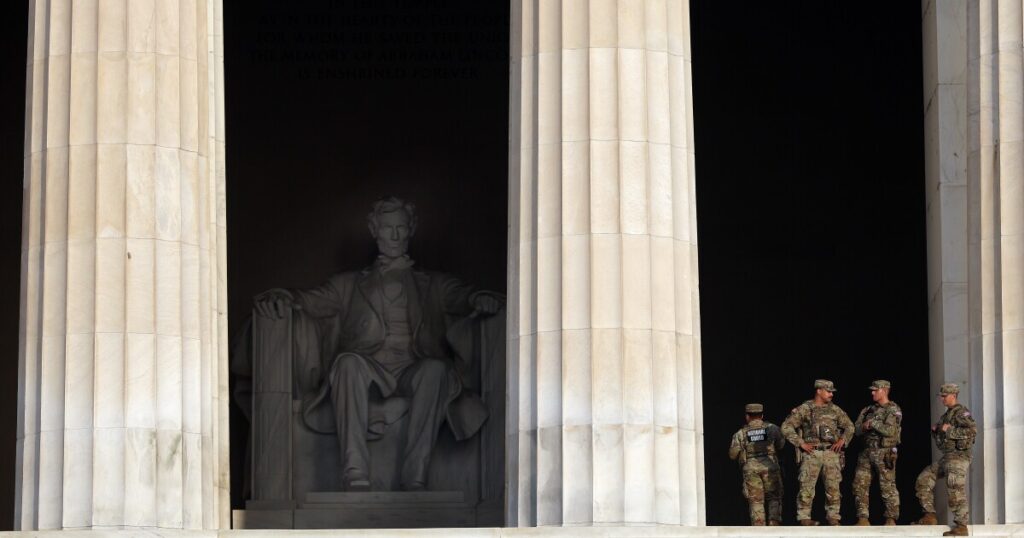
The National Guard’s extended presence in Washington, D.C., is set to continue until at least Inauguration Day 2029, marking a significant commitment to President Trump’s anti-crime initiative in the nation’s capital. This deployment, which began in 2025, has grown considerably, drawing concerns and mixed reactions from various quarters.
The Pentagon recently confirmed the deployment, noting an increase in troop numbers to approximately 5,000, sourced from over 20 states. This is part of a “summer surge” strategy announced by federal authorities in May. The operation is costing more than $3 million daily, as estimated by the Congressional Budget Office.
Background and Deployment Details
Initially deployed in August 2025, in response to a declared “crime emergency”, the National Guard’s presence in D.C. has persisted despite a significant decrease in violent crime rates. The initiative is part of the D.C. Safe and Beautiful Task Force, which continues operations beyond the original emergency period.
The task force’s visible presence has sparked debate about its necessity and implications for democracy. Critics, including constitutional experts and former military officers, have voiced concerns about the militarization of domestic policing and its potential impact on democratic processes. Elizabeth Goitein, from the Brennan Center for Justice, stated, “An emergency is a sudden, unforeseen, and temporary state of affairs. Announcing that an emergency will last for another 2 1/2 years means it’s not an emergency.”
Legal and Political Challenges
Despite legal challenges, a Federal Appeals Court ruled in favor of the continued deployment late last year. However, local leaders and residents have expressed opposition. D.C.’s unique status means the president can authorize such deployments without local government consent. Ankit Jain, one of D.C.’s nonvoting senators, remarked, “The fact that National Guard troops are being sent to a jurisdiction without the elected representatives of that jurisdiction even knowing that the troops are coming there, you would never see that happen in any other place in the United States of America.”
Impact and Cost Analysis
While the National Guard’s presence aims to deter crime through “presence patrols,” studies indicate its limited effect on reducing violent crime. A recent study by the Center for American Progress and another by the Niskanen Center observed minimal impact on crime rates, though a decline in opportunistic crimes was noted. The deployment’s financial burden is substantial, with estimates suggesting costs could reach between $2.5 billion and $3.4 billion by 2029.
Public Reaction
Trump maintains the operation’s success, while public sentiment varies. Activists have increasingly voiced their opposition, urging the Guard to leave the city. Local politicians, including members of the city council and Mayor Muriel Bowser, have expressed dissatisfaction, asserting that the deployment was neither requested nor approved by them.
Amidst the ongoing debate, the future of the National Guard’s role in Washington, D.C., remains a contentious issue, intertwining political, legal, and social threads.
—
Read More Michigan News