The Mathematical Beauty Hidden in Sunflower Patterns
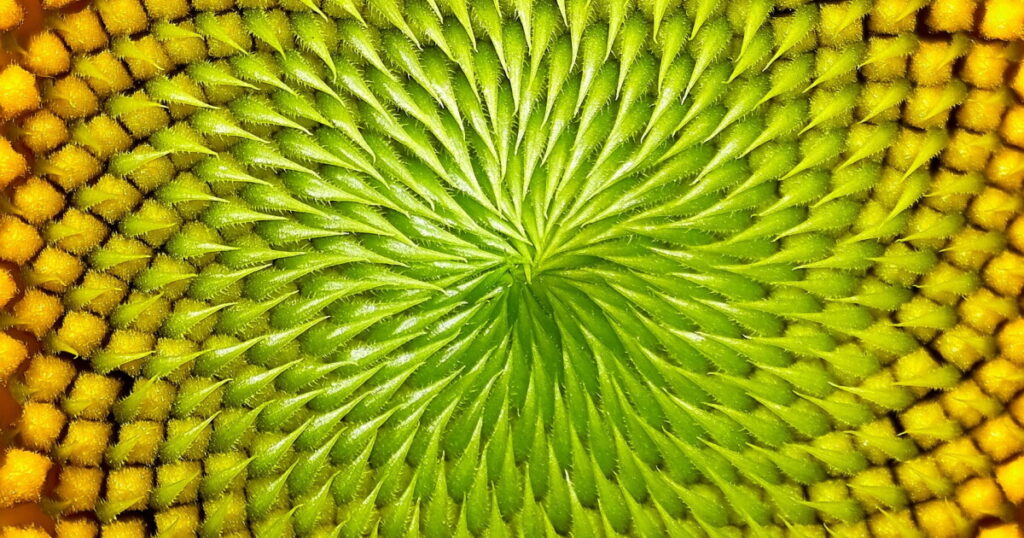
Sunflowers, with their golden hues, are a common sight along roadsides and in fields this time of year. However, a closer examination of these flowers reveals something extraordinary—a spiral pattern as they go to seed.
This spiral design is a visual testament to a fascinating link between mathematics and the natural world, specifically tied to the Fibonacci Sequence. This sequence, introduced by the Italian mathematician Leonardo Pisano, known as Fibonacci, in the early 13th century, is a series where each number is the sum of the two preceding ones: 1, 1, 2, 3, 5, 8, 13, and so forth.
Though Fibonacci was celebrated in his era, his work faded into obscurity until a French mathematician later resurrected the sequence in his name. The Fibonacci Sequence encompasses the “golden ratio,” a mathematical principle that is not only evident in sunflowers but also in the leaf arrangements on plants, the form of snail shells, the structure of spiral galaxies, and even the human body’s proportions.
This mathematical marvel is acknowledged by biologists and other scientists in nature, while artists and architects incorporate it into their designs. The recurring presence of this pattern prompts curiosity: why does it appear so frequently? Although a definitive answer remains elusive, it is suggested that such patterns may offer evolutionary advantages, like optimizing seed arrangement or maximizing sunlight absorption.
Nature can be chaotic, and these spirals do not manifest everywhere. However, when the Fibonacci sequence is present, its harmonious symmetry is truly captivating.
This Earth Note was written by Rose Houk and produced by KNAU and the Sustainable Communities Program at Northern Arizona University.
—
Read More Arizona News