Scott Dersam’s discoveries in the Beartooth Mountains are challenging our understanding of human history. During his recent expedition, he found prehistoric artifacts at 9,500 feet, questioning established knowledge of ancient ecosystems. These findings suggest human habitation in areas believed unreachable due to massive glaciers.
Dersam, led by passion and expertise, uncovered sediment that shouldn’t logically exist, alongside what might be the oldest human habitation sites in North America. “We could have the oldest Clovis sites in North America here,” he says. “It’s more than a monkey wrench to the current paradigm. It’s a full kick to the chest.”
Dersam, 39, has a knack for discovering rare artifacts. His fascination with archaeology began in childhood and has driven his focus on alpine prehistory. He operates the Alpine Ecosystems Research Institute (AERI) with his wife, Sari, pursuing groundbreaking research funded by donations and small grants. AERI’s mission is to explore why high-elevation ecosystems, often archaeological blanks, are integral to human history.
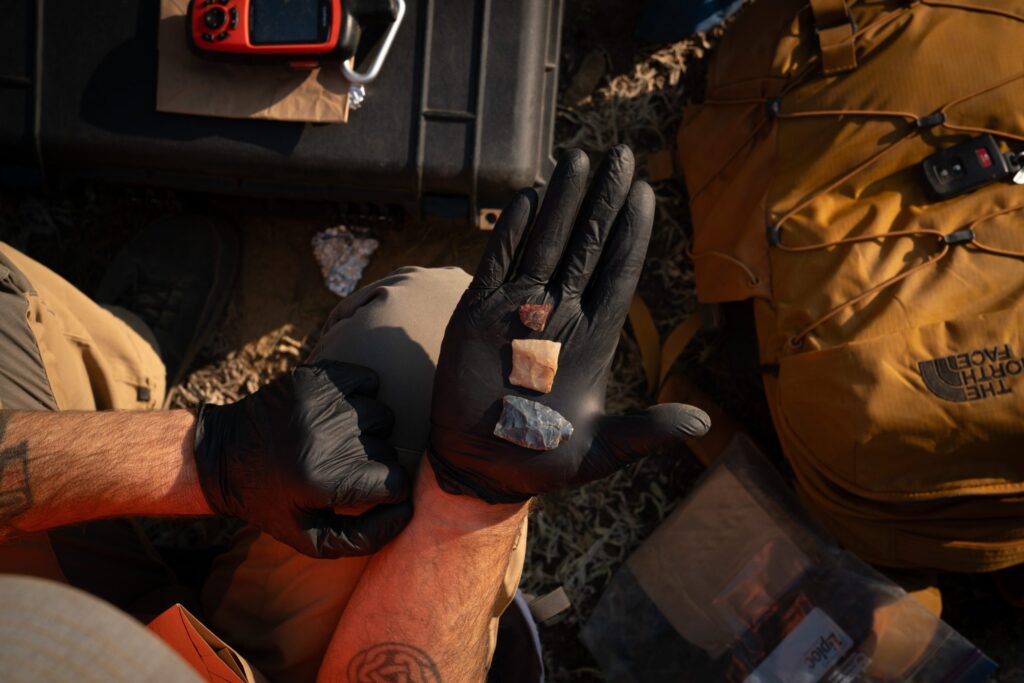
A 2022 rain-on-snow event revealed artifacts buried by sediment for thousands of years. Clovis artifacts, typically found at lower elevations, emerged in these newly uncovered areas. Such discoveries challenge the belief that mountains were uninhabitable during glaciation.
In the Beartooths, Dersam’s team splits into groups: one surveys for new sites while another excavates existing ones. The survey, conducted in secret to protect artifacts, involves scanning dense grizzly territory for ancient tools. Bill Powell, a Ph.D. anthropology student, says, “There’s no way that flake doesn’t have friends.”
The implications of Dersam’s work reach beyond scientific discovery; they bridge a gap between indigenous perspectives and traditional archaeology. The Anzick site controversy illustrates a history of exploitation. Today, Dersam aims for respectful collaboration with tribes, gaining support for his respectful methodology. By preserving and studying ancient artifacts, he seeks to expand our understanding of human interaction with these environments.
Dersam’s surveys often reveal astonishing artifacts. On one occasion, he found a Folsom point, astonishing even seasoned archaeologists. His work in the Beartooths has unearthed six Clovis sites, potentially transforming understanding of early human migration. Craig Lee, a high-alpine archaeology expert, praised Dersam’s contributions to the field.
As climate change pressures increase, Dersam believes high-elevation areas will gain importance. He argues that historical understanding of these ecosystems can guide future conservation efforts. “These ecosystems are going to be more important than ever,” he says, emphasizing the necessity of ongoing research.
Dersam’s findings challenge preconceived notions about prehistoric human activity. His dedication to unearthing this history provides a fresh lens on our past, offering insights into how ancient peoples may have thrived in seemingly inhospitable environments.
—
Read More Montana News