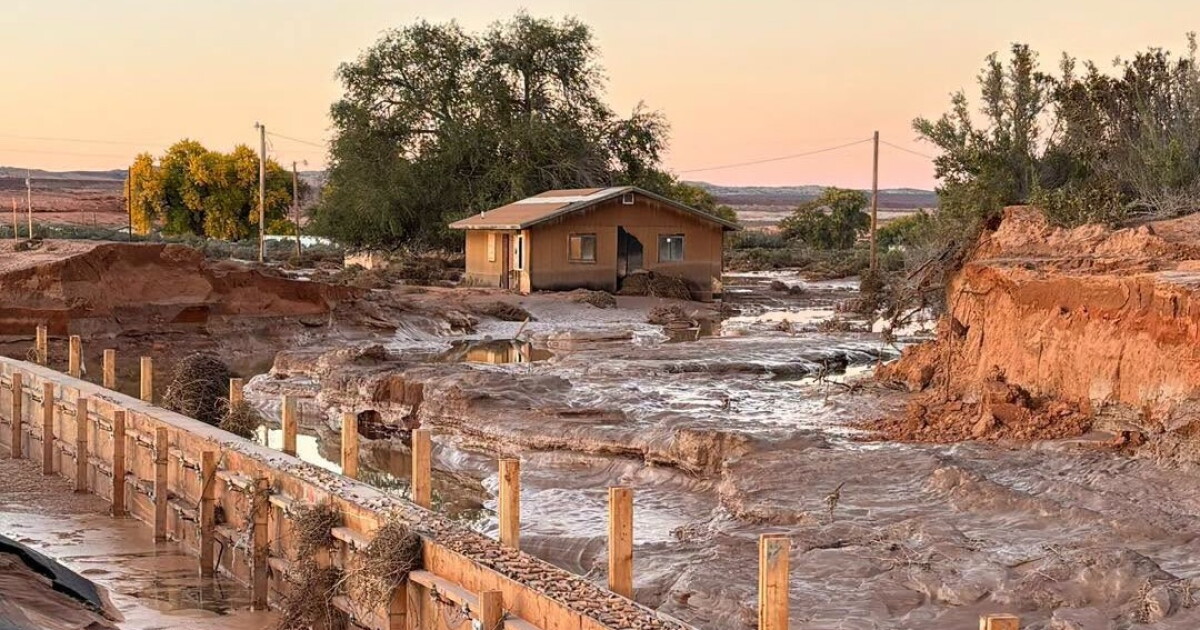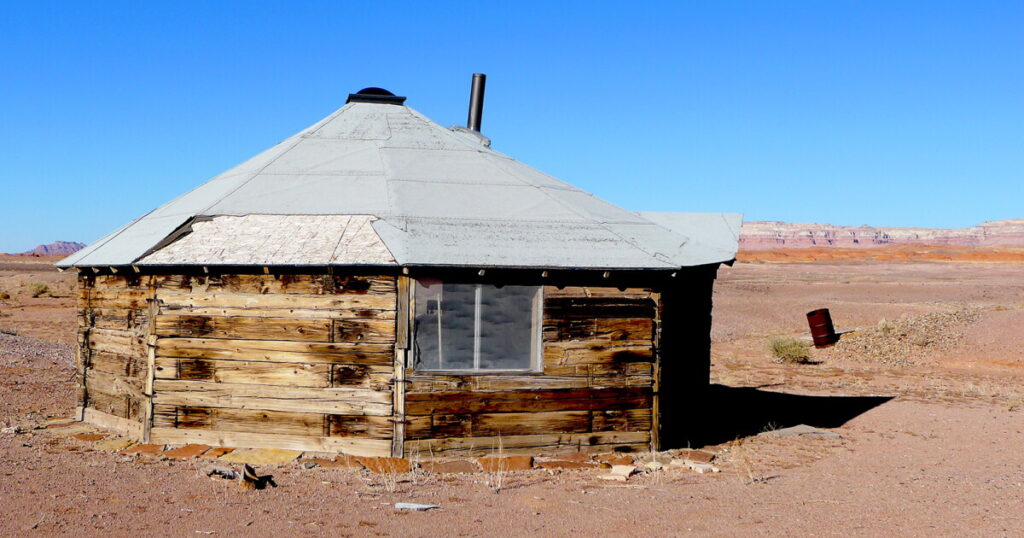
As floodwaters surged across Navajo country, Scott Thybony was reminded of the challenges faced by those cut off by mud and washouts. His memories drifted back to a winter spent in a hogan, a traditional Navajo dwelling, where he later discovered its deeper cultural significance.
The crisp air cascades down the mountains overnight, forming a dense layer. Just before dawn, the sunlight refracts, creating a mirage effect on the distant buttes beyond Merriam Crater.
On my way to Tsaile, I cross the Little Colorado River, catching sight of a Navajo homestead marked by a trailer’s flat roof beside a rounded hogan. Memories of a winter spent in a traditional Navajo home near Red Lake surface, recalling the structure’s peeled logs and east-facing door that welcomed the morning sun.
At Diné College, museum director Harry Walters sits surrounded by carved Yeibichai figures, pottery, books, and Elvis memorabilia. As the head of the traditional studies program, he delves into the origins of the world to explain the hogan’s significance, emphasizing the cyclical nature of life.
“And these cycles repeat themselves,” Walters explains. “All living things on earth live in accordance with the changes of these cycles. Their attitude, their behavior – all happen in accordance with them. Navajo culture is based on ceremonies linked to them. We plant according to them, breed livestock. Everything we do is in accordance with these cycles. To live this way is to live in harmony with the world.”
He describes the central fire within the hogan as a representation of the North Star, a constant around which life revolves. At birth, a child’s head is turned toward this fire, symbolizing the enduring connection to home. Even those who leave still acknowledge this bond, saying, “That’s where my fire is.”
The term hooghan translates to “place-home,” rooting it within the landscape. For the Navajo, hogans are a cultural touchstone, even as modern housing becomes more common. They often maintain hogans for significant events, such as births, weddings, and healing ceremonies.

Walters elaborates, “The hogan is a miniature universe. It is a replica of the outer universe, and it has the same power. By having a ceremony in the hogan, everything comes together. We are set in place, in the natural order. The sky is our father. The air we breathe comes from the father. Our physical being comes from the same elements found in the earth. This is female, it comes from the mother. In the order of the hogan there is great love, there is healing there. The roof is the sky, the floor is earth. When you are touching earth, there is healing and love from the mother.” He pauses, adding, “This is our home, our universe.”
Evenings at Red Lake would find me inside a hogan stretched out on a goat skin next to a potbelly stove. At the time I knew little about the significance of this place-home. But I remember marking time by looking up through the smokehole to watch Orion cross the nightsky high above.
Scott Thybony is a Flagstaff-based writer. His Canyon Commentaries are produced by KNAU Arizona Public Radio and air on the last Friday of each month.
Brought to you by Sedona Red Rock Tours, offering guided tours to Sedona, the South Rim, Antelope Canyon.
In his latest Canyon Commentary, Scott Thybony recounts an unusual encounter with a slow flash flood deep in the Grand Canyon.
—
Read More Arizona News