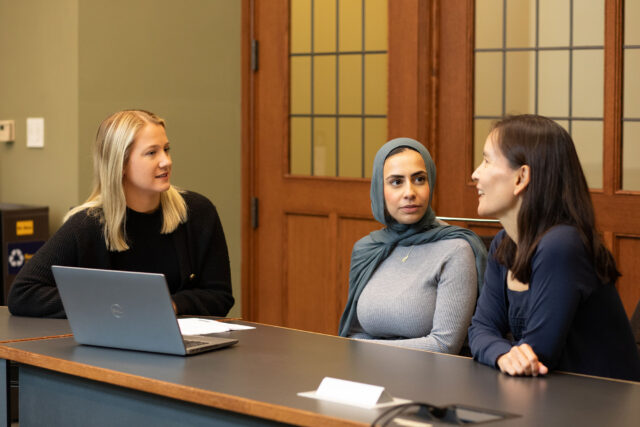
In the winter 2024 semester, first-year law students Nithya Arun and Hiba Dagher transitioned from doctrinal classes to practical experience by serving as guardians ad litem in a divorce case through the 1L Advocacy Clinic. This opportunity allowed them to pursue their goal of making a positive impact in people’s lives, despite initial anxiety about their preparation. Uncertain but determined, they embarked on this journey, questioning their readiness.
“We were really stressed out,” Dagher said. “We were like, ‘How are we going to ask them questions? We feel totally unprepared. Are we ready for this?’”
Similarly, fellow students Rana Thabata and Grace Martin were assigned to an immigration case involving the Violence Against Women Act, assisting a domestic violence survivor in self-petitioning for lawful status. Initially, Martin felt unqualified due to her limited legal education but soon adapted. “At first, I was so excited and confident in myself,” Martin said. “But then we met our client, and I was so nervous. Having only a semester of law school, I did not feel qualified to handle the complicated and heavy details of our client’s case.”
Eventually, the students gained valuable hands-on experience, which became a highlight of their 1L year. “Getting hands-on experience and being able to help make a difference in our client’s life reminded me why I wanted to go to law school,” Martin said. “And it taught me skills that we don’t get in the classroom. Working with our client in the clinic was one of the highlights of my 1L year.”
Learning by Doing
While 1L students traditionally await practical opportunities in their 2L and 3L years, the University of Michigan’s Law School offers the 1L Advocacy Clinic, allowing first-year students to engage in real-world cases. In winter 2024, 22 students worked on guardian ad litem cases, while six handled immigration cases. This unique clinic provides a glimpse into the legal profession and helps students start defining their identities as lawyers.
Frank Vandervort, clinical professor and co-director of the clinic, emphasized the importance of practical experience. “They love to do something that they describe as ‘real,’ not just reading cases and case books,” Vandervort said. The clinic aims to transform students into compassionate legal advocates, as noted by Julianna Lee, a clinical assistant professor who supervises immigration students.
Dagher and Arun: Guardians ad Litem
Nithya Arun and Hiba Dagher, now 2L students, began their guardian ad litem roles with preparatory classes. These sessions taught them essential skills like interviewing children and courtroom conduct. Weekly meetings with Vandervort further guided their efforts. “We were tasked by the court with learning about each of the parents and how the children fared with each of the parents,” Arun said.
Despite their initial discomfort with probing into clients’ personal lives, Arun and Dagher recognized its necessity for the children’s best interests. As the semester progressed, their confidence and effectiveness grew, aided by consultations with child psychologists. Their journey ended unexpectedly when the parents reconciled, but the experience was invaluable.
Thabata and Martin: Immigration
Thabata and Martin spent early weeks learning about the Violence Against Women Act, which aids domestic violence survivors in self-petitioning for permanent residency. “None of our doctrinals from the fall informed our immigration work. It was an entirely different ballgame,” Thabata noted.
The students’ work involved complex cases, often referred by the Michigan Immigrant Rights Center, requiring additional advocacy. Through persistent effort and guidance from Lee, Thabata and Martin became adept at handling sensitive issues like domestic violence. “The domestic violence that our client faced was the most compelling aspect of our case,” Martin said.
While guardian ad litem cases conclude within a semester, immigration cases can span years, introducing uncertainties. Thabata reflected on the challenges of navigating a dynamic legal landscape. “In reality, though, it’s a very long process, and we don’t really know what will happen next.”
—
Read More Michigan News

![Jody White’s Unconventional Michigan Supreme Court Candidacy Explored[embed]https://www.youtube.com/watch?v=8NfxFIPE4ac[/embed]](https://www.kitchentablenews.org/wp-content/uploads/2026/10/Jody-Whites-Unconventional-Michigan-Supreme-Court-Candidacy-Exploredembedhttpswwwyoutubecomwatchv8NfxFIPE4acembed.com2F842F0e2Fc7223daa43c9876b36a4e00773a42Fme-supc.png "Jody White’s Unconventional Michigan Supreme Court Candidacy Explored[embed]https://www.youtube.com/watch?v=8NfxFIPE4ac[/embed]")