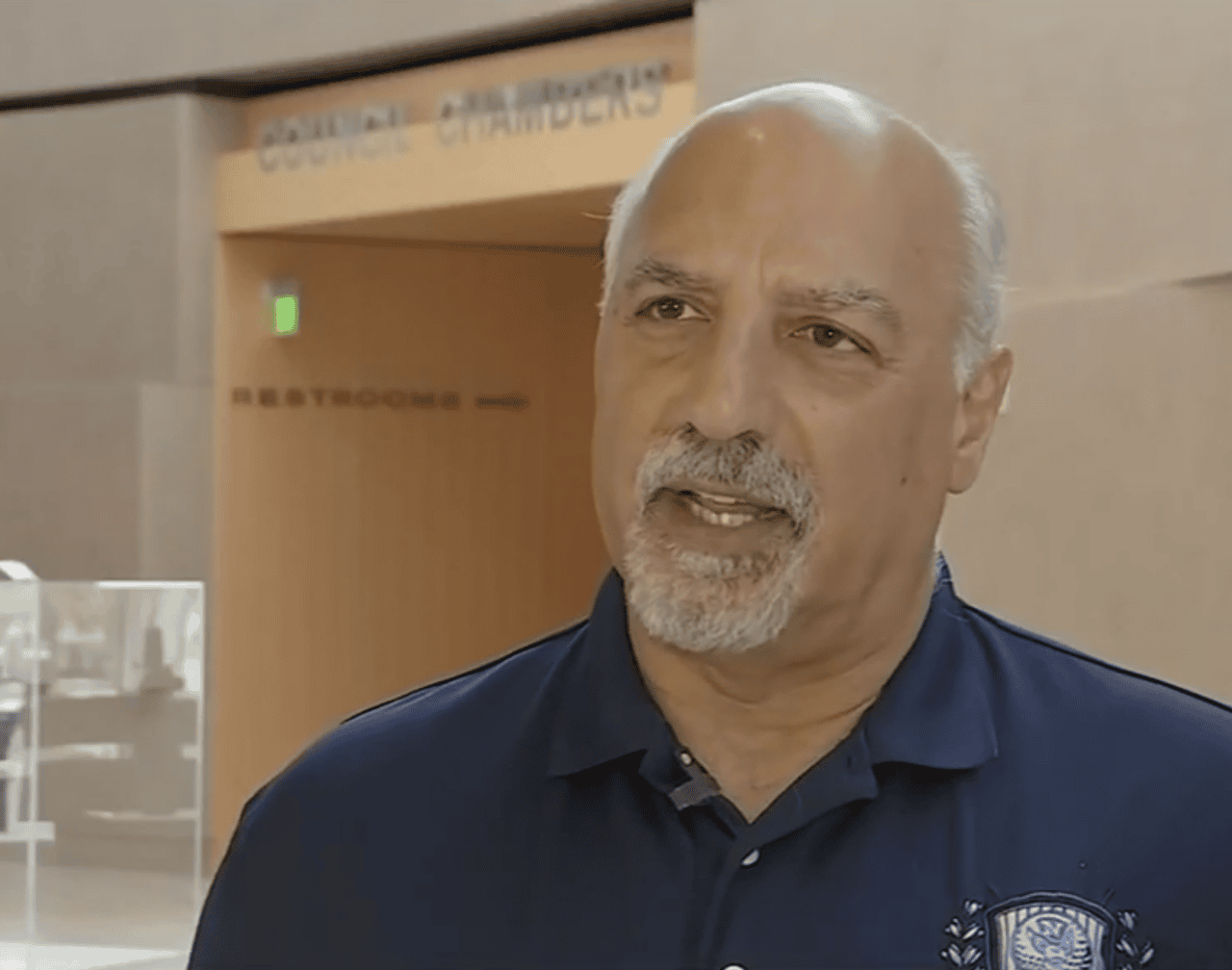
Arizona has lost one of its political stalwarts with the passing of Alfredo Gutierrez at the age of 79. As a significant figure in the state’s political landscape, Gutierrez was known for his passionate activism and dedication to immigrant rights.
Born in Miami, Arizona, Gutierrez was the son of a miner and quickly rose through the political ranks. He entered the Arizona Legislature at 27 and was soon recognized as a radical by his peers. Despite this, he was elected to lead the Democratic caucus within two years. His legislative career spanned 14 years before transitioning to a consulting role. His run for governor in 2002 saw him lose the primary to Janet Napolitano, yet his influence continued unabated.
Gutierrez co-founded Chicanos Por La Causa, a prominent advocacy group, and was a vocal critic of Arizona’s immigration law, SB 1070. In 2010, during a protest against the bill, his activism led to his arrest. Reflecting on immigration, he told KJZZ, “At some point, no matter how strongly one might feel that ‘illegals should be returned’ — at some point, you would think that some rational decision making can begin to take place, and some thoughtful decision making can take place.”
His activism roots trace back to his college days at Arizona State University, where he was expelled for participating in civil rights protests. Gutierrez later returned to ASU in 2024 to complete his undergraduate degree, demonstrating his enduring commitment to education.
Today, many across Arizona remember Gutierrez for his lasting impact on the state’s politics. Notably, Lydia Guzman, a longtime activist, and Rusty Bowers, a former Speaker of the House, shared their memories of Gutierrez on The Show.
Lydia Guzman on Gutierrez: ‘He motivated anybody who heard Alfredo speak. Immediately they felt that fire in their belly’
LAUREN GILGER: How long did you know Alfredo?
LYDIA GUZMAN: I’ve known Alfredo since probably the first week I landed in Arizona. I’m a transplant activist from Southern California. And when I came to Arizona, I enrolled in a leadership development program from an organization called MALDEF, the Mexican American Legal Defense and Education Fund. And I wanted to meet other leaders, other like-minded folks. And, this was in 1999.
So one of the speakers was Alfredo Gutierrez. And when I first heard him speak to the group, he was powerful. He motivated, and he talked about something that had just happened in Chandler, the immigration roundups. But he spoke in a way that we must all get involved, because what happened there happens to all of us.
And he lit the fire under my feet, under everybody’s feet. And he was that kind of a guy. He motivated anybody who heard Alfredo speak. Immediately they felt that fire in their belly to want to get involved. And that’s what he did to a lot of us, he did to me.
GILGER: He’s being remembered as such a force. Fiery is a word being used a lot. He was strong in his convictions and beliefs. Determined. How do you remember him? Is there a story that stands out to you?
GUZMAN: Yes. So, there are several stories. Alfredo, he had a knack for gathering folks. He was a coalition builder, and people followed him. Different groups: faith groups, students, labor, just different leaders and elected officials. So they followed him.
And as he would build coalitions, I remember that we sat around and we talked about we need to start gathering information. We need to start gathering cases and victims because (former Maricopa County Sheriff Joe) Arpaio had said that he was going to start rounding immigrants. And I remember having a conversation, and it was a conversation about, well, Arpaio has a hotline. And he said, and I quote, “We’ll start own damn hotline.” And we did.
And this is how all of the information was gathered so that we can collect all of that for the case against racial profiling. This is where the Melendres case came from because of that hotline.
GILGER: So tell us a little bit about what you think his legacy will be when it comes to the Latino community here in the Valley. As we mentioned, he was one of the founders of Chicanos por la Casa, but also just one of the people who began organizing in that community here.
GUZMAN: That’s right. As a young organizer, he worked with students, students that were upset because they wanted access to higher education. And so they had students that were organizing that were protesting. And he was one of the organizers, and this was the founding of Chicanos por la Causa.
But like I said, other organizations — like Valle del Sol, like the Friendly House — he was involved in the founding of those organizations as well.
What Alfredo believed in is finding ways to help empower the community. And empowerment meant everything from social justice, economic justice and political justice. That also meant political power. Alfredo was a firm believer in registering to vote and getting involved in elections.
GILGER: Civic engagement, yeah. Let me ask you, lastly, in the last minute or so here, Lydia, about the last time you saw him, which was not long ago. It sounds like he was still involved up until the end.
GUZMAN: Oh, yes. He was very involved. There was a meeting where we were talking about the governor’s budget bill, and he, along with other seasoned legislators, were talking with some of the legislators in the House now, with the minority leader. And they were talking to him, but they’re mostly talking also to the community about how we should support this budget.
And he talked about all of the good things regarding the budget that was good for our community. There were programs in there. There was funding for programs. And so all of those things, Alfredo still had that fire. And he says, “If we let this go, and if we stay silent on this, our communities will lose.”
And so up until the end, he was there and he was talking about this as recent as helping to pass this budget.

Rusty Bowers on Gutierrez: ‘I want to make sure that everybody remembered him as being true to his roots’
LAUREN GILGER: Tell us a little bit about Gutierrez, his impact on the Legislature. I know he had this famous friendship with Burton Barr, when Burton Barr was the majority leader on the Republican side, and Alfredo was the Democratic minority leader. What kind of legacy did that leave?
RUSTY BOWERS: Well, I first met Alfredo in the transition. And Burton, we met, in fact talked to Burton Barr down at the First Watch one time. They, they were kind of the big posts in the fence, at that time. And, most of the time publicly, they weren’t afraid to take different positions, but they talked to each other, which I thought was great.
And that thing, he then had set up some type of a meeting with me, and I was just a, I guess, I’m still just a freshman. We all think we learned something, but he set up a meeting downtown, the restaurant, and it was good. I had only known him from news clips and his involvement and his very, very vociferous support of things that have transitioned into even stronger, supportive.
Like early on, social justice was more, it didn’t have a lot of meat on the bones, but they knew it because they felt it.
GILGER: Let me ask you about some of the issues he championed. Immigrants rights we’ve talked about. But he was also a big defender of education, public education. He helped launch the state’s Medicaid program. ADOT was a big thing he worked on. Tell us about those legacies.
BOWERS: Well, I was thinking specifically of the education, the medical stuff and ADOT. In trying to get access for people to be more mobile, to be more capable of accessing employment and education. He very much pushed some of the early initiatives for freeways and bus service. And I think that’s one of the subjects that we talked about downtown.
I know that he was supportive, of course, of AHCCCS and the state Medicaid programs. And very specifically because he had concerns about specific clinics and strata of people in certain groups who were less capable of accessing those things.
And education and, an early proponent of opening education to as many people as could, could find the time to do it. He promoted big time, and I think it’s the important point – I grew more involved with, with Alfredo after the legislative kind of the umbrella.
He went kind of through a lull of the public profile, then picked up steam and, and we had talked about more, about bridge building. “Yes. I differ with you. I will not be anything but an activist. But there are things that you’ve done and been through that I can respect you,” kind of back and forth between us.
GILGER: Yeah.
BOWERS: And we, we even talked about having an educational kind of a think tank, the speaker’s bureau, where the two of us would talk together and invite people to come in and, and kind of do a three way with him and I, prior to his demise.
He got more interested in finding voices and combining voices from across the aisle, or even modulated positions within each side across the aisle, to get more unity, because he could see what was coming of a, a very polarized position, which is what we’re in now.
GILGER: That’s so interesting as someone who was an activist and began his career in the Legislature, being called a radical, to end up being somebody who was so much about civil dialogue and reaching across the aisle, to work across the aisle throughout his career.
What does that mean to you now, especially in this time, as you mentioned, which is kind of lacking for that kind of dialogue?
BOWERS: Well, I’m chasing him. I mean, we were not getting younger. We were getting older. And the point, I think is a point is really critical. He did not move from his position of promoting those issues that were important to his quote “people.” And, but his people got bigger. There were more he could see more nuances of need beyond just the Latino community.
But he never moved away from being an activist. He would try to pigeonhole me and say, “look, you’re a voice right now. You’ve got to come out in favor of X, Y or Z.”
And I said, “but I still have certain values and principles that don’t let me do that.” And we could laugh together and you know, sit across the room on couches and, and have good conversation.
But he didn’t abandon his roots. And while I may not agree totally with all the positions that he took, and we say that about people, of course, when they’re passed, “we say we didn’t get along, but we did this.” I want to make sure that everybody remembered him as being true to his roots.
GILGER: Yeah.
BOWERS: But he also saw beyond that, he could see where these things, the whole kind of map, where it was leading us and was concerned and wanted to be a voice to moderate that into dialogue, where we could solve problems, focus on the problems, not just on the agenda or who is leading it.
KJZZ’s The Show transcripts are created on deadline. This text is edited for length and clarity, and may not be in its final form. The authoritative record of KJZZ’s programming is the audio record.
—
Read More Arizona News