Arizona’s Air Quality Challenges Amid Regulatory Changes
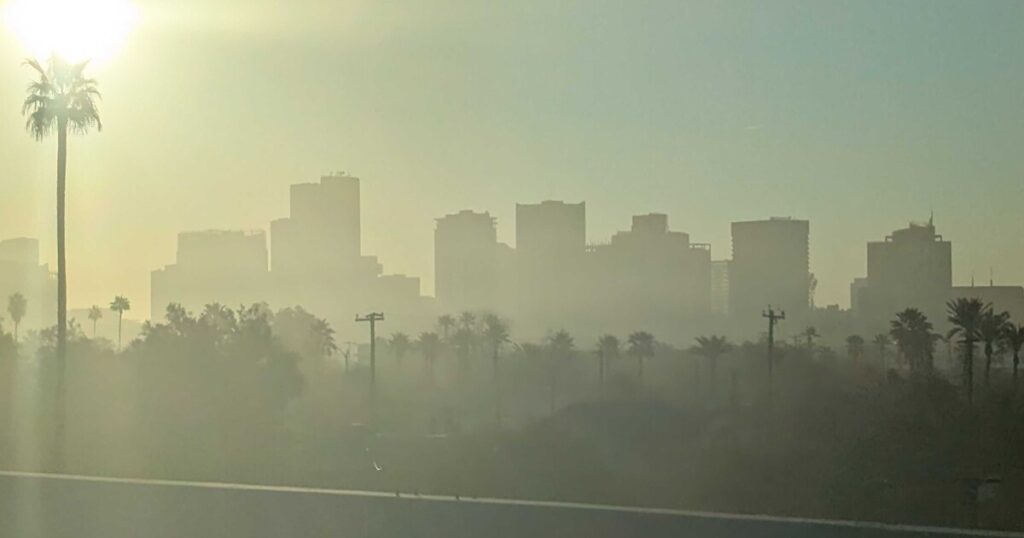
For nearly a third of the year, a persistent brown haze enveloped downtown Phoenix, obscuring the skyline and affecting views from nearby Tempe offices. Dennis Hoffman, an economist, noted that while Phoenix’s air quality has never reached the severity of Los Angeles, it has seen improvements thanks to targeted pollution control efforts.
However, these advancements are at risk as the Arizona Department of Environmental Quality (ADEQ) faces potential budget cuts due to compliance with federal mandates referred to as the Big Beautiful Bill. This Thursday, the Trump administration’s Environmental Protection Agency (EPA) plans to reverse the 2009 “endangerment finding,” which previously allowed for regulation of greenhouse gases.
In response to these changes, Sen. Lauren Kuby (D-Tempe) has proposed a green amendment to the Arizona Constitution. Unveiled during Environmental Day at the Capitol, this amendment seeks to guarantee clean air, water, and a healthy environment as constitutional rights for all residents of Arizona.
“In this moment in this country, Arizona’s environmental protections are not just weak, they’re moving backwards,” Kuby stated. “By passing this amendment, Arizona voters will lead on environmental protection to show that a healthy environment is a fundamental right, just like free speech or religious expression.”
According to Sandy Bahr from the Sierra Club’s Grand Canyon chapter, Phoenix’s air quality issues are exacerbated by its geographic location within a valley, trapping pollutants. “Here in the greater Phoenix area, we have very poor air quality,” Bahr explained. “If they make those kinds of cuts, then we are going to be out of compliance with the Clean Air Act, and there may actually be implications from an economic perspective as well.”
Health professionals warn that poor air quality can lead to conditions such as asthma and heart disease, and Arizona faces additional challenges from cross-border pollution.
D. J. Portugal, director of operations at Chispa Arizona, emphasizes the need for equitable air quality, particularly in Latino communities disproportionately affected by pollution. “Corporations, for the longest time, were able to just do whatever they want and pollute the air and create products that polluted the air,” Portugal said. “We want our communities to also be safe to breathe in, because it’s literally our lives on the line.”
The proposed repeal of the endangerment finding could lead to deregulation of greenhouse gases, allowing corporations more leeway in emissions. “It’s really the corporate polluters that are responsible for the bulk of, in this case, air pollution,” Portugal added. “If there’s no regulatory standard that they have to adhere to. They have no incentive, right? Their incentive as a corporation is just to make money.”
Hoffman, who leads the Center for Competitiveness and Prosperity Research at Arizona State University, noted that the most likely area for ADEQ cuts is air quality monitoring. Jennifer Allen, chair of the Pima County Board of Supervisors, remarked on the difficulty of advancing new environmental protections: “We need the facts, we need data, which is what air quality monitoring provides, and it ensures then that regulators know when to step in and put some limits on polluting industries,” she said. “It helps set better policies to protect our air.”
For more stories from Cronkite News, visit cronkitenews.azpbs.org.
—
Read More Arizona News