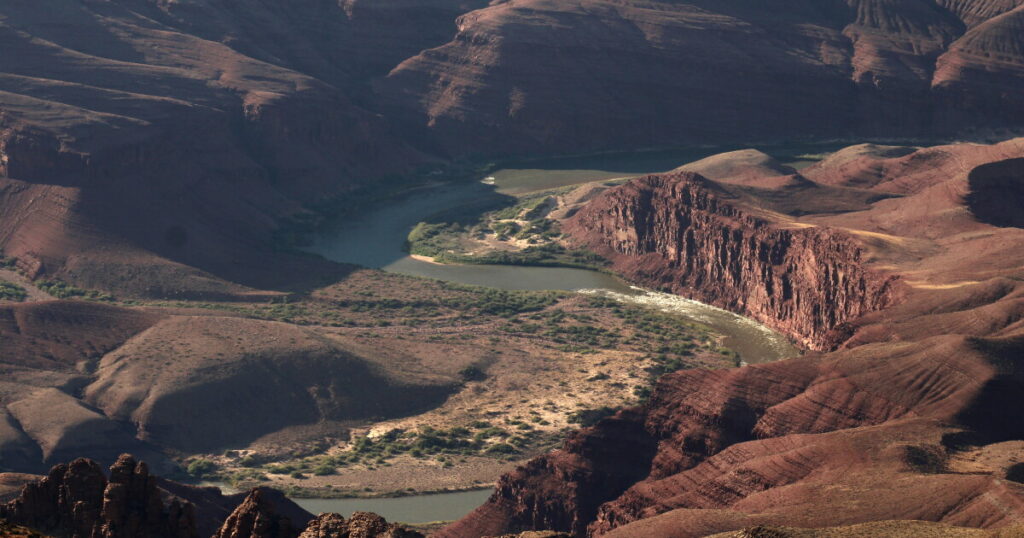
As new regulations for the Colorado River take effect, Arizona is preparing for future changes in its water supply. While these new rules commence this Thursday, Arizona’s water distribution remains unchanged for now, as the state works on a collaborative agreement with California and Nevada. This agreement is crucial, as Arizona’s water reductions won’t be enacted until January 1, 2027. Arizona’s chief water negotiator remains “very optimistic” about the ongoing discussions with the neighboring states.
The complexity of the timeline underscores the unique scheduling of water management along the Colorado River. Unlike the standard calendar year, the “water year” spans from October 1 to the following October 1. This means that the federal plan, designed to adjust the water flow from Lake Powell to Lake Mead, is effective this week. However, the downstream water allocations from Lake Mead to places such as Phoenix and major agricultural areas in California follow a January-to-January schedule. As a result, the actual outflow will remain consistent until 2027.
Arizona, California, and Nevada, which rely on the Colorado River’s downstream water, must finalize their agreement by the year’s end. Although the federal guidelines predominantly impact Arizona, California and Nevada have expressed willingness to mitigate some of Arizona’s burden, as highlighted in their proposal.
Challenges in Finalizing the Agreement
Since the federal plan was announced in August, the states’ leaders have been negotiating a supplementary agreement. However, several obstacles have delayed the process. One major challenge is determining which specific cities and farms will reduce their water usage.
John Berggren from Western Resource Advocates noted, “It’s kind of been the story of the Colorado River for many years now. The people negotiating these agreements reach a high-level agreement of ‘Here’s what we’re willing to do,’ and then they have to go back and shop it around their state and make sure they can get their water users on board with what they are tentatively agreed to.”
Tom Buschatzke from Arizona, along with Nevada, has outlined plans. California is finalizing its strategy to ensure significant water reductions, particularly impacting the Metropolitan Water District of Southern California and the Imperial Irrigation District, both major water consumers. Buschatzke noted, “It’s more dotting I’s and T’s. I’m very optimistic, based on recent discussions, that we’re going to close on the agreement language in a way that it will be then ready to go to various boards over the next few weeks.”
Legal Complications in Nevada
Nevada’s unexpected lawsuit against the federal government adds another layer of complexity. The state argues that the Interior Department did not adhere to necessary legal protocols when formulating the new plan. The lawsuit is ongoing, influencing the pace of negotiations between Nevada and the other states.
Berggren commented, “People are interested in waiting to see how the federal government responds, which we should know in the next month or so. So, depending on how they respond, I think that will dictate what other people do.”
Nevada is suing the federal government over cuts to its allocation of Colorado River water. It came as a surprise to many who follow water policy.
Buschatzke acknowledged that Nevada’s legal action has impacted the tripartite agreement discussions. “The Nevada lawsuit was something we did have to deal with in regards to the Lower Basin Agreement,” he stated. However, he remains optimistic about a “positive path forward” to resolve the issues.
Arizona’s Legislative Approval
Once the interstate pact is finalized, it must pass through the Arizona Legislature, the only legislative body among the seven Colorado River states with such authority. Buschatzke previously mentioned that he won’t endorse the agreement unless it’s likely to gain legislative approval, potentially necessitating a special session.

Recently, water issues have become a key political topic in Arizona. Both gubernatorial candidates, Democratic Gov. Katie Hobbs and Republican Andy Biggs, have placed significant emphasis on water policy in their campaigns, as have candidates across various races. Republican lawmakers have requested more updates on Colorado River negotiations from Buschatzke’s agency, suggesting a lack of uniform information availability.
Despite the politicization of water issues, Buschatzke remains hopeful that bipartisan support will be achieved for the three-state agreement. “We’ve been briefing the legislature quite a bit on the agreement itself and its status,” he stated. “I believe, at the end of the day, that the agreement will go through the legislature once we get there. It is an agreement that shows strong collaboration among the three states.”
—
Read More Arizona News