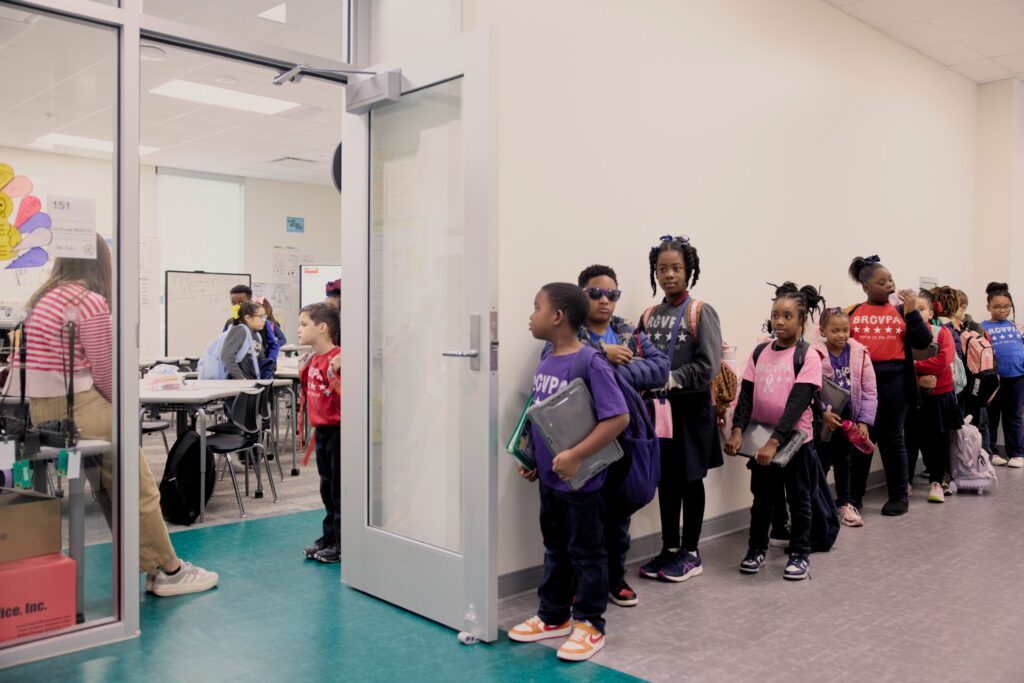
BATON ROUGE, La. — In a vibrant second-grade classroom at Baton Rouge Center for Visual and Performing Arts, students energetically practiced math fundamentals. “Two needs eight!” they chanted, reinforcing the basics before advancing to larger computations like “Forty-six needs four ones.” This early exposure to departmentalized learning is part of the school’s innovative approach, where even young students transition between classes for different subjects.
Unlike traditional elementary schools, Baton Rouge’s visual and performing arts center implements departmentalizing, allowing teachers like Jacquelyn Anthony to specialize in math. This method starts with students as young as six, aiming to enhance subject expertise among educators. “We want to ensure our teachers are experts,” stated Sydney Hebert, the school’s magnet site coordinator, highlighting the importance of specialization in the face of evolving educational demands.
Facing a persistent decline in math scores, exacerbated by the pandemic, schools are increasingly adopting this strategy. Recent data shows that from 2000 to 2021, the number of fourth and fifth-grade classrooms adopting departmentalization doubled from 15% to 30%. The model promotes subject specialization, potentially improving teaching effectiveness, especially in math, where teacher anxiety can impact learning.
However, the effectiveness of departmentalizing remains debated. A 2018 study in Houston indicated negative impacts on test scores and student behavior, possibly due to decreased teacher-student interaction. Conversely, a 2024 Massachusetts study noted improvements in English and science scores, although math gains were minimal. Despite mixed outcomes, many educators believe passionate subject teaching can enhance educational delivery.
While departmentalizing may benefit older students, it presents challenges for younger grades. The approach can hinder the development of strong teacher-student bonds, vital for early education. Shifts between classrooms can disrupt learning, and smaller schools may face staffing challenges. Nonetheless, the Baton Rouge school has embraced this model, adapting it even for first and second graders, with positive feedback from teachers.
As more schools explore departmentalization, successful implementations like at San Tan Heights Elementary in Arizona demonstrate potential benefits. The school transitioned to specialized teaching post-pandemic, resulting in improved academic ratings and high teacher retention. Principal Henry Saylor-Scheetz expressed enthusiasm for the approach, stating, “There’s merit in doing it, but there has to be a commitment to it.”
In Baton Rouge, the system’s success is attributed to careful implementation, with teachers meeting regularly to discuss strategies and student progress. Despite challenges, educators like Jacquelyn Anthony appreciate the opportunity to focus on their passions, enhancing their teaching effectiveness. “It’s a joy to dig into the content,” Anthony remarked, reflecting on the balance between specialized instruction and holistic student engagement.
—
Read More Kitchen Table News