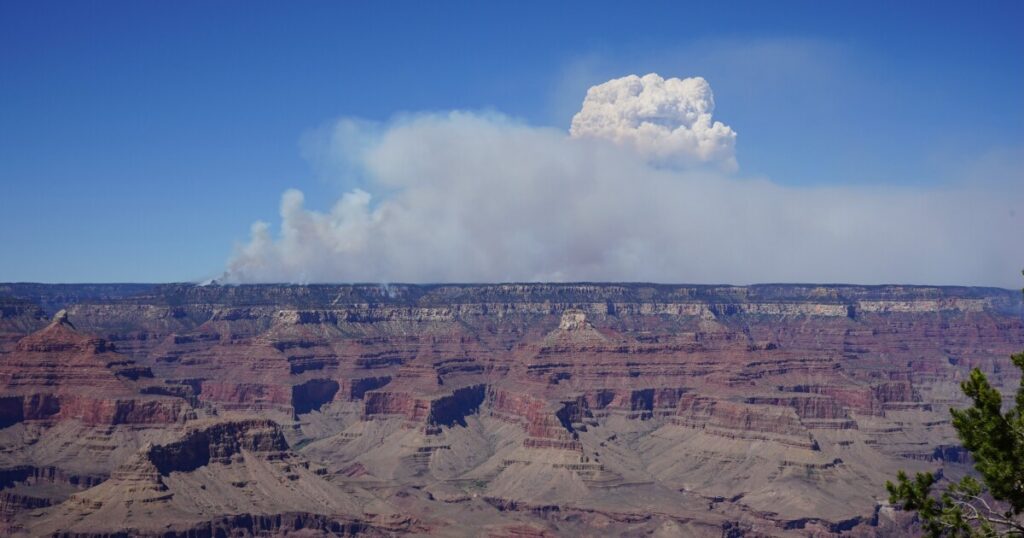
The National Park Service has unveiled the executive summary detailing the repercussions of the Dragon Bravo Fire on the North Rim of the Grand Canyon and adjacent forest regions.
A specialized team from the Park Service conducted assessments in August, determining the fire exhibited a “mosaic” burn pattern, predominantly of low to moderate severity.
According to the report, “While localized threats to life, infrastructure, and sensitive resources exist, the fire’s burn pattern supports natural recovery in most areas.” It further explains that emergency stabilization measures are in place to address immediate risks to water quality, public safety, and historic structures, while Burned Area Rehabilitation treatments focus on long-term recovery through invasive species control, trail maintenance, and wildlife monitoring.
The Burned Area Emergency Response (BAER) team assessed various impacts of the Dragon Bravo Fire on the landscape, particularly the watershed.
They noted that post-fire debris flows in the canyon are confined to steep, narrow drainages, such as Dragon Creek and upper Bright Angel Creek, and are not expected due to typical monsoon events. The report adds that while an increase in runoff and debris flow is anticipated in the short term, these are unlikely to significantly affect values-at-risk during normal storm conditions.
Joe Rondone/AP
/
Pool The Arizona Republic
The BAER team observed that in areas of low-severity burns, trees and seed sources remain intact, while moderate-severity patches are already showing signs of new growth. However, biologists caution that these regions might be susceptible to invasive species proliferation.
Notably, fisheries were largely unharmed, and there is minimal risk to threatened species like the humpback chub. The habitat for wildlife, including nesting sites for the endangered California condor, remains largely unaffected.
The Dragon Bravo Fire impacted 73 miles of trails, including moderate damage to the North Kaibab Trail, where 2,200 feet are obstructed by debris. Persistent rockfall and instability are anticipated in some steep regions.
Among the most significant damage was to park infrastructure, particularly historical buildings. A total of 114 buildings, including the century-old Grand Canyon Lodge, were destroyed. Many guest cabins and 24 buildings within the National Park Service’s Headquarters Historic District, 11 of which were historic, were also lost. Efforts are underway to salvage materials and artifacts from the lodge.
The fire scorched 149,399 acres, with 71,129 acres within Grand Canyon National Park. The severity was mostly low to moderate, with 68% of park lands classified as low severity, 24% as moderate, and 1% as high severity.
Arizona’s U.S. senators are preparing to propose legislation aimed at accelerating reconstruction efforts on the North Rim, following the devastation caused by the Dragon Bravo and White Sage fires last summer.
—
Read More Arizona News