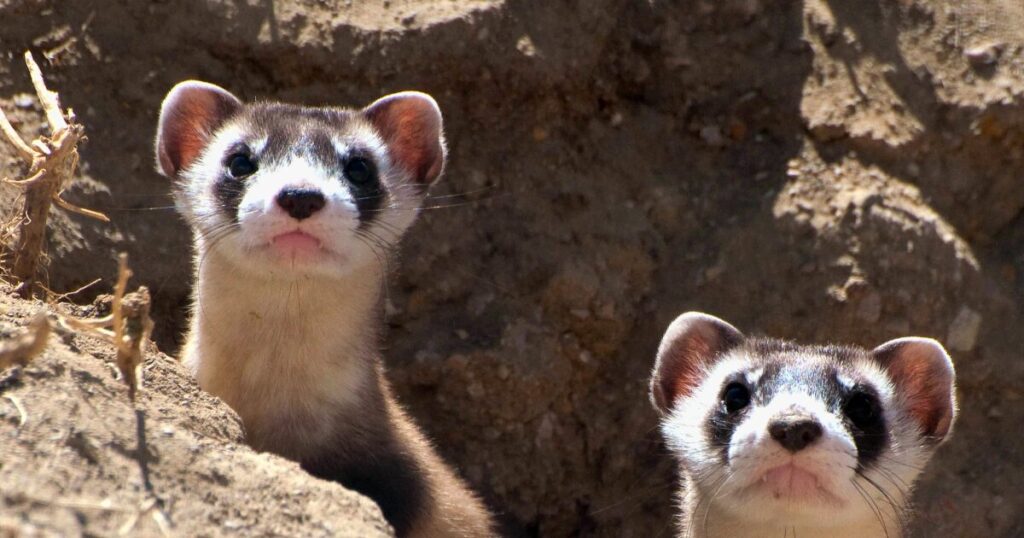
In a significant move to revive one of America’s most endangered mammals, the Arizona Game and Fish Department has introduced 19 black-footed ferrets into the wild. This initiative targets three strategic sites in northern Arizona, aiming to increase the population of these rare creatures.
On the night of March 10, biologists released 13 ferrets into the Aubrey Valley and Double O Ranch areas near Seligman, while another six were placed at Garland Prairie near Parks. Jennifer Cordova, the black-footed ferret Project Field Coordinator for AZGFD, explained the timing of the release: “We are anticipating that a spring release will give the ferrets a greater chance at survival since prairie dogs are beginning to emerge and it will be easier for the ferrets to find prey. It is also at the beginning of the breeding season for ferrets so we are hoping that we will find wild born litters this summer.”
These ferrets were bred in captivity at the Toronto Zoo and the Smithsonian National Zoo before being trained at the U.S. Forest Service’s Black-footed Ferret Conservation Center in Colorado to hone their hunting and survival skills.
Of the 35 ferret release sites across the United States, Garland Prairie is notable as one of only two locations on land overseen by the Forest Service. It saw its inaugural release in 2025.
The black-footed ferret, distinguished by its unique black markings on its feet, tails, and faces, is the only ferret species native to North America. Once widespread across the continent, their numbers dwindled drastically in the 20th century due to habitat destruction and disease. The species faced near extinction until a small group was discovered in Wyoming during the early 1980s.
By 1986, the population had dropped to just 18 individuals. In response, conservationists established a captive breeding program to save the species from disappearing completely. Today, around 300 black-footed ferrets live in the wild, with approximately 20 residing in Arizona.
The primary threat to these ferrets is the sylvatic plague, a bacterial disease transmitted by fleas that affects both the ferrets and their primary prey, the Gunnison’s prairie dogs. While released ferrets receive vaccinations against this disease, their offspring remain at risk.
Fortunately, biologists have detected minimal signs of plague at the Arizona release sites. Continuous monitoring through spotlighting and trapping will help track the ferrets and their young.
Meanwhile, in northern California, tribal biologists are observing two critically endangered California condors, which may be nurturing an egg that could become the first fledgling in the region in over a century.
—
Read More Arizona News