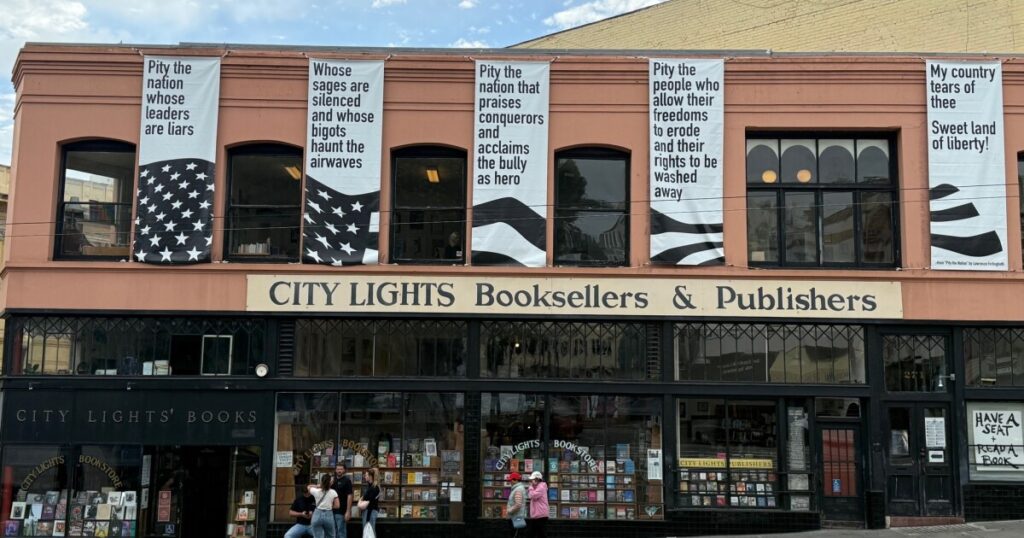
In the heart of San Francisco, a bookstore was born from a simple handshake and a modest $1,000 investment in 1953. This modest beginning laid the foundation for City Lights, a bookstore that would soon become a legendary institution known for its pivotal role in the Beat Generation and its unwavering commitment to free speech.
City Lights wasn’t just a backdrop for literary giants like Jack Kerouac and Allen Ginsberg but a thriving institution with a life of its own. NAU professor and author Gioia Woods explores this rich history in her new book, “City Lights: Lawrence Ferlinghetti and the Biography of a Bookstore.” She delves into why the bookstore’s legacy is much larger than its famous patrons.
Interview Insights
BREE BURKITT: The book’s subtitle describes it as a biography of the bookstore. What led you to focus on the institution rather than its founders or famous visitors?
GIOIA WOODS: The institution itself has a living presence, not just as a relic of the past. It’s a vibrant part of the community, both locally and globally. I wanted to highlight its ongoing significance and the need for our support.
BURKITT: The bookstore has provided a platform for writers with unconventional and subversive ideas. Can you elaborate on this role?
WOODS: Indeed, City Lights served as a sanctuary. Lawrence Ferlinghetti’s reputation was bolstered in 1956 when he published Allen Ginsberg’s “Howl,” which faced obscenity charges. In 1957, with the ACLU’s help, Ferlinghetti successfully defended the poem in court. Judge [Clayton] Horn remarked, “The book is not obscene, but in fact, it reflects what’s obscene in society at the time. It reflects the things that destroy the best parts of human nature.” These words inspired Ferlinghetti throughout his career.
Judge Horn identified key societal issues like conformity and materialism that Ferlinghetti aimed to challenge through his work and the bookstore’s mission.
BURKITT: City Lights is often associated with a specific literary movement. How does this narrow view limit our understanding of its impact?
WOODS: Focusing solely on its Beat Generation ties overlooks its broader contributions. In the 1970s, City Lights published works on ecology. The 1980s saw it addressing the AIDS crisis and in the 1990s, it commented on U.S. intervention in Latin America. Today, it tackles issues like police brutality, climate crisis, and LGBTQ+ rights. City Lights has been a cultural first responder across decades.
BURKITT: Congratulations on your book, Gioia, and thank you for sharing your insights.
WOODS: Thank you, Bree.
“City Lights: Lawrence Ferlinghetti and the Biography of a Bookstore” is now available.
—
Read More Arizona News