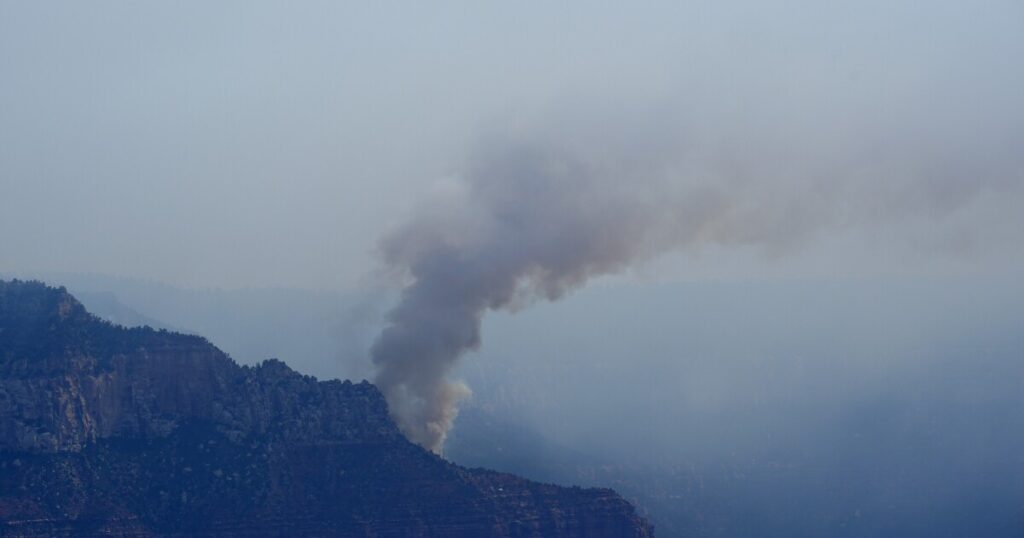
In a dramatic turn of events, a wildfire ignited by lightning has ravaged the Grand Canyon’s historic North Rim structures, including the Grand Canyon Lodge. The National Park Service is standing by its initial containment efforts, attributing the spread to sudden, unforeseen wind shifts.
The fire, known as the Dragon Bravo Fire, started on July 4 and was immediately targeted with a full suppression strategy. The Park Service detailed in an email to The Associated Press that containment lines had been established and preparations were in place to use defensive firing if necessary. Unfortunately, an unexpected and severe wind change, surpassing forecasted conditions, hampered these efforts.
Officials from Arizona, including the governor and congressional delegation, have called for an inquiry into the Park Service’s actions after the loss of the lodge and other valuable structures. Initially, the fire was managed under a “confine and contain” strategy to balance the natural role of fire with infrastructure protection.
Fire information officer Stefan La-Sky explained that the fire was unusually driven by strong nighttime winds exceeding 40 mph, a rarity due to typically higher humidity and cooler temperatures at night. “Normally, the fire ‘lays down’ at night… but this thing was really wind-driven,” La-Sky remarked.
With more favorable weather conditions, firefighters are actively working to prevent further destruction, particularly protecting critical infrastructure like a water pumping station vital to the South Rim. Meanwhile, another fire, the White Sage Fire, is burning to the north, and together the two fires have scorched over 90 square miles.
Tourists Observe the Impact
Tourists visiting the South Rim have witnessed the dramatic effects of the fire, with smoke clouding the iconic views. Christi Anderson, a visitor from California, described the scene as “crazy” and felt fortunate to have changed her reservation to avoid evacuation.
As the North Rim remains closed to visitors, efforts continue to control the fires, which are yet to be contained. “We’re always at the mercy of Mother Nature,” La-Sky noted, emphasizing the unpredictable nature of wildfire management.

Advanced Fire Management Techniques
The Grand Canyon has long been a leader in fire management, using both prescribed fires and natural wildfires to enhance forest health. Andi Thode, a fire ecology expert, praised the park’s approach, noting that repeated burns have created a “jigsaw puzzle” that helps mitigate fire impact. The Dragon Bravo Fire’s behavior was notably reduced where it intersected with previously burned areas.
The park’s fire management plan emphasizes the protection of its World Heritage Site values while prioritizing public and firefighter safety. Areas with significant infrastructure, such as the North Rim, are subject to stringent fire management policies to protect life and property.
Despite the loss of the historic lodge, the Park Service remains committed to safeguarding the park and its visitors, stating, “Firefighters are continuing to respond to this fire in the safest way possible putting their lives and the lives of the community, park visitors, and park employees ahead of buildings.”
—
Read More Arizona News