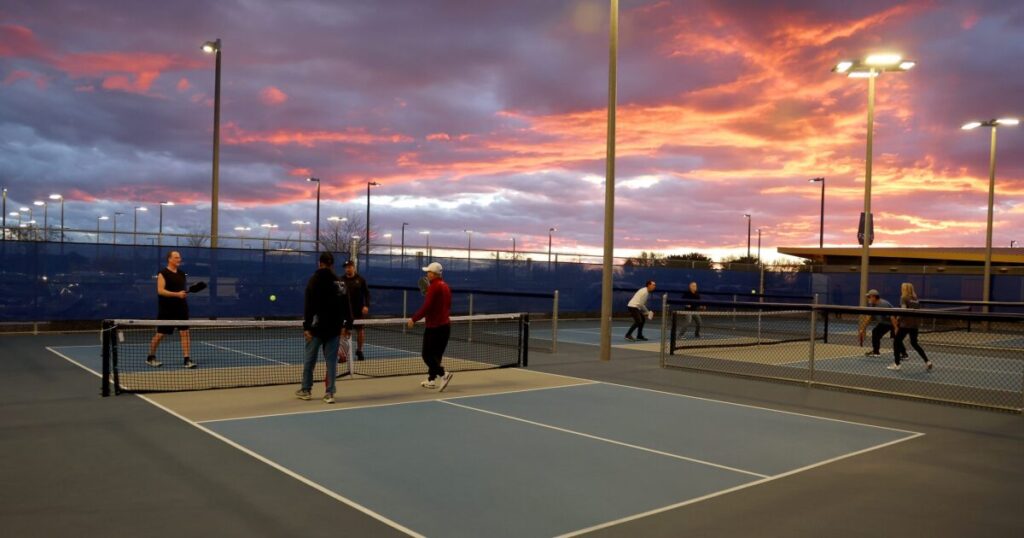
The Rise of Pickleball: A Sport for All Ages
In recreation centers worldwide, a distinct sound resonates through the air—the sharp pop of a plastic ball connecting with a paddle. This sound marks the rapid rise of pickleball, a sport that has transformed from a niche hobby into a global phenomenon.
Originating in 1965 on Bainbridge Island near Seattle, pickleball has been recognized as the fastest-growing sport in the United States for four consecutive years, according to a Sports and Fitness Industry Association study. The sport’s appeal spans generations, attracting players regardless of age, athletic ability, or socioeconomic status.
This inclusivity has led to a surge in popularity among high school athletes. Riley Palmer, director of pickleball at Mesa’s Dink and Dine Pickle Park, notes, “There are tons of high school clubs. I’m a junior competitive club coach for Monster Athlete as well, and they had over 180 kids, 18 teams. It is picking up with a lot of speed, hopefully quickly becoming an Olympic sport.”
This weekend, the facility will host its first high school pickleball state championships, featuring over 20 club teams competing in boys and girls singles, doubles, and mixed doubles. The event underscores the sport’s growing popularity, particularly among youth.
As pickleball continues to gain traction, the question arises: Will it become a sanctioned sport within the Arizona Interscholastic Association (AIA)? AIA’s director of media services, Seth Polansky, explains the process: “If the school’s been playing a sport for a certain while and they say, ‘We want to be part of the AIA oversight,’ the schools will make an application. We’ll send in an agenda item for an executive board meeting and our executive board will hear the case and see if they want to add it or not.”
Should the board approve, the sport enters an “emerging status” phase, with no sanctioned championship initially. The AIA would then monitor its progress over two years, seeking feedback from member schools before making it official.
Kenny Cail, commissioner and chairman of National High School Club Pickleball, is eager to expedite the process. He actively advocates by writing to schools, highlighting the sport’s benefits and its rapid growth at the collegiate level, where teams increased from 41 to over 250 in just one year.
Cail emphasizes the sport’s inclusivity and its potential to connect students with their schools. “You could see the kids progress,” Cail said. “They had teammates that lasted a lifetime. They had purpose in their life. The problem with sports is that it’s not there for everybody. It’s generally for only the best. And you want to make kids count. And when they count, they get connected to their schools.”
Advocating for pickleball as a coed sport, Cail notes its alignment with Title IX requirements, allowing for mixed doubles play and promoting equal opportunities for all genders. His enthusiasm is tempered by the reality that it may take several years for pickleball to gain AIA-sanctioned status. However, he remains optimistic, especially if the NCAA embraces it at the collegiate level.
Despite the current wait, the AIA has previously demonstrated a willingness to add sports quickly when participation warrants it, as seen with girls flag football in 2022.
Pickleball’s appeal lies in its accessibility and the social connections it fosters. “Creating a social group and getting to meet new people grows the sport,” says Caiden Hardy from Center Court Pickleball Club. “It just gets you out on the court.”
With its low barrier to entry and strategic gameplay, pickleball is attracting a diverse range of players. “Whether you are older or younger, you can actually play together because a lot of it has to do with where you’re placing the ball,” Palmer explains.
As pickleball continues to thrive, its community-driven growth suggests a bright future, with advocates and enthusiasts alike eager for more people to experience the sport’s many benefits. “I would just say, give it a try,” Palmer encourages. “I’ve never had anyone – and I’ve taught over 3,500 people – leave and say, ‘I didn’t like that.’”
This article first appeared on Cronkite News and is republished here under a Creative Commons Attribution-NoDerivatives 4.0 International License.
—
Read More Arizona News