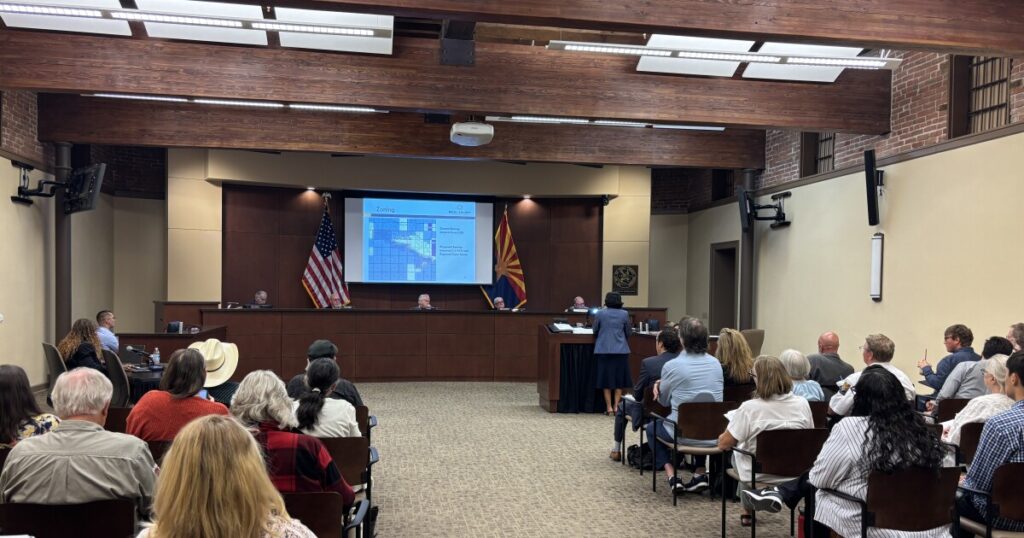
In a significant decision, Pinal County supervisors turned down the proposed La Osa Energy Center, a major project intended for development near Eloy. This ambitious proposal aimed to become one of Arizona’s largest data centers.
The project, spearheaded by developer Vermaland, included plans for 11 data center structures, a 500-megawatt natural gas facility, and battery storage systems with a total energy capacity of 1 gigawatt, enough to power a sizable city.
Despite Vermaland’s attempts to address concerns by reducing the project’s scope by 80%, imposing water use restrictions, and agreeing to cover all energy expenses, the proposal faced substantial local resistance.
Residents expressed skepticism about the motives behind the proposed reductions. Hidden Valley resident Robin Davis speculated, “Ask for more than you want and settle for what you really wanted.”
Following the last public discussion in May, Vermaland introduced 22 new conditions for development, including capping fresh water use at 600 acre-feet—almost 200 million gallons—within the data centers and natural gas plant.
While Vermaland suggested potentially offsetting water consumption by purchasing treated wastewater, no firm commitments were made. The water was to be sourced from the Central Arizona Irrigation and Drainage District, whose manager deemed the Eloy sub-basin of the Pinal Active Management Area sufficient for the project’s needs.
However, local resident Mary Eileen Flanagan highlighted existing aquifer challenges, noting, “Many of my neighbors’ wells have gone dry and require additional depth. It currently costs about $70,000 to drill a well to 900 feet. The problem is, for many, water is at 1,200 feet.”
Another concern was the project’s energy requirements. Vermaland associate Robert Clang revealed that 500 megawatts of natural gas had been secured, but additional energy would have to be sourced from nearby solar facilities or the Palo Verde nuclear station, over 100 miles away.
Supervisor Jeffrey McClure questioned the feasibility of this plan, mentioning that much of the local solar power is already allocated. “My understanding is that’s dedicated to some other companies,” he remarked.
Since last September, La Osa Energy Center has been under county evaluation. The Planning and Zoning Commission initially approved a comprehensive plan envisioning 59 data centers requiring 3 gigawatts of energy.
Nevertheless, Planning and Zoning Commissioner Karen Mooney pointed out that earlier applications lacked complete data and accurate projections for jobs and economic impact.
Community members like Florence resident Mark Seidel are now urging county officials to establish stricter guidelines for future projects. Seidel stated, “I don’t want an incomplete and hastily built and ever-changing proposal. I don’t want stipulations that are unenforceable or not enforced. I don’t want promises from a lawyer or seller that have no meaning after the sale. I don’t want a county code structure ignorant of data center specifics.”
The proposal was rejected with a 4-1 vote. Supervisor Stephen Miller, who opposed the decision, argued that it contradicted free market principles and the U.S. Constitution, questioning the widespread opposition to such developments. “Individuals have a right to use their property the way they want,” he asserted.
Pinal County’s zoning code currently lacks specific regulations for data centers, with the 33 stipulations approved by the Planning and Zoning Commission primarily addressing basic landscaping and setback requirements.
—
Read More Arizona News

![Botched Ad Mix-Up: Super PAC Error in Arizona Congressional Race[embed]https://www.youtube.com/watch?v=bEMgIlCkHz0[/embed]](https://www.kitchentablenews.org/wp-content/uploads/2026/10/Botched-Ad-Mix-Up-Super-PAC-Error-in-Arizona-Congressional-RaceembedhttpswwwyoutubecomwatchvbEMgIlCkHz0embed.com2F0e2F962Fe971102f49e7a4f2a64fd3cc60a22Fjonatha.png "Botched Ad Mix-Up: Super PAC Error in Arizona Congressional Race[embed]https://www.youtube.com/watch?v=bEMgIlCkHz0[/embed]")