Climate Change Threatens Pinyon-Juniper Forests Across the Western US
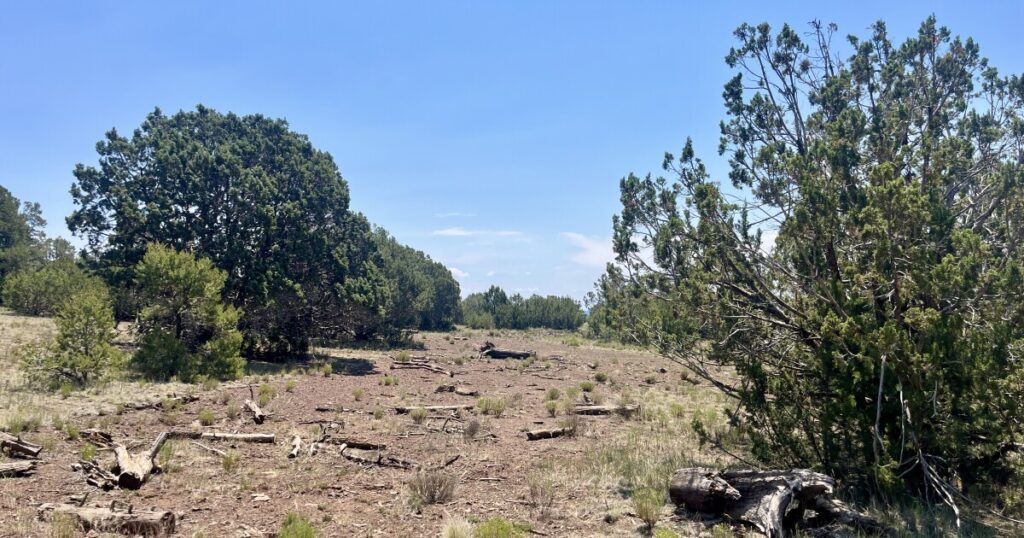
Pinyon-juniper forests, known for their resilience in arid conditions, are facing unprecedented challenges due to climate change. These ecosystems, prevalent in the western United States, are experiencing significant stress, leading to increased tree mortality.
Researcher Kyle Rodman from Northern Arizona University’s Ecological Restoration Institute discussed these changes in a conversation with KNAU’s Adrian Skabelund, set against the backdrop of a pinyon-juniper forest near Flagstaff.
KYLE RODMAN: “What we’re seeing generally is that there was a huge amount of dieback and die off in the early 2000s, particularly of pinyon pine. Eighty percent, or four out of five trees, have died since the late 90s in a lot of these places.”
Rodman explains that this gradual die-off over decades might go unnoticed by those unfamiliar with the area. However, the phenomenon is significant, with the current tree mortality rate exceeding the typical ‘background mortality’ rate, which ranges from zero to 1%.
Despite pinyon pine and juniper being adapted to survive in dry conditions, the recent warm and dry climate has been harsher than what these species have historically endured. Over the past century, temperatures have risen by a few degrees, further stressing the trees.
Skabelund questioned the varying impacts on different species within these forests. Rodman noted that pinyon pine has been more adversely affected by drought conditions compared to juniper, which remains more resilient, particularly larger trees.
In areas around Flagstaff and New Mexico, the shift towards juniper dominance is evident. While juniper trees continue to thrive, up to 90% of pinyon pines have perished in certain areas since the early 2000s.
Looking ahead, Rodman predicts a gradual decline of these forests over the coming decades. “The last 30 years might be the best climate that we’ll see for the rest of our lives,” he reflects, suggesting that proactive forest management and relocation of species might be necessary strategies.
While discussing the role of human intervention, Rodman emphasizes the importance of stewardship in mitigating the damage humans have contributed to these ecosystems.
Though the price of gas at the pump is falling, it’s still roughly $1 higher in Arizona than it was a year ago, due in part to the war with Iran. That’s putting a squeeze on the river rafting economy.
—
Read More Arizona News


![Jody White’s Unconventional Michigan Supreme Court Candidacy Explored[embed]https://www.youtube.com/watch?v=8NfxFIPE4ac[/embed]](https://www.kitchentablenews.org/wp-content/uploads/2026/10/Jody-Whites-Unconventional-Michigan-Supreme-Court-Candidacy-Exploredembedhttpswwwyoutubecomwatchv8NfxFIPE4acembed.com2F842F0e2Fc7223daa43c9876b36a4e00773a42Fme-supc.png "Jody White’s Unconventional Michigan Supreme Court Candidacy Explored[embed]https://www.youtube.com/watch?v=8NfxFIPE4ac[/embed]")