U.S. Supreme Court Upholds Penalties Against Lawyers Challenging Arizona Voting Machines
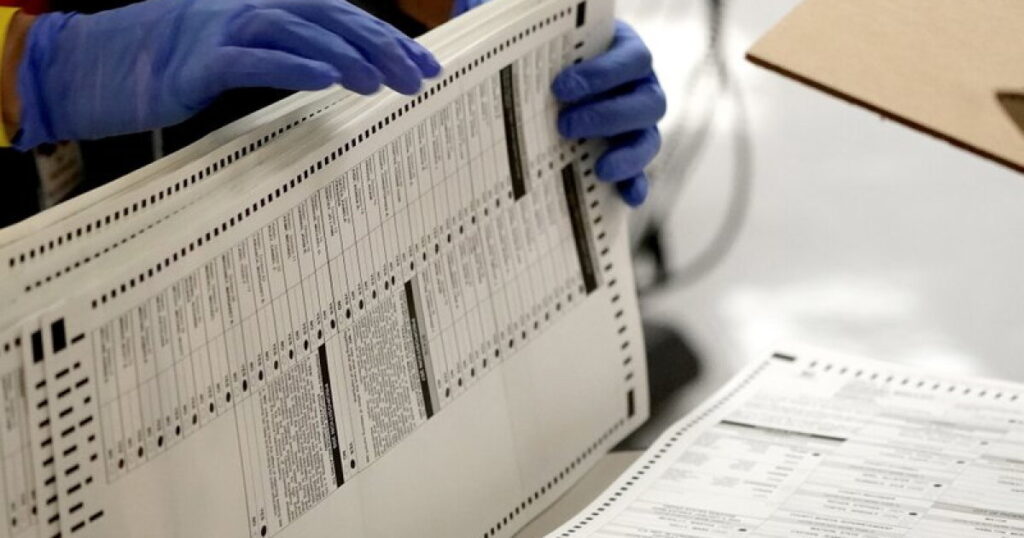
The U.S. Supreme Court has declined to overturn financial penalties imposed on an attorney representing Kari Lake and Mark Finchem, who challenged the reliability of voting machines in Arizona. This decision comes as a reinforcement of a lower court’s ruling that deemed the lawsuit “frivolous.”
Andrew Parker, the attorney involved, faced sanctions after U.S. District Court Judge John Tuchi determined that claims made about the machines’ inaccuracy were speculative and not substantiated with concrete evidence. The judge criticized the lawsuit as politically motivated, given its timing just before the 2022 elections.
Judge Tuchi emphasized the importance of deterring similar future lawsuits, stating, “It is to make clear that the court will not condone litigants … furthering false narratives that baselessly undermine public trust at a time of increasing disinformation about, and distrust in, the democratic process.”
The 9th Circuit Court of Appeals upheld these penalties, reinforcing the view that the lawsuit not only lacked merit but also misled the public, contributing to unnecessary concern about election integrity.
Lake and Finchem, who were candidates in the 2022 election—Lake for governor and Finchem for secretary of state—pushed for a manual counting of paper ballots, arguing it was the only secure method. However, their claims were dismissed, and both lost their respective races.
Arizona Secretary of State Adrian Fontes reassured voters that mail voting would continue unaffected by the Supreme Court’s decision. Read more.
The lawsuit’s rejection by the Supreme Court was anticipated after the 9th Circuit’s decision, which wasn’t unanimous. Appellate Judge Patrick Bumatay expressed concern that such sanctions could hinder legal advocacy, stating, “By sanctioning parties and their lawyers for bringing debatable, long-shot complaints, courts risk chilling legal advocacy and citizens raising ‘questions’ under the guise of defending the rule of law.”
The attorneys representing Lake and Finchem were criticized for not adequately researching the facts before filing the lawsuit. Judge Tuchi pointed out that a reasonable inquiry would have revealed publicly available information contradicting their claims. “Thus, plaintiffs either failed to conduct the reasonable factual and legal inquiry required (under court rules), or they conducted such an inquiry and filed this lawsuit anyway,” he wrote.
In the aftermath of the 2022 elections, Lake and Finchem pursued different political paths. Lake, after losing her gubernatorial bid, ran unsuccessfully for the U.S. Senate. Finchem relocated and was elected to the state Senate representing Prescott.
The decision underscores the judiciary’s stance against baseless election-related lawsuits and highlights the challenges of maintaining public confidence in electoral processes.
—
Read More Arizona News