This story was originally published by Outlier Media. Sign up for Outlier’s newsletter.
This story is part of Beyond Repair, a series on Detroit’s home repair crisis — and what the city stands to lose if it doesn’t take action. Read all the reporting.
Detroit Faces Critical Home Repair Challenges Amid Limited Funding
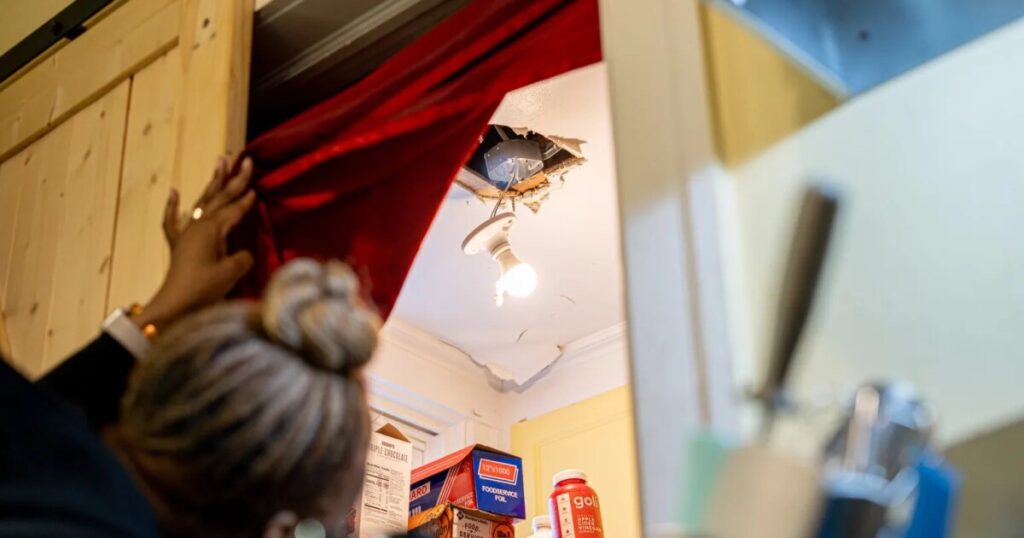
In a city grappling with significant home repair needs, Jennine Spencer-Gilbert’s story is emblematic of the challenges many Detroit homeowners face. Living on the eastside, Spencer-Gilbert is confronted with a crumbling foundation, a leaky roof, and outdated electrical systems. The cost of these repairs runs into tens of thousands of dollars, a burden she cannot shoulder.
Despite her efforts, Spencer-Gilbert, at 55, finds herself in a funding gap—too young for senior grants and earning too much for income-based programs, yet not enough to afford the repairs independently. “It always gets to — ‘the money is gone, we’re gonna get back to you’ on this, that and the other,” she lamented. “Continuously.”
Detroit’s home repair needs surpass $1 billion, yet the available funding falls woefully short. Currently, no city-run repair programs are accepting applications, though a new initiative targeting “critical” issues is anticipated to launch in March.
In 2024, Detroit allocated over $63 million to home repair programs, buoyed by a one-time American Rescue Plan Act infusion. However, current fiscal spending is just over $20 million, highlighting the impending funding challenges. Heather Zygmontowicz, senior housing advisor for the city, acknowledges the complexity, stating, “We want to believe that this can be solved in a year or two. But the fact of the matter is that this is a crisis that was created over decades.”
‘I Can Breathe’
For residents like Mary Solomon, timely assistance has been a lifeline. Solomon, who inherited her Dexter-Linwood home in 1998, faced mounting maintenance issues, worsened by a lupus diagnosis in 2017. After a series of floods in 2021, she feared she might have to leave her home.
Her fortunes changed with the help of the Detroit Home Repair Fund, which facilitated extensive repairs costing nearly $30,000. “I can breathe, literally and figuratively,” Solomon expressed with relief, as her home was transformed with a new roof, mold remediation, and updated utilities.
This grant program, supported by $20 million from the Gilbert Family Foundation, ProMedica, and DTE Energy, has aided nearly 700 households since 2022, with plans to reach 1,000 homes.
The streamlined process of this program contrasts sharply with the typical homeowner’s experience of navigating disparate repair funds with varying applications and eligibility criteria. Efforts are underway by the city’s Home Repair Task Force, consisting of nearly 50 organizations, to align these programs and simplify access.
Zygmontowicz emphasizes the importance of demonstrating the impact of home repairs to attract further funding, stating, “How do we get more money in to address a problem that we know is so large? I truly believe that we can’t do that unless we have a baseline understanding.”
Who Will Benefit?
Homeowners like Spencer-Gilbert, who have remained steadfast through Detroit’s economic challenges and foreclosure crises, risk losing their homes without repair aid. Having rescued her home from tax foreclosure, she fears selling may become her only option without support.
As property values rise, these homes represent a potential for generational wealth, a rare opportunity in a city that has endured significant economic hardships. However, if current residents are forced to sell, the benefits may accrue to new investors. Alex Alsup of property data firm Regrid highlights the issue, noting, “The question is, who gets the return on investment? Because the homes are going to be fixed up regardless after the private market steps in.”
This article first appeared on Outlier Media and is republished here under a Creative Commons Attribution-NonCommercial-NoDerivatives 4.0 International License.
—
Read More Michigan News