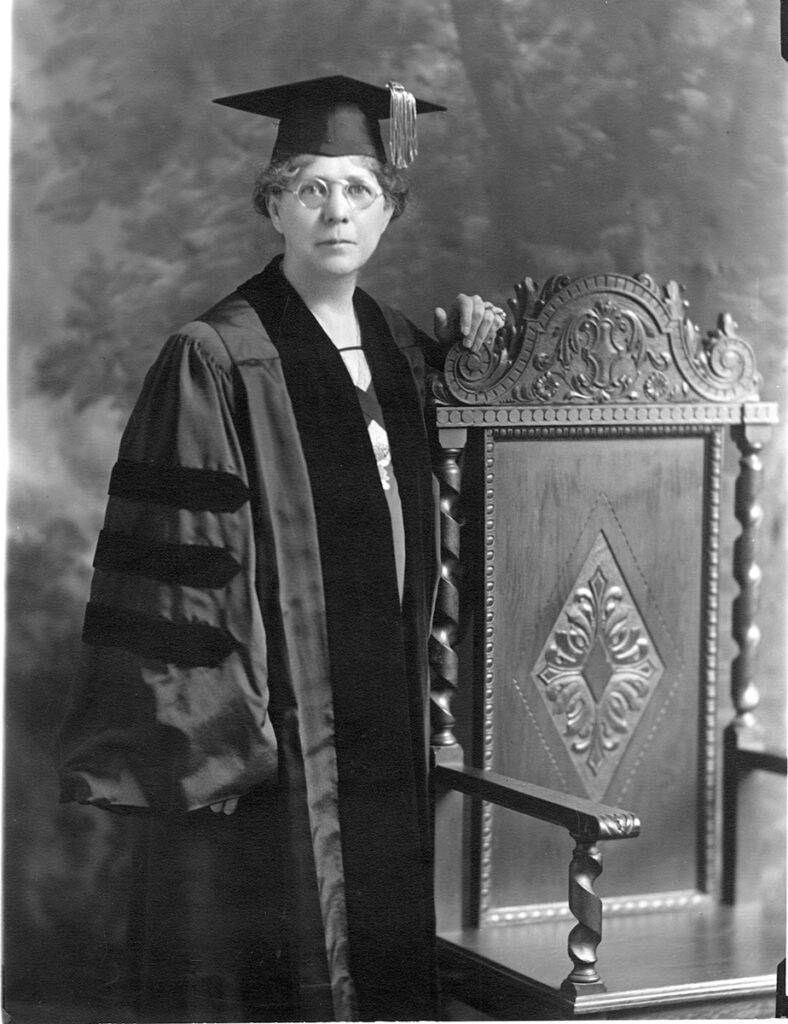
The University of Michigan, established in 1817 in Detroit, had an exclusively male governing board for nearly a century. It wasn’t until 1929 that Esther Marsh Cram, a 57-year-old alumna, became the first woman appointed to the Board of Regents. She filled the vacancy left by Benjamin S. Hanchett, after being selected by Gov. Fred W. Green, a fellow Michigan graduate.

Green explained, “The women of Michigan rightly feel that they are entitled to representation on the Board of Regents of our university. Over 2,500 women are attending the university, and surely there are problems connected with their attendance that will be settled best with the advice of a woman alumnae on the Board of Regents.” He added that Mrs. Cram would be a capable and intelligent regent.
Women had been admitted to U-M since 1870. Cram, originally Esther Hewitt Marsh, followed her father, Augustus, who graduated in the mid-1800s. After graduating in 1898, she taught history at Michigan high schools before resigning in 1909 to focus on family. “I consider this appointment as a great honor to the womanhood of Michigan,” Cram remarked.
Cram joined at a pivotal moment; President Clarence Cook Little resigned in early 1929, and Alexander G. Ruthven was acting as dean. Her first vote was to elect Ruthven as U-M’s seventh president unanimously. She also joined the Michigan League Board of Governors, collaborating on appointing a new dean of women.
Her term lasted until 1935, after which Michigan voters elected her to another eight-year term. She resigned in 1943 due to health issues. Her dedication was commended by her peers, who noted her deep commitment to the university and its women students. They highlighted her loyalty and active involvement in alumnae and women’s organizations.
—
Read More Michigan News