Welcome to the It’s Just Politics newsletter. Subscribe here to receive it in your inbox, and tune into the It’s Just Politics podcast for weekly political updates.
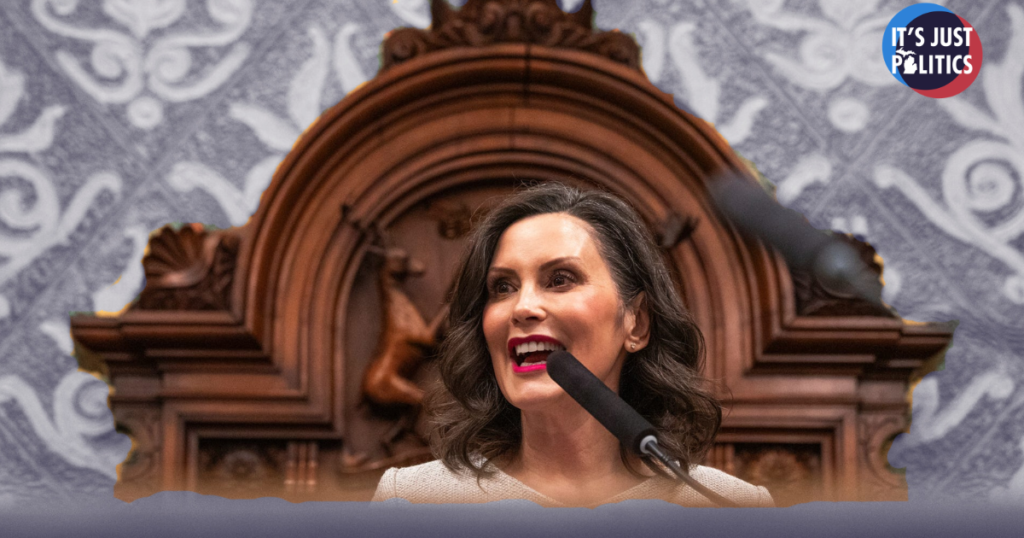
Governor Gretchen Whitmer is set to traverse Michigan, promoting her initiatives following her State of the State address earlier this week. In a conversation with Rick Pluta, she discussed her main priorities and the experience of delivering her final address in a familiar venue. Here’s a glimpse of their exchange:
Rick Pluta: Governor Whitmer, thanks for joining us.
Governor Gretchen Whitmer: Thank you.
RP: With ten months remaining in your term, you emphasized affordable housing, health care, and literacy in your address. Given the current political dynamics and a divided Lansing, how much of your agenda do you anticipate accomplishing?
GW: All of it, Rick. All of it. I’m not going to settle for anything less. Listen, people in Michigan need us to stay focused on the things that matter to them. And I know we’ve got a Republican House and a Democratic Senate. I know that it’s an election year and rhetoric is hot coming out of Washington, D.C., but I also know this: the people of Michigan expect us to work hard, deliver on the things that they care about. And I selected three things that, number one, are important for the people of Michigan. Number two are crucial for the economy of Michigan. And number three are not inherently political. We should be able to find common ground around literacy and affordable housing and keeping healthcare affordable. I think every constituency in every part of the state would love for us to make ground on all three of those fronts, so I’m optimistic about our ability to do it.
RP: You highlighted the importance of LGBTQ+ protections in Michigan’s civil rights law. Why was this a specific focus in your speech?
GW: Well, it’s a big part of the work that we’ve done in these last seven years. So is making sure that women have access to abortion care and can make their own decisions about their bodies. So is making sure that people of color aren’t discriminated [against] based on how they wear their hair. Our gun violence prevention work that [we did] when we had the trifecta. You know, common sense things like background checks and our extreme risk protection orders, these are great things that we accomplished, that were things that we fought to get done for a long time. We got them done. And I wanted to highlight that. Michigan, the best part of Michigan is the people who call it home, all the people. And so that was why I lifted those things up, highlighted it, and we’ll continue to protect that work.
RP: In your address, you expressed gratitude towards President Trump. Could you elaborate on why?
GW: Well, you know, the work that we did to recapitalize Selfridge, it’s really important for national security, for our defense ecosystem, for all the men and women who do work on that base. Under many administrations, our congressional delegation tried to get a commitment to recapitalize. I was able to get it done working with the members in our delegation and President Trump. And I thought that that was important to lift up. You know, I disagree with the president on, you know, probably 95% of the things that he champions. And yet, if I can find common ground on something that benefits the people of Michigan, I’m going to do it and I’m going to make sure to share credit.
RP: Let’s talk legacy. You mentioned your accomplishments over the past seven years. How do you view your legacy as governor?
GW: You know, it’s always a funny question. I don’t even know how to answer that. I can just tell you this: I’m not thinking a lot about legacy per se. I’m thinking about an agenda that improves the quality of life for the people of Michigan, strengthens our economy, helps people keep money in their pockets. We’ve delivered on a lot of good stuff that I highlighted, but it’s a very real moment for a lot of folks in our state. They need us to continue the work. And so whether it is affordable housing or helping people with health care, we know that the cuts coming out of Washington, D.C., and the tariffs from the administration in Washington, D.C., have had a real hard impact on people, on our pocketbooks and on our state in particular. And so we’ve got to do everything we can at the state level to mitigate that. And that’s what I’ll continue to stay focused on. And people will define the legacy in the coming years. But right now, that’s not my primary concern.
RP: Governor, you delivered that speech from the rostrum of the state House, where you started your political career – at least the elected portion of it. What was it like being up there and looking out at the room in that moment?
GW: You know, it’s bittersweet, Rick. I sat as a freshman legislator watching John Engler give his last two States of the State. I sat through all eight of Governor Granholm’s and four of Governor Snyder’s when my time in service overlapped with his. It was an honor to stand at the rostrum and give my speech last night. It also made me reflect on my dad, who I lost last month, and it was really hard. He was the one who encouraged me to learn about state government and apply for an internship in the House of Representatives when I was in college at Michigan State, just down the road. So it was one of those moments that, for me, was about gratitude. And the people of Michigan always center the work that I do and my family drives me. So it was a bittersweet moment, but certainly I was pleased to be standing there and grateful to the people of Michigan for the opportunity.
RP: Governor Gretchen Whitmer, thank you so much for your time.
GW: Thank you Rick.
The conversation was edited for length and clarity.
_______________________
Have questions about Michigan politics? Or, just want to let us know what you want more of (less of?) in the newsletter? We always want to hear from you! Shoot us an email at politics@michiganpublic.org!
_______________________
What’s in the proof-of-citizenship and voter ID ballot proposal, and what is the state of the state budget as Governor Whitmer prepares for her final State of the State address.
_______________________
What we’re talking about at the dinner table
Something special: Much of Whitmer’s 2026 agenda will have to be approved by a Legislature divided between a Senate controlled (for now, at least) by Democrats and a House run by Republicans. Whitmer has shown some knack for bipartisan deal-making with the House GOP leader, but it sure helps to have the Senate majority (mostly) with her. So, there’s a lot riding on the 35th Michigan Senate District special election, including how Whitmer’s final months in office play out. Saginaw Fire Captain Chedrick Greene is the Democratic nominee facing attorney Jason Tunney on the Republican side of the ballot. The results of the May election to fill the mid-Michigan swing seat vacancy will determine whether the Senate goes the rest of the year with a 20-18 Democratic majority or a 19-19 tie. The winner of that race will start in reelection mode and will no doubt be called on to make some early, tough votes. (More on that in #2)
Taxing choices: Republican House Speaker Matt Hall set up one of the biggest political debates of 2026 with his conceptual rollout of how to pay for a property tax relief plan (which has yet to be shared in the form of actual legislation). First of all, leave it to the stage-stealing GOP leader to launch a plan as Whitmer was about to deliver her final State of the State address. Also, this will not only help set the parameters of the debate, it allows Republicans (who climb onboard) to burnish their populist cred with a soak-the-rich “luxury tax.” If/when, this makes its way through committee to the floor, expect a lot of amendments designed to force vulnerable incumbents into roll call votes that could be turned into campaign fodder. Governor Whitmer, who will not be on the ballot this year, said she finds the concept, at least, intriguing. “To have a speaker of the House put up about $5 billion in different taxes on the table is kind of remarkable,” Whitmer told Senior Capitol Correspondent Tim Skubick on WKAR-TV’s Off The Record. “So, I’d like to see where he wants to go with it.” (Rick and Zoe are both on the OTR panel this week to provide some analysis on the week in political news.)
Who’s next: In the midst of all of this, there’s a lively gubernatorial campaign underway. The folks who want Whitmer’s job include Secretary of State Jocelyn Benson, State Senate Minority Leader Aric Nesbitt, Congressman John James, and former Michigan Attorney General Mike Cox. They were among those in the audience during Whitmer’s address and no doubt envisioning themselves in the role. We, ourselves, will be taking the stage with invited guests (and a few pints) this coming Wednesday evening. At our first Issues & Ale of this election year, we will be talking about the gubernatorial campaign (plus, so much more). We want to see you there and answer your pressing politics questions! Free in-person seats are filling up so be sure to register to attend (you can also join virtually!) See you next week in Farmington!
_______________________
Yours in political nerdiness,
Rick Pluta & Zoe Clark
Co-hosts, It’s Just Politics
_______________________
IJP On the Road
Zoe and Rick are both on WKAR’s Off the Record panel this week to provide some analysis on the week in political news.
Also, join them in Farmington for the first Issues & Ale of the year!
—
Read More Michigan News