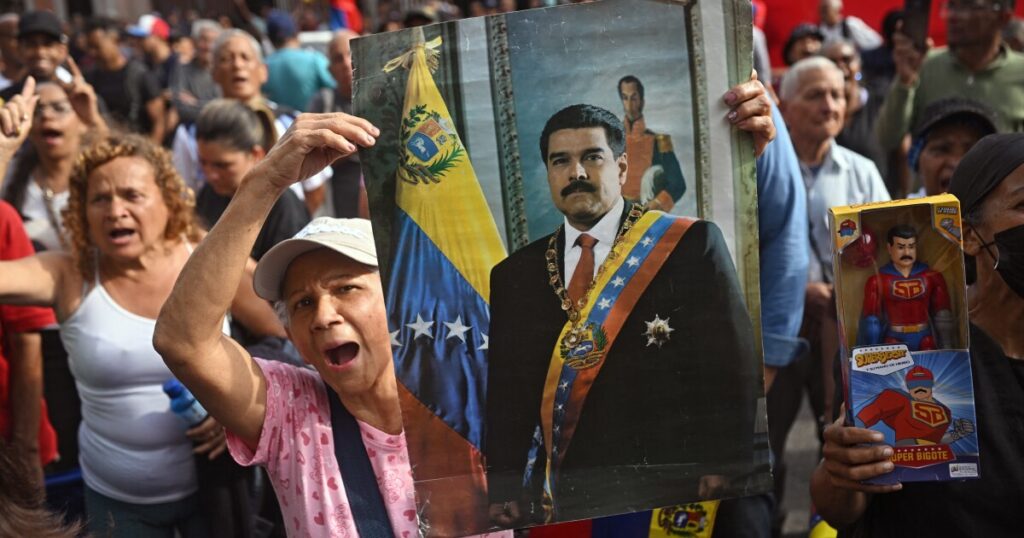
As former Venezuelan President Nicolás Maduro finds himself on American soil, the legal proceedings against him have commenced in earnest.
During his initial court appearance in Manhattan, New York, Maduro entered a not guilty plea to four charges: narco-terrorism conspiracy, cocaine-importation conspiracy, and possession of and conspiracy to possess machine guns.
Accompanying him in court was his wife, Cilia Flores, who was similarly charged in the superseding indictment and apprehended alongside Maduro during a Saturday morning raid in Caracas. She too pleaded not guilty.
U.S. Attorney General Pam Bondi declared over the weekend that both Maduro and Flores “will soon face the full wrath of American justice on American soil in American courts.”
This marks the beginning of what is likely to be a protracted legal journey involving pretrial motions, possible plea discussions, and perhaps a jury trial for the Venezuelan leader who governed the country for over a decade.
Shane Stansbury, who has experience prosecuting international leaders, highlighted that while the case is expected to follow the general pattern of criminal proceedings, its unique elements could prolong the process. Security concerns and the nature of the evidence are among the factors that might contribute to delays, according to Stansbury, now part of Duke University School of Law.
Experts predict these complexities may prevent Maduro’s trial from occurring this year, even as the case progresses. Here’s what to keep an eye on.
Maduro’s Status as a Former Head of State
Maduro’s defense might argue that his actions as Venezuela’s head of state should not be subject to criminal charges. Two former federal prosecutors indicated this possibility in conversations with NPR.
Barry Joel Pollack, a lawyer based in Washington, D.C., represents Maduro, though he hasn’t commented on the charges. Flores’s defense attorney, Mark Donnelly from Houston, expressed readiness to scrutinize and contest the government’s evidence, acknowledging a “long road ahead.”
The U.S. ceased recognizing Maduro as Venezuela’s legitimate leader in 2019, after his contentious reelection. Maduro assumed power in 2013 following Hugo Chávez’s death. (The indictment alleges Maduro’s involvement in drug trafficking into the U.S. started in 1999, spanning his different roles in Venezuela’s government.)
There is precedent for the U.S. prosecuting foreign leaders, such as the early 1990s case against Panamanian dictator Manuel Noriega, where a federal appeals court dismissed Noriega’s head-of-state immunity claim. Yet, Adam Fels, a former assistant U.S. attorney now in private practice, anticipates similar challenges may arise again.
“I imagine those challenges, while they have already been litigated before, will be litigated again,” Fels stated.
Other national leaders prosecuted by the Justice Department include former Guatemalan President Alfonso Portillo for money laundering and former Honduran President Juan Orlando Hernández, convicted on drug trafficking charges and pardoned by President Trump last month.
During his court appearance, Maduro identified himself as Venezuela’s president and a prisoner of war.
Legal Concerns Over Maduro’s Arrest
Maduro’s capture, executed by the U.S. military in Caracas without formal extradition, might provide another angle for defense arguments. Legal experts suggest this could form the basis for a challenge.
Fels referenced the case of Mexican cartel leader Ismael “El Mayo” Zambada, who ended up in U.S. custody under similar contentious circumstances, to illustrate potential legal complications.
“There was a challenge because there was a concern about whether or not Mr. Zambada went to the United States on his own free will and accord,” Fels noted. “So I imagine that litigation will also at least be something that Judge [Alvin K.] Hellerstein, who is the judge in this case, will be considering.” (Zambada pleaded guilty to drug trafficking charges last year.)
However, overcoming such challenges may prove difficult. According to Stansbury, federal courts have “generally declined to interfere with the means of arrest.”
Implications of Classified Evidence

The discovery phase of Maduro’s case might face delays due to the potential inclusion of classified evidence, as noted by Stansbury. The origin of some evidence from intelligence sources could further complicate matters.
“The government may not want to use any classified information at trial, but that doesn’t mean that the government doesn’t have an obligation to turn over some classified material potentially if it’s exculpatory or otherwise is discoverable under the federal rules,” he explained.
The Classified Information Procedures Act (CIPA) outlines the use of classified evidence in court, potentially extending pretrial proceedings. CIPA was similarly applied in Trump’s classified documents case.
Possibility of a Plea or Trial
Despite Maduro’s not guilty plea, there remains an opportunity for negotiation between prosecutors and the defense to reach a plea agreement.
Legal experts pointed out that the machine gun charges, which carry severe penalties, might influence Maduro to consider a plea.
Should the case proceed to trial, prosecutors will need to meticulously prepare, potentially involving witness interviews and evidence compilation. Fels, who led the prosecution of El Chapo in 2019, emphasized the importance of assembling a coherent case for the jury.
“There was a substantial amount of evidence in the Chapo case. I would like to think that there’s substantial evidence in this case as well, given the efforts that were undertaken by the United States government to obtain and bring [Maduro] to justice,” Fels remarked. “The question is going to be: How do you put these allegations together and prove them with witnesses and documents in a way that will make sense to a jury?”
Copyright 2026 NPR
—
Read More Michigan News