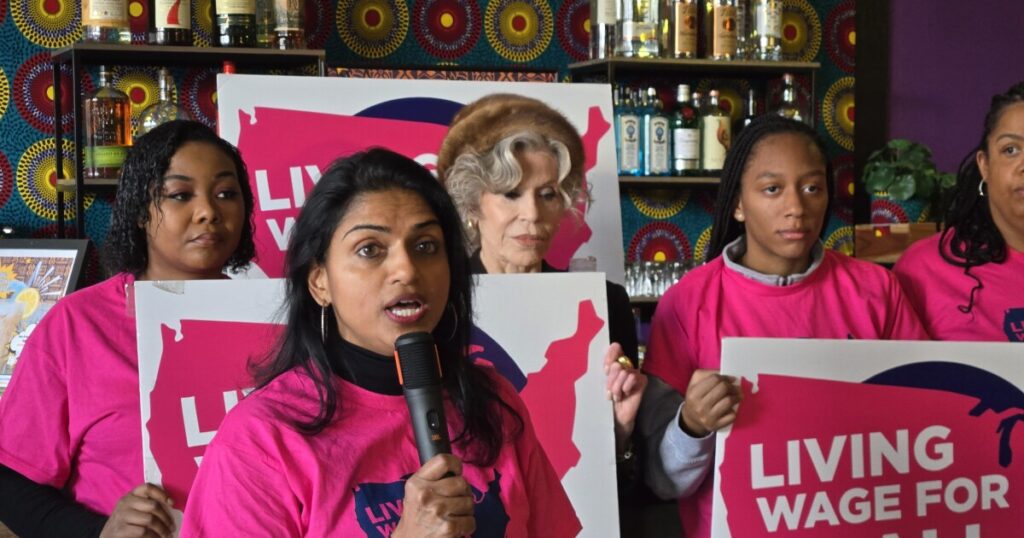
In a move that could reshape Michigan’s wage landscape, campaigners are intensifying efforts to overturn a newly enacted minimum wage law. Last Friday, actress and activist Jane Fonda joined the initiative, participating in events across southeast Michigan to rally support.
The law in question, passed in February, plans to increase Michigan’s minimum wage to $15 an hour by next year. However, it also stipulates that tipped employees, such as servers and bartenders, may be compensated at half this rate, with the full implementation set for 2031.
This legislation replaces a previous policy intended to incrementally raise the minimum wage, establishing a standard base pay for all workers, inclusive of those receiving tips. One Fair Wage, the group advocating for the referendum, aims to reinstate this original policy, having championed higher pay rates for years. Tameka Ramsey, the group’s Michigan state director, emphasized the need for fair wages.
“When you have billionaires taking space trips for fun but you can’t pay people a living wage, we’re fighting to make sure that everyone, tipped workers, hourly workers are getting their fair share and nobody has to work two or three jobs in order to take care of their family,” Ramsey stated at a Detroit event.
If successful, the referendum would enable voters to reject the 2025 law, reverting to the initial policy. To appear on the ballot, One Fair Wage must gather a minimum of 223,099 signatures by March 24. The group is targeting 300,000 signatures to ensure a buffer for possible invalid entries, having collected around 50,000 to date.
Should One Fair Wage secure a spot on the ballot, the 2025 law’s implementation would be delayed pending voter decision. John Sellek, representing a coalition of hospitality businesses and workers who supported the law, warned of the potential financial impacts.
“Increased costs for anybody (are) a problem because everyone is suffering from higher costs in everything that they buy. Restaurants are no different. If wages continue to be artificially changed in a way that restaurants can’t handle, there’s no secret pot of money to pay that with,” Sellek explained.
Decade-Long Debate Over Tipped Wages
The discussion over whether tipped workers should receive a full or partial base wage, supplemented by tips, has persisted in Michigan for nearly a decade. In 2018, One Fair Wage gathered enough signatures to propose the issue on the ballot, only for the Republican-majority legislature to adopt and amend the proposal, enacting a diluted version before it reached voters.
In 2024, One Fair Wage triumphed in a legal battle when the state Supreme Court declared the legislative maneuver unconstitutional. Despite this, businesses and hospitality workers expressed concern over the ruling’s implications, prompting the state Legislature to revise the law again before it was enforced.
Saru Jayaraman, president of One Fair Wage, criticized this outcome, stating, “Restaurant workers have led the fight for $15, for a living wage for all workers in Michigan and have been at the forefront of that. So, for them to be the ones cut out, is grossly unjust and unfair.”
On the other hand, State Senator Kevin Hertel, a sponsor of the 2025 minimum wage law, defended the legislation by highlighting the feedback from small business owners and restaurant workers who supported maintaining a lower tipped wage.
“We met with small business owners, we met with the employers, we understood the effect that it would have, and we increased the wages so that everybody is making more without creating that entire shock to the system that we think would have a pretty dramatic impact,” Hertel remarked.
The 2025 law accelerates the timeline for overall minimum wage increases more rapidly than One Fair Wage’s original proposal, potentially reducing the current minimum wage rate for non-tipped workers temporarily if the referendum succeeds.
One Fair Wage and Save MI Tips, a hospitality industry coalition, continue to contest each other’s foundational support. Save MI Tips has accused One Fair Wage of being largely influenced by out-of-state interests, with Sellek urging them to respect Michigan’s 2025 law.
“To intentionally seek to disrupt a major compromise that was years in the making that took place between Democrats, Republicans, and the governor last February is incredibly selfish and self-serving,” he noted.
Conversely, One Fair Wage argues that their opponents rely heavily on funding from affluent restaurant chains. Fonda highlighted the opposition they have encountered, asserting, “The fact that our opponents are so set on destroying what we’ve tried to do which is to allow people to earn a livable wage and have some dignity. What this tells us is this is an important issue. This is a foundational issue.”
—
Read More Michigan News