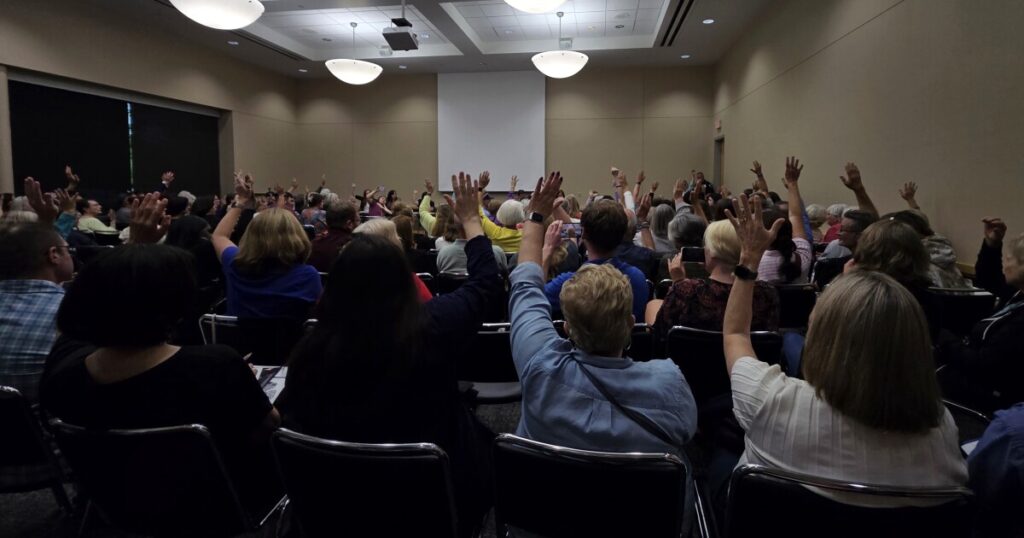
In a crowded community center in Troy, Michigan, residents gathered to express their apprehensions over the newly enacted federal budget, which has sparked a heated debate. The law, known as the One Big Beautiful Bill Act, spans over 850 pages and significantly impacts social services and fiscal policies.
The legislation encompasses key elements of former President Donald Trump’s policy agenda, including the amplification of tax reductions from his initial presidential term and heightened expenditures on border security and immigration detention facilities. However, the primary focus of attendees at the town hall was the reduction in funding for essential social service programs such as Medicaid and food assistance.
Angela Martin, a local resident, shared her concerns at the event, emphasizing the difficulty of managing daily life amidst the uncertainty surrounding crucial programs for her loved ones. “I have to say it’s pretty exhausting after a while but I don’t think people can give up. Because, at some point, the voice of the people is going to be heard, and it’ll have an impact. At least we have to believe that, right?” she remarked following the forum.
Advocates of the bill, primarily from the Republican Party, argue that it aims to eliminate superfluous government expenditure and stimulate economic growth through tax cuts. “Tipped and shift workers will no longer pay taxes on tips or overtime. Our border will be far more secure and criminal illegal aliens will be removed from our communities. The American military will be even stronger. And taxpayers will finally see better value for their dollars as wasteful programs and fraud are cut out of the budget,” stated Michigan House Speaker Matt Hall (R-Richland Twp) in a press release last week.
Conversely, opponents of the bill caution that it may result in significant reductions in support for vulnerable populations, affecting services like adult foster care and disability support. State Representative Sharon MacDonell (D-Troy) expressed concern over the state’s inability to compensate for the federal cuts, noting, “Last term I remember hearing that we had a $2 billion rainy day fund and I thought, ‘My gosh, that’s so much money. That’s wonderful.’ That’s not nearly enough to cover what we are going to lose with these Medicaid cuts and all these other cuts.”
During the meeting, Senator Mallory McMorrow emphasized the outdated nature of the state’s revenue strategies, highlighting, “We’ve been operating [with] the same revenue, adjusted for inflation, since 1968. If we were able to cut our way to prosperity, we would have been able to do that by now.”
The exact approach that state lawmakers will adopt to reconcile the federal budget with the upcoming state budget remains uncertain. Despite a statutory deadline of July 1 for passing the state budget, lawmakers adjourned for an extended Fourth of July break without finalizing it, leaving many questions unanswered about the future financial landscape. More information about the legislative delay can be found here.
—
Read More Michigan News