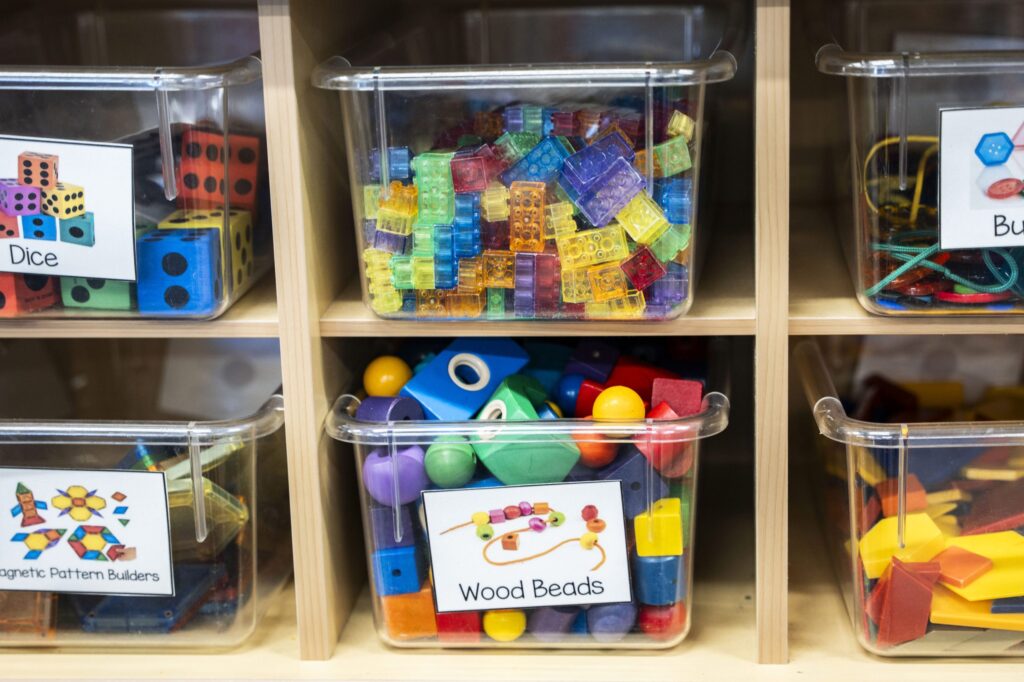
CORINTH, Miss. — At Corinth Elementary, Vaughn Dodd, a four-year-old pre-K student, is building a rocketship with Magna-Tiles, recognizing complex shapes like rhombuses and circles. While her proficiency with these translucent plastic shapes may not directly lead to a career in Mississippi’s aerospace industry, it lays a solid foundation for math-related fields.
Kayla Wood, Vaughn’s teacher, integrates math into daily activities without relying on traditional worksheets. Instead, students use toys like Magna-Tiles for hands-on learning to enhance counting and sorting skills. “We don’t do worksheets at any time, even during literacy. We can form letters and numbers with Play-Doh. It’s very hands-on,” Wood stated.
Wood employs Building Blocks, a key part of the Mississippi Beginnings curriculum, making Mississippi the first state to enforce a math curriculum for state-funded pre-K programs. Serving about 8,700 children, this initiative began in 2022, aiming for full implementation by August 2027.

The standardized preschool math curriculum serves multiple purposes, remarked Christina Weiland, an education professor at the University of Michigan. It allows teachers and coaches to focus on mastering one curriculum, ensuring that math education extends beyond basic number recognition. “Without an explicit math curriculum, preschools spend very little time on math,” Weiland observed. “Often it’s a pretty neglected part of the curriculum.”
Mississippi’s initiative aligns with a national trend to enhance early math learning. More than twelve states have enacted laws to assess early math skills. Initiatives include placing math coaches in schools and revising teacher-preparation programs to enhance early math instruction.
Additional foundational math skills for preschoolers include recognizing groups of items without counting and understanding number decomposition. Even shape recognition is a chance to use math-focused language, Weiland explained. For instance, a triangle not only has three sides but also three angles, teaching children precision in language.

Mississippi aims to replicate its literacy success, the “Mississippi Miracle,” in math through programs like Building Blocks. Jill Dent, from the Mississippi Department of Education, described the initiative as a “Mississippi Marathon.” After the previous preschool curriculum was discontinued, Dent sought alternatives and was inspired by Boston’s successful gains with its Focus on Pre-K curriculum.
Building Blocks adapts from Focus on Pre-K, introducing one or two math concepts weekly, along with daily math activities interwoven into the curriculum. The Boston Public Schools Department of Early Childhood made Focus on Pre-K free and adaptable nationwide, yet implementation has costs for Mississippi.
Support includes manuals and training, but Dent emphasized coaching’s importance. “Coaching is part of what has made Mississippi move forward,” Dent said. “It’s part of the literacy piece. If you don’t support teachers after you offer them professional learning, they’re not going to apply it.” Mississippi employs 32 classroom coaches focused on early childhood education.
Shira Kolnik Mattera of MDRC agrees that coaching is vital. “A lot of teachers moved into that world because they didn’t want to do math,” Mattera noted. Coaches like Robin Brand travel between schools, observing teacher-student interactions and devising lesson plans to integrate math into daily activities.
Stephanie Bullard, a pre-K teacher at Corinth Elementary, initially struggled with Building Blocks but became a proponent with guidance from a trusted coach. “This way is more interactive,” she said. “Children choose their own direction, and that’s how they learn.”
At Kossuth Elementary, Chassey Nelms’ students engaged in a math game identifying pepperoni slices on a toy pizza without counting. Nelms encouraged the children, saying, “We can do…” to which they replied, “Hard things!”

—
Read More Kitchen Table News