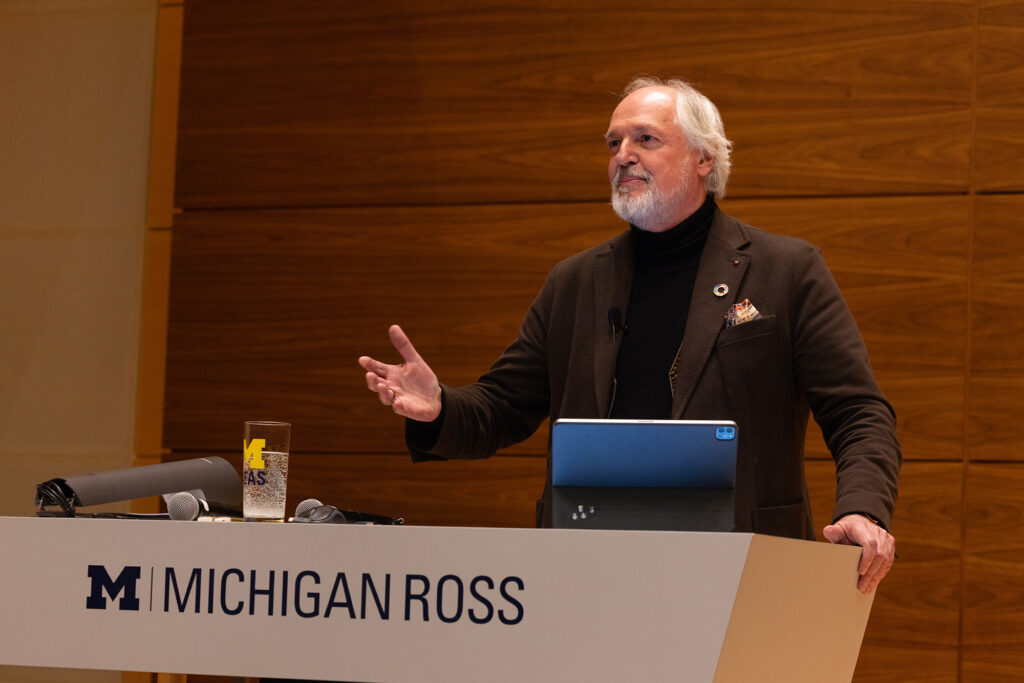
Economic success and environmental responsibility are intrinsically linked, emphasized businessman and author Paul Polman on March 26 during the Peter M. Wege Lecture on Sustainability. He argued that companies prioritizing sustainability will achieve better financial results compared to those neglecting it. At the lecture, Polman highlighted key challenges like climate change, nature loss, inequality, and supply chain disruptions.
Polman stressed that CEOs must embrace sustainable business strategies now or risk future financial consequences. “The financial market is already rewarding companies that are positioning themselves to this greener, more inclusive, more sustainable future that we all aspire to,” Polman stated.

Former Unilever CEO from 2009-19, Polman championed purpose-driven leadership. Post-Unilever, he engaged in sustainable finance and helped craft the United Nations Sustainable Development Goals (SDGs). He explained that companies “building this flywheel of sustainability” are enjoying equitable growth, greater efficiency, cost savings, and innovation.
The 24th Wege Lecture, a highlight of U-M’s sustainability lecture series, attracted over 250 attendees at the Robertson Auditorium in the Stephen M. Ross School of Business. It was co-sponsored by the School for Environment and Sustainability and its Center for Sustainable Systems, with additional support from the Erb Institute.
Polman referenced his 2021 book, “Becoming Net Positive: How Courageous Companies Thrive by Giving More Than They Take,” as a tool to inspire leaders to run businesses in a “restorative, reparative and regenerative” manner. He stated, “At the end of the day, it’s an issue of leadership and putting humanity back at the center and doing what we know is instinctively right. But that’s hard to do, and it takes courage.”

After his talk, Polman engaged in a discussion with Professor Andrew Hoffman, addressing the urgency of global problems and existing inequalities. “This is still a world where 95% of the people are not in the positions where we are,” Polman said. He emphasized the obligation of the privileged 5% to serve the remaining 95% lacking basic resources.
—
Read More Michigan News