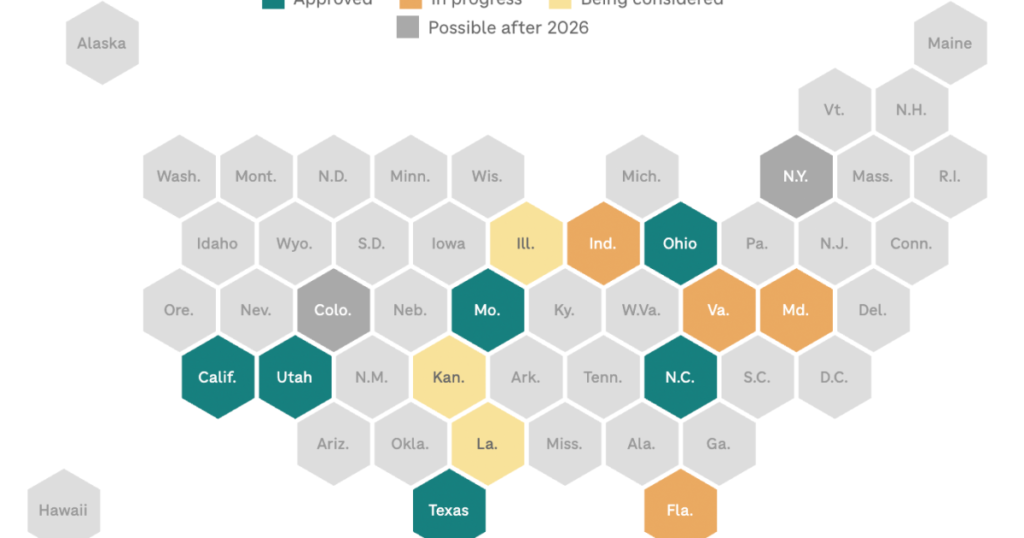
The recent Supreme Court decision favoring Texas lawmakers has given Republicans a strategic advantage in the 2026 election cycle, underscoring the ongoing redistricting efforts initiated during President Trump’s tenure.
Despite a lower court’s findings of suspected racial gerrymandering, the Supreme Court’s conservative majority allowed Texas’s new congressional map to proceed. This adjustment might secure an additional five seats for the GOP.
This move marks a significant development in the national redistricting landscape, stretching from California to Florida, all aimed at preserving Republican dominance in the House of Representatives. The balance of power in the House is critical, as a Democratic majority could impede the president’s legislative goals and initiate investigations into his administration.
Currently, the House is narrowly split, with 220 Republican seats against 213 Democrat seats. Typically, the president’s party tends to lose ground in midterm elections.
Projections suggest the redistricting battle might shift 12 to 14 seats toward Republicans, while Democrats could gain roughly nine seats. However, these outcomes hinge on ongoing legal challenges and legislative decisions, leaving the final outcome uncertain.
In Indiana, legislative discussions on redistricting are underway, while Missouri petitioners face a signature collection deadline that could delay redistricting until a public referendum.
Trump’s Initiatives in Texas, California’s Response
Typically, states undertake redistricting after each decennial census, which allocates congressional seats based on population changes. However, Trump’s efforts have sparked an intense redistricting race, reminiscent of the 1960s.
This summer, Texas experienced political drama when Trump urged the state to favor the GOP by five seats. In response, Democrats staged a two-week walkout to delay map adoptions they argued marginalized Black and Latino voters’ influence.
California Democrats countered by holding a special election to approve a map that could turn five Republican-held seats in their favor.
Republicans in Missouri and North Carolina have targeted Democratic seats, and Indiana’s House recently passed a new map potentially beneficial to the GOP, pending Senate approval. Indiana Republicans remain divided, with some expressing reluctance to align with Trump’s directives, despite threats of primary challenges from Trump and Governor Mike Braun.
Republican Redistricting Advantages
Republicans hold a strategic edge in redistricting due to their control of more state legislatures. Conversely, some Democrat-led states face legal limitations on partisan gerrymandering or require independent commissions to draw maps.

In Virginia, a Democratic-led legislature voted to hold a special election for a constitutional amendment on redistricting, potentially favoring Democrats by two or three seats. Maryland’s Democratic governor has established a commission for redistricting recommendations, but the state has only one Republican-held House seat.
Florida’s Republican Governor Ron DeSantis advocates for a spring redistricting to favor Republicans by as many as five seats. However, Florida’s laws against partisan gerrymandering and potential federal Voting Rights Act constraints could limit Republican gains. The Supreme Court is currently reviewing the Voting Rights Act, which could impact the legality of certain redistricting efforts.
The Voting Rights Act prohibits deliberate efforts to dilute minority voting power through strategies like “cracking” or “packing” districts.
Copyright 2025 NPR
—
Read More Michigan News