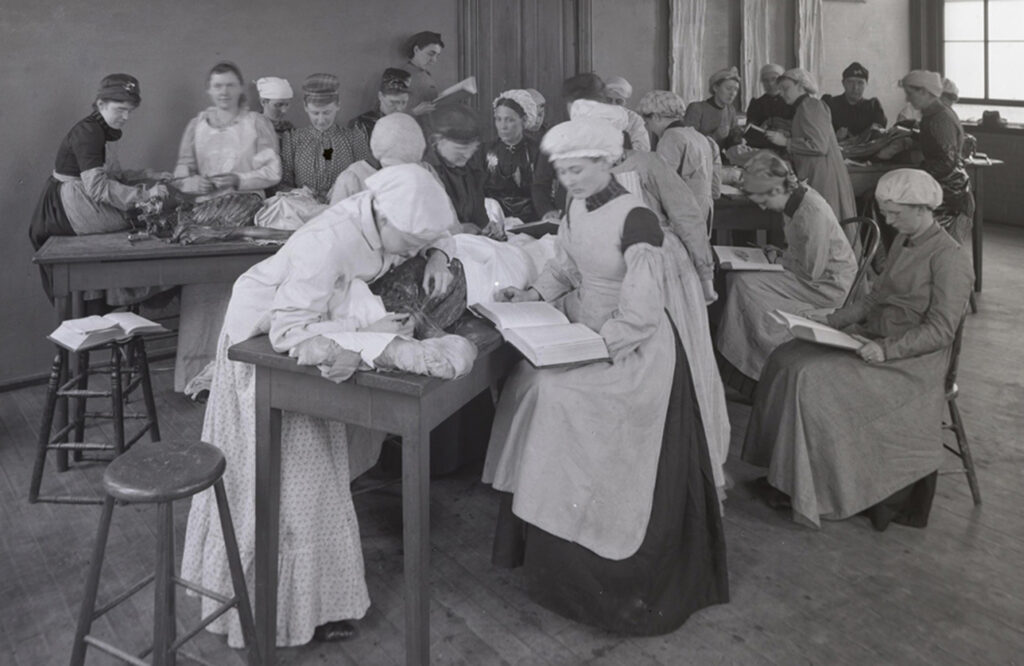
In 1870, the Board of Regents at the University of Michigan made a groundbreaking decision allowing women to study medicine alongside men. This pivotal move opened doors for countless women to pursue careers as doctors, contributing immensely to medical research and care. Despite this progress, integration faced challenges as the first 18 female medical students in the fall of 1870 had to attend classes separate from their male counterparts. Their journey laid the foundation for a significant transformation in the medical field.
Emma Call, one of the early female students, noted the scrutiny they faced, stating, “The first class of women … were naturally the objects of much attention, critical or otherwise (especially critical) so that in many ways it was quite an ordeal.” Despite initial resistance, only one faculty member was moderately supportive of admitting women, yet the students felt fairly treated by all but one member. In 1871, Amanda Sanford, the first female medical graduate, completed her degree with highest honors. During her graduation, she faced jeers as she presented her research on eclampsia, yet went on to practice in New York and advocate for women’s suffrage.
The following year, Sarah Gertrude Banks and five other women graduated, although their names were relegated to the end of the program and excluded from the class photo. Banks became a prominent physician in Detroit, treating various patients, including Clara Ford, and joining the fight for women’s suffrage. By fall 1874, men and women attended classes together, but women were still segregated by a curtain or line.
Eliza M. Mosher, who graduated in the spring, worked as an anatomy demonstrator and became the university’s first female faculty member in 1896, serving as both a professor of hygiene and the first dean of women. The Mosher-Jordan residence hall commemorates her contributions. In 1878, Grace Roberts became the first Black woman to graduate from any part of U-M, earning a degree from the now-closed homeopathic medical school.
By 1900, the University of Michigan had graduated 394 women with medical degrees, with women comprising 20% of that year’s class. Today, the university sees over half of its incoming medical and biomedical graduate students identifying as female, with nearly half of the 4,000 Medical School faculty being women. Despite these achievements, disparities in faculty rank and endowed chair distribution persist.
—For more information on women making history at Michigan Medicine, visit myumi.ch/jJ9NG.
—
Read More Michigan News