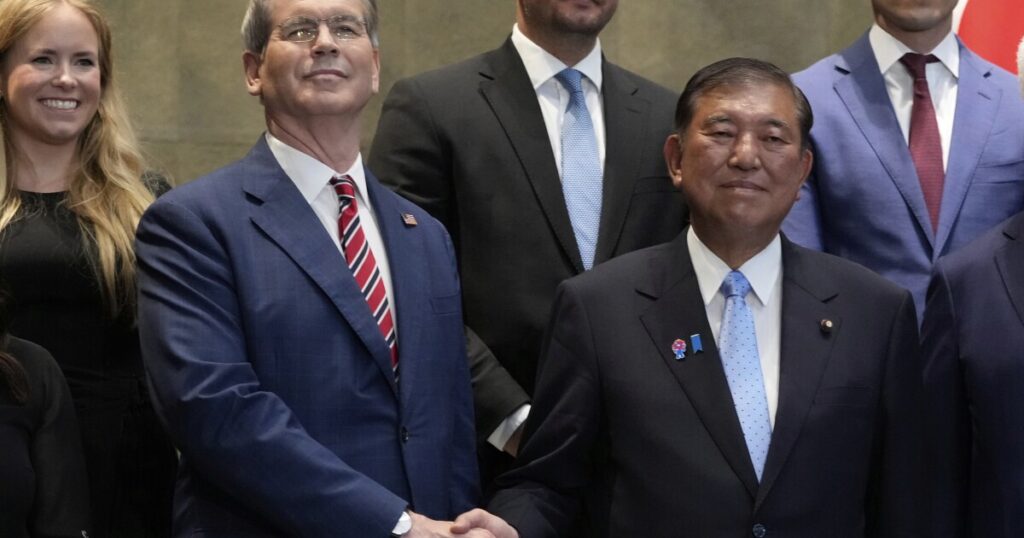
U.S. Announces New Trade Framework with Japan
In a move to reshape economic relations, the United States has unveiled a new trade agreement with Japan. President Donald Trump introduced a 15% tariff on Japanese imports, aiming to bolster domestic industries.
Trump highlighted the significance of the deal on Truth Social, “This Deal will create Hundreds of Thousands of Jobs — There has never been anything like it,” reinforcing the U.S.’s ongoing positive ties with Japan.
Under the agreement, Japan is set to channel $550 billion into the U.S. economy, a move directed by Trump, which also includes opening Japanese markets to American automobiles and rice. The newly imposed 15% tariff presents a significant reduction from the previously considered 25% rate that was communicated to Japan’s Prime Minister Shigeru Ishiba.
Prime Minister Ishiba acknowledged the agreement early Wednesday, expressing optimism about its mutual benefits.
Amidst fluctuating economic sentiments, Trump aims to demonstrate his prowess in deal-making. Initial tariff announcements in April had sparked concerns over market stability, but current conditions suggest a stabilization. However, questions linger regarding potential tariffs on Japanese automobiles, which could still face the higher 25% rate.
The new framework is part of Trump’s broader strategy to present tariffs as advantageous to the U.S. economy. The administration argues that the tariffs will help diminish the budget deficit and attract more manufacturing operations back to the U.S. soil.
Nonetheless, there are concerns about potential price hikes for consumers if companies choose to pass the tariff costs onto them. This was evident when General Motors reported a 35% drop in its net income for the second quarter, attributing future business challenges to the tariffs.
As the Aug. 1 deadline for implementing these tariffs approaches, Trump also revealed a similar trade outline with the Philippines, setting a 19% tariff on its exports while exempting U.S. products from import duties. The president reaffirmed a 19% tariff on goods from Indonesia as well.
According to the Census Bureau, last year the U.S. experienced a $69.4 billion trade deficit with Japan, alongside imbalances of $17.9 billion with Indonesia and $4.9 billion with the Philippines. These figures highlight America’s higher import rates compared to exports with these nations.
With the broader tariff strategy taking effect on Aug. 1, attention is turning to possible developments in U.S.-EU trade discussions. Trump noted during a dinner that European Union representatives would engage in talks in Washington soon.
In correspondence earlier this month, Trump warned EU member states of impending 30% tariffs, effective from Aug. 1.
Meanwhile, trade negotiations with China are ongoing, with a deadline set for Aug. 12. Currently, Chinese goods face a 30% base tariff.
Treasury Secretary Scott Bessent is scheduled to meet with Chinese officials in Stockholm next week, aiming to pivot the American economic focus towards manufacturing and encourage consumer spending in China.
Appearing on the Fox Business Network, Bessent remarked, “President Trump is remaking the U.S. into a manufacturing economy. If we could do that together, we do more manufacturing, they do more consumption. That would be a home run for the global economy.”
—
Read More Michigan News