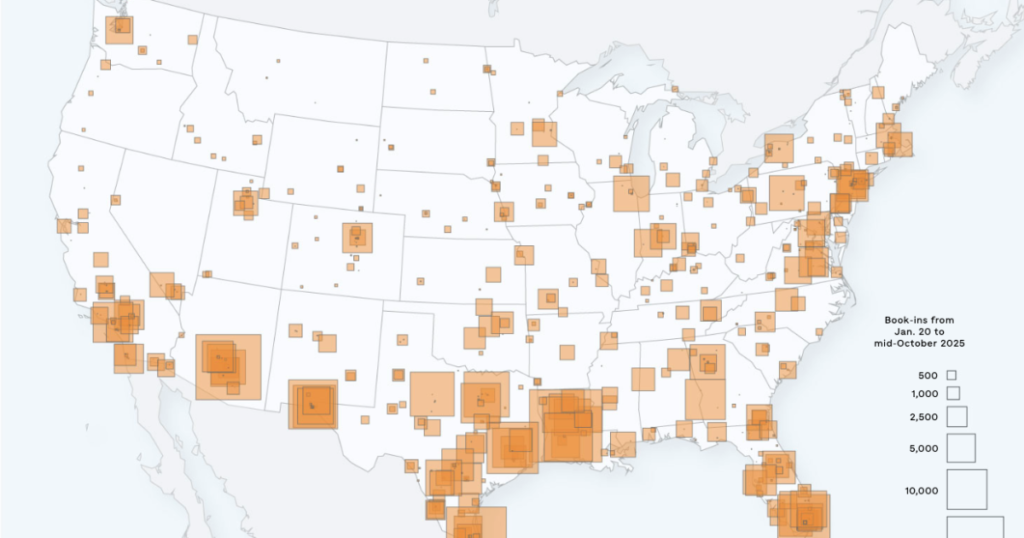
The expansion of migrant detention facilities under the Trump administration is drawing significant pushback across the United States. With billions in new funding, the administration is rapidly increasing its detention capacity, aiming to arrest, detain, and deport more immigrants than ever before.
Immigration and Customs Enforcement (ICE) is using an influx of $85 billion, including $45 billion earmarked for expanding immigration detention, to lease and repurpose spaces nationwide. This includes retrofitting warehouses and expanding contracts with local jails and private prisons. ICE now boasts the largest funding of any U.S. law enforcement agency, according to a recent report.
for NPR / Wesley Lapointe for NPR
/
Wesley Lapointe for NPR
Information from a Freedom of Information Act request analyzed by NPR shows over 220 ICE detention sites nationwide, ranging from ICE facilities and private prisons to jails and newly converted warehouses. The number of locations continues to increase, with the largest operations centered in the southern U.S. States like Texas, Florida, and Georgia host over 60% of the 750,000 ICE detention book-ins, with Texas leading the count.
The number of detainees has risen sharply, from 37,000 a year ago to over 72,000 by January 2026. The Department of Homeland Security (DHS) aims to create bed space for 100,000 undocumented immigrants, with detention facilities averaging 70,000 daily occupants. This level of detention has not been seen since World War II, when Japanese Americans were interned.
ICE’s expansion strategy follows a “Hub and Spoke Model,” which involves large centers supported by smaller regional processing sites. An example is the planned mega-center in Social Circle, Ga., which would double the town’s population. However, these plans face opposition across the nation, with communities citing financial, infrastructure, and moral concerns.
Community Resistance
Grassroots opposition is growing. In states like Georgia, Texas, and Arizona, residents have successfully halted the establishment of new detention centers. For instance, in Merrimack, N.H., community outcry stopped a proposed facility, which local representative Bill Boyd called a significant victory.
Similarly, Oklahoma City residents opposed a plan to convert a warehouse into a detention center, leading DHS and ICE to abandon the project. Even in Texas, sustained community resistance thwarted a plan to purchase a large warehouse for conversion into a detention center.
Private companies like Geo Group and CoreCivic continue to profit from ICE contracts, with both reporting significant revenue increases. Despite the opposition, some communities are cautiously open to detention centers for the economic benefits they could bring.
Transparency Issues
Local officials across the country report being kept uninformed about DHS’s plans. In Social Circle, Ga., city leaders barred water use for a proposed ICE facility until further details are provided. In Indiana, Merrillville town leaders passed a resolution opposing a detention center without prior communication from ICE.
San Diego’s mayor, Todd Gloria, highlighted the lack of transparency and communication from ICE and private companies, raising concerns about accountability. Community leaders in Oakwood, Ga., expressed dissatisfaction with the federal government’s lack of engagement in the planning process, which they say leaves them to manage the situation independently.
While some places have preemptively banned detention facilities, others view them as opportunities for economic growth. In Georgia, a detention center contract with GEO Group is expected to provide significant financial benefits to Charlton County, despite ethical concerns.
Data for this analysis was obtained from ICE’s response to a FOIA request by the Deportation Data Project. The original dataset refers to a “book-in” as a “stint,” with most noncitizens experiencing one book-in per detention stay, although some are transferred between facilities.
Contributors to this report include Sergio Martinez-Beltran, Jasmine Garsd, Ximena Bustillo, Alyson Hurt, and Preeti Aroon.
Copyright 2026 NPR
—
Read More Michigan News