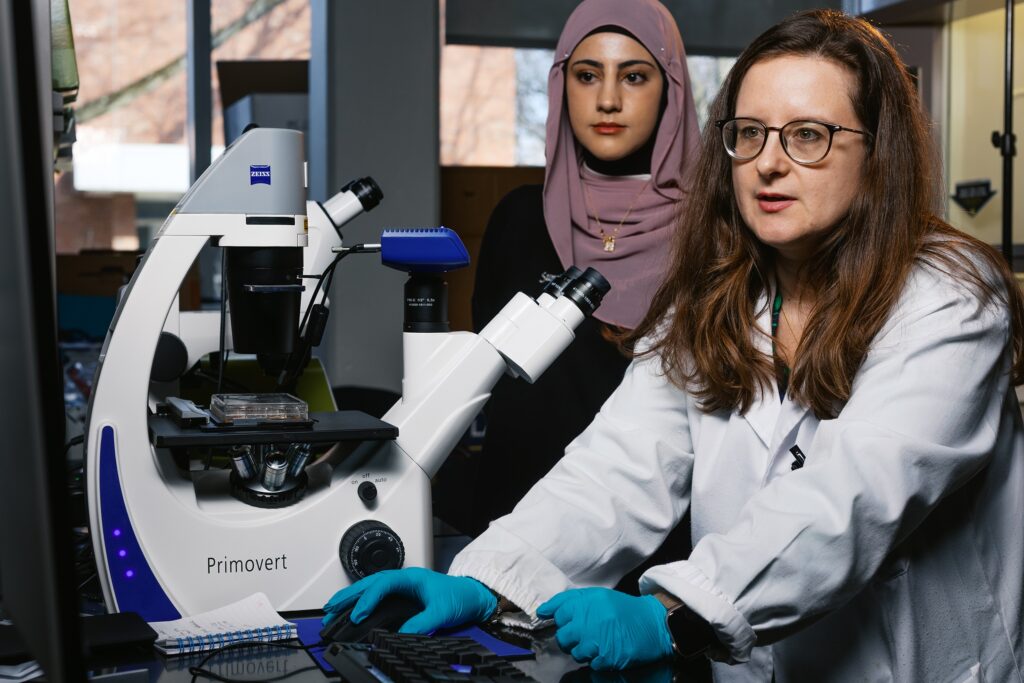
In the Cancer Therapeutics Lab at UM-Dearborn, junior biochemistry major Wiam Almahdi investigates the potential of natural compounds in cancer treatment. Under the guidance of Besa Xhabija, associate professor of biochemistry, Almahdi studies melanoma skin cancer cells to determine if Spinosyn A, a soil-based pesticide, can slow their growth. Almahdi aims to pursue a career in epidemiology.
“I have learned how a lab operates, how to use the equipment and run tests. I’m becoming more independent and I’m becoming more confident in trusting my decisions and results. I am doing cancer research as an undergraduate. This is not something many people can say,” Almahdi said.
Almahdi attributes her enriching lab experience to Xhabija, her biochemistry mentor, having taken courses and conducted research under her for a year. “She is always there to help if I need it and she takes technical topics and makes them easy to understand,” says Almahdi. “In her lab, we are performing tests that are done in industry to make discoveries of our own.”

Xhabija collaborates with research entities including Cayman Chemical and the Rogel Cancer Center at Michigan Medicine, emphasizing the lab’s industry relevance. “If you want to work in medical research, Professor Xhabija’s lab is where you want to be,” Almahdi shared.
Almahdi’s brother, Yazan, also a UM-Dearborn alum, trained in Xhabija’s lab and now works at the Rogel Cancer Center. Xhabija seeks to nurture students’ technical skills and scientific reasoning. As a molecular cancer researcher, her work focuses on disrupting cancer cell nutrient pathways to inhibit growth in renal cancer, breast cancer, and melanoma.
Xhabija and her students have published findings that highlight targeting cancer cell processes to slow growth in melanoma and renal cancer. Despite industry offers, Xhabija remains committed to teaching, inspired by her own journey in science from Albania to Canada.
“I really enjoy watching students develop confidence in their ability to think critically. Over time, they begin to trust their reasoning and contribute their own ideas. Being part of that development is profoundly meaningful,” she said.
Her early interest in science was fostered by her parents’ sacrifices to provide educational resources. After moving to Canada for college, she found mentorship with Panayiotis “Otis” Vacratsis at the University of Windsor, who helped shape her path in cancer research.
“I wouldn’t be where I am today without him. I always have that in mind and I try to show the same type of care with my students,” Xhabija said. Her work with students at UM-Dearborn is a testament to her commitment to nurturing future scientists.
In Xhabija’s lab, Almahdi measures melanoma cell growth, aspiring to work for the CDC within a decade. Her undergraduate research experience is already setting her apart. “Working in Professor Xhabija’s lab will help me stand out. I am learning so much,” Almahdi said.
Xhabija emphasizes the importance of undergraduate research in addressing critical health issues and inspiring future scientists. “They are not standing at the edge of discovery — they are inside it,” she said.
—
Read More Michigan News