The University of Michigan, in partnership with the William Davidson Institute and the Asian Development Bank, has initiated a collaboration to enhance sustainable development in Asia and the Pacific. This partnership, formalized through a memorandum of understanding, focuses on leveraging global knowledge for supporting clean energy transitions in ADB’s developing member countries, and reflects a mutual commitment to sustainable, inclusive growth.
University of Michigan and WDI will cooperate with ADB on diverse projects including clean energy, e-mobility, climate and health, water, food security, and biodiversity across the Asian region. Specialists from U-M and WDI will act as research partners, collaborating with ADB’s teams and various stakeholders from government, industry, and academia in the bank’s member countries. Founded in 1966 and headquartered in Manila, ADB consists of 69 member countries, with 50 from the Asia-Pacific.
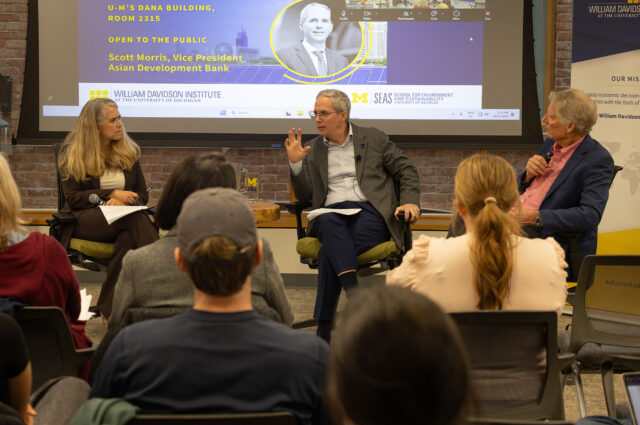
Scott Morris, vice president of ADB, stated, “This collaboration will help us tap into Michigan’s expertise and access global innovation to create more opportunities to advance inclusive and sustainable development in the region.” He further emphasized ADB’s commitment to empowering communities with skills and knowledge to foster resilience and economic opportunity in Asia and the Pacific.
The announcement coincided with Morris’s visit to U-M, where he attended the “Powering Asia’s Future: Climate Innovation and the Energy Transition” event. These discussions, supported by SEAS and WDI, examined energy transitions in Asia and insights from Michigan. Morris also engaged with the SEAS Detroit Sustainability Clinic and other Michigan-based sustainability initiatives.
The partnership will commission research, engage in projects in ADB member countries, and facilitate discussions and learning activities in Asia, the Pacific, and Michigan. This will enable collaboration among policymakers and experts from Michigan and ADB member countries. Jonathan Overpeck, Dean of SEAS, noted, “This partnership underscores the University of Michigan’s commitment to global collaboration in addressing the challenges and opportunities presented by the energy transition and the drive for more sustainable development.”
This alliance aims to accelerate e-mobility by collaborating with stakeholders to enhance electric vehicle adoption, supply chain innovation, and workforce development. In July, with ADB support, WDI released a report titled “Driving a just transition to e-mobility in the Philippines,” detailing its research findings and collaborative efforts with ADB and the Apl.de.Ap Foundation International.
WDI’s engagement included extensive market research, fieldwork in the Philippines, and interactions through focus groups, interviews, and site visits. While concentrating on the Philippines, the research also explored e-mobility advancements in other Southeast Asian countries to contextualize the findings. Wendy Taylor, CEO of WDI, remarked, “By working alongside the University of Michigan and the Asian Development Bank, we’re creating pathways for inclusive economic growth that engage communities, strengthen innovation ecosystems, and accelerate progress toward a clean energy future.”
—
Read More Michigan News