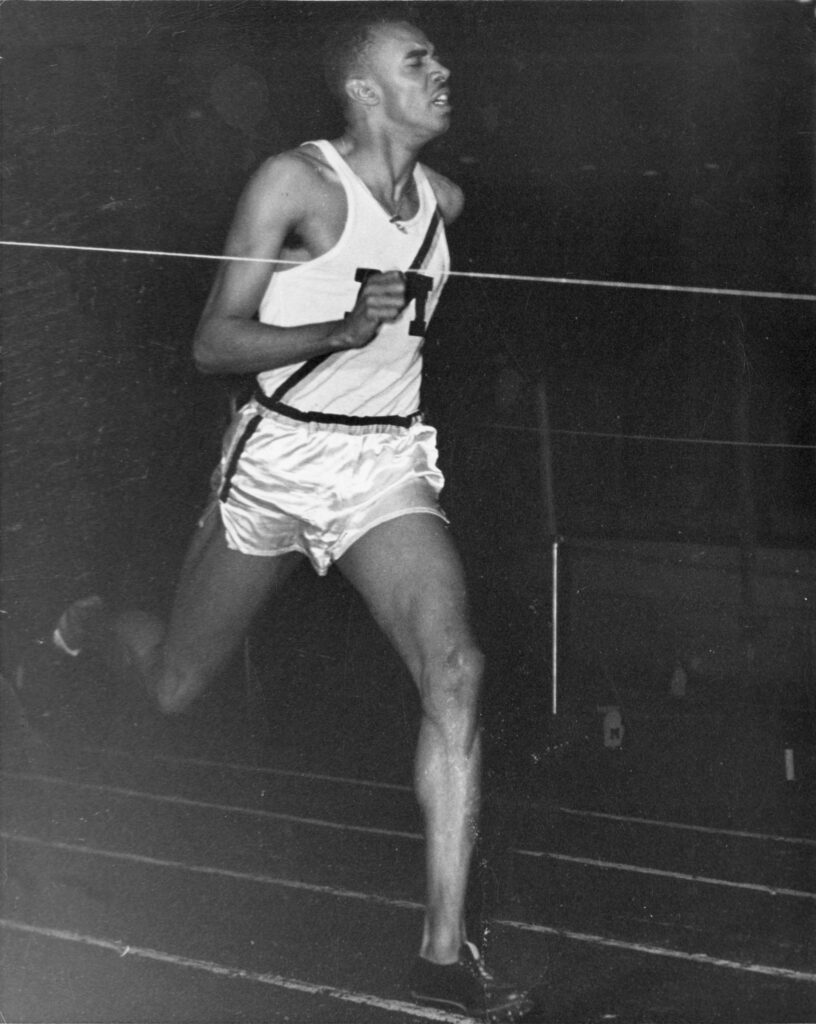
In 1948, Orval “Val” Johnson, among the few Black students at the University of Michigan, boldly campaigned for senior class president. His competitor, Peter R. “Pete” Elliott, was the celebrated star of U-M’s undefeated football team. Elliott, a quarterback on championship teams, earned 12 varsity letters across sports, setting a record. Johnson, a track and field athlete known as “the gentlemanly runner,” was also active in student government, the Sphinx honor society, and his dorm council.

Despite the odds, his engaging personality and campus involvement made him a formidable candidate. Running against one of U-M’s most decorated athletes, Johnson faced the challenge of winning over a predominantly white student body.
Ann Arbor’s Campus Climate in the Mid-Century
After World War II, U-M’s enrollment surged to 20,000, largely white veterans. Johnson often stood alone as a Black face in student government, among varsity athletes, and campus leaders. Off-campus, Ann Arbor’s environment was often hostile to Black students. Restrictive housing practices and discriminatory restaurants were common, and the Michigan Union had unwritten rules about who was welcome.
Johnson’s campaign branded him as “Michigan’s Man of Distinction.” Campaign workers distributed buttons and lollipops, urging votes for him. Johnson personally visited dorms to rally support.
Students Spur Change
The election day in late November was cold and windy. The Michigan Daily emphasized the importance of voting. In the late 1940s, U-M students advocated for change, aligning with national moves like military desegregation and Jackie Robinson’s breakthrough in baseball. On campus, civil rights groups protested discrimination, including boycotts of barbershops excluding Black customers. The election became a pivotal moment beyond a popularity contest.
Voting stations spanned the campus, drawing over 7,000 voters. After two days, Johnson won decisively, becoming the first Black senior class president at U-M and likely any predominantly white university.
Johnson learned of his victory around 3 a.m. “I’m completely overwhelmed,” he told a Michigan Daily reporter. His win gained mention in The New York Times and Black newspapers like the Michigan Chronicle.


After his win, Johnson thanked classmates for their support in a note. He graduated with a bachelor’s degree and later a master’s. He worked for United Nations Radio in Paris and taught at the National Autonomous University of Mexico before returning to Detroit to teach Spanish. Johnson passed away in 1995 at age 69.
This article was adapted from “First in Class,” a piece by Kim Clarke for U-M’s Heritage Project.
—
Read More Michigan News