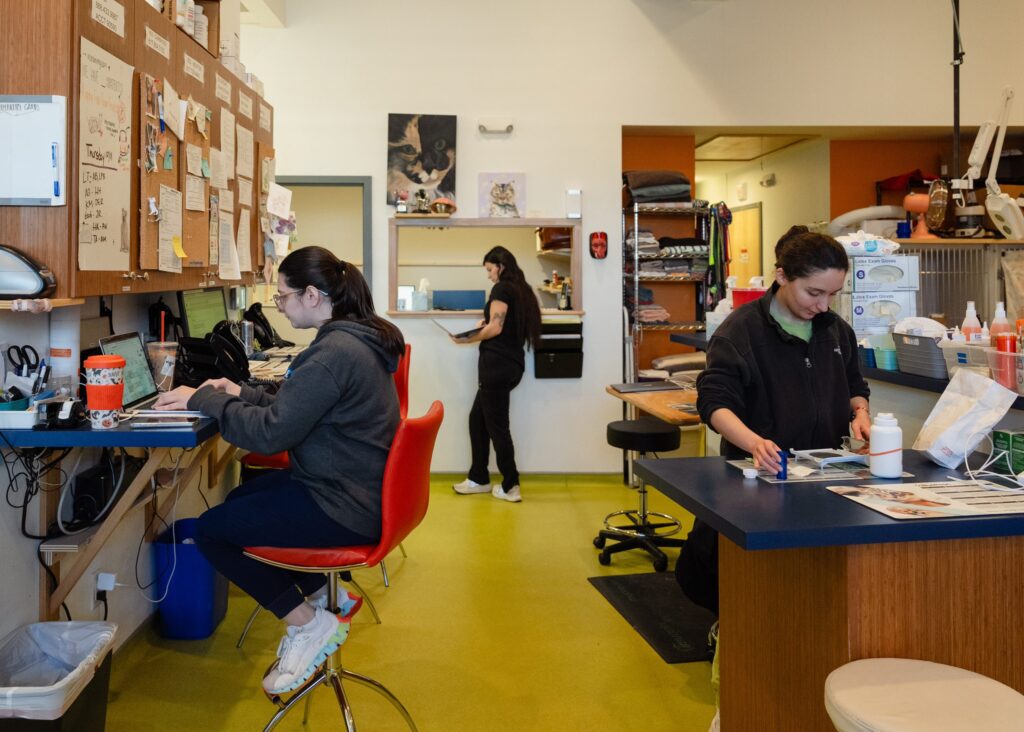
WATERTOWN, Mass. — Amanda Leef’s childhood dream of becoming a veterinarian began at age four with a garter snake encounter in her Michigan backyard. Today, at 48, she co-owns Heal Veterinary Clinic, a thriving practice in a Boston suburb, where the entire team of seven veterinarians and 22 medical staff members are women.
“I think every girl goes through a phase of wanting to be a vet,” Leef said, reflecting on her lifelong passion. She believes women are often drawn to veterinary medicine due to their interest in the emotional and empathetic aspects. This trend is evident as women studying veterinary medicine now outnumber men by four to one.
The shift isn’t limited to veterinary schools. Women now surpass men in law, medical, pharmacy, optometry, and dental schools. The U.S. Department of Education reports that women earn 40% more doctoral degrees and nearly twice as many master’s degrees as men, reshaping high-end professions.
This change is partly due to increased female enrollment and a decline in men attending graduate and professional schools. “Having all students represented ensures healthy communities and a vital economy,” said Chevelle Newsome, president of the Council of Graduate Schools.
The trend has broader implications for the nation’s competitiveness, affecting marriage and family dynamics. “Men aren’t seeing higher education as valuable,” said Newsome, noting that many opt for trades or jobs after high school. The National Student Clearinghouse reports a drop of nearly a quarter million male undergraduates since 2020.
Women account for 60% of undergraduate enrollment, with nearly half of women aged 25 to 34 holding bachelor’s degrees, compared to 37% of men, according to the Pew Research Center. The American Bar Association notes women earning more law degrees, while the Association of American Medical Colleges reports 55% of future doctors are women.
While women outnumber men in psychology, dentistry, optometry, and pharmacy, men still predominate in business, engineering, and sciences. Yet, women make up majorities in health sciences, education, and social sciences, according to the Council of Graduate Schools.
The declining male enrollment poses challenges for universities, some healthcare sectors, and the economy. Graduate enrollment at private colleges has already fallen, and new federal loan limits may further impact enrollment. The cost of graduate education has more than tripled since 2000, raising questions about its return on investment.
Claudia Buchmann, an Ohio State University sociologist, warns that stagnant college-going rates among men harm economic competitiveness. If the trend continues, the U.S. may struggle to compete globally.
The gender shift impacts not just economics but relationships. As educational disparities grow, marriage rates decline. “A lot of masculine norms are about being the breadwinner,” said Buchmann.
At Heal Veterinary Clinic, Amanda Leef highlights the importance of gender diversity in the workforce. “A diverse staff is more accessible to a broader range of people,” she said, emphasizing the benefits of a gender-balanced team.
—
Read More Kitchen Table News