Some museums resist incorporating smudging, a traditional Indigenous cleansing practice, fearing potential harm to exhibits or visitor discomfort. Smudging involves burning sage, sweetgrass, or tobacco in a shell, extinguishing the flames, and wafting the smoke over oneself. Yet, the new Montana Heritage Center prominently features a smudging room at its east entrance, aligning with the Plains tribes’ tradition of east-facing tipi doorways.
“This kind of stuff is usually a little bit of a fight for a lot of museums,” shared Nina Sanders, Indigenous curator at the state history museum. “Everybody was incredibly open,” she continued, noting the room’s HVAC system, natural light, and seating areas. This inclusion reflects the museum’s collaboration with tribes to accurately portray Native American stories in the exhibits.
“[Smudging is] important to us because we view these artifacts as living items,” said Major Robinson of the Northern Cheyenne Tribe. He emphasized the importance of self-care when interacting with exhibits, urging visitors to utilize the smudge room before entering exhibit spaces. Sanders, Apsáalooke and a former curator for Smithsonian’s National Museum of the American Indian, highlighted the museum’s approach. Unlike others, this museum integrates Native American history throughout, acknowledging it as a vital part of American history.
A walk through the museum
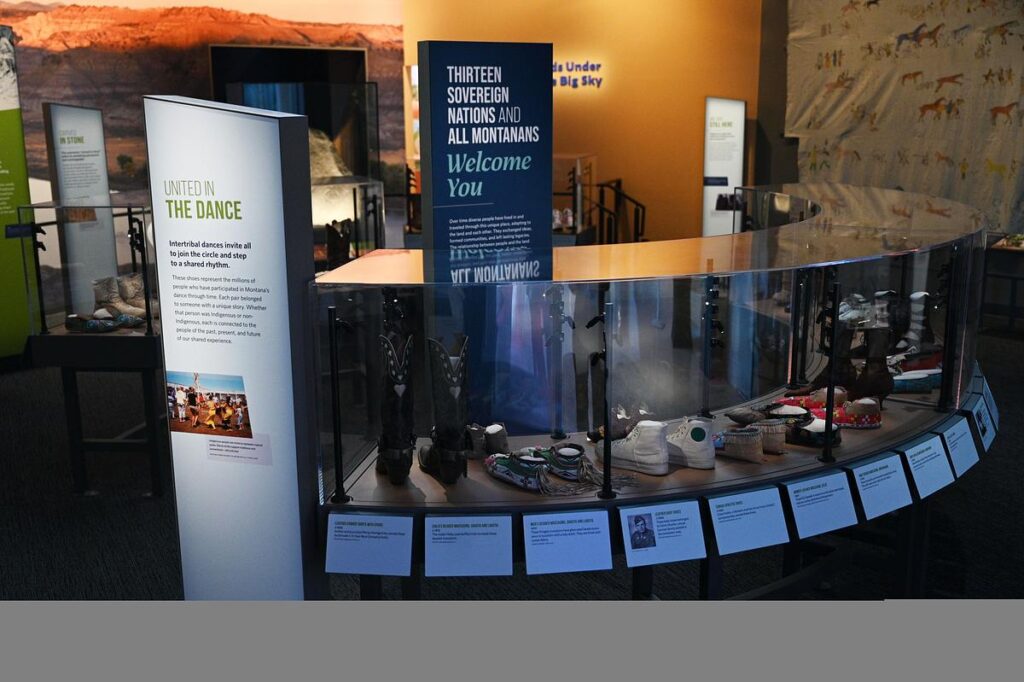
Near the smudge room, the museum’s east entrance features a shoe exhibit symbolizing a round dance, a traditional Indigenous ceremony. “It’s very celebratory,” said Amanda Trum, curator of collections. The circle includes moccasins, cowboy boots, military boots, and high heels. “It’s very uplifting,” she said, noting the representation of diverse backgrounds. Other exhibits include a lightweight Cree tipi from the 1800s, an elk tooth dress from the 1870 Baker Massacre, and George Catlin’s drawings depicting early Native Americans.
A section covers genocide, starvation, and assimilation, including accounts of the 1851 Fort Laramie Treaty and boarding school era. A flyer reads “Indian land for sale.” Sanders explained how the museum tackles difficult subjects, promoting reflection on past actions. Adjacent, an exhibit on Native resilience showcases Indigenous art. “Even when things were terrible, they were still creating beautiful things,” Sanders said.
The sovereign nations section, Robinson’s favorite, displays tribal items chosen by each nation’s leaders. A lodge exhibit offers videos of tribal culture, showing homeland beauty and traditions. Robinson wishes Native visitors see authentic reflections and non-Natives gain appreciation for the nation’s first peoples. “Our contributions are important,” he noted.
Tribal collaboration
Museum-tribe relationships can be complex. While museums call items artifacts, tribes view them as ancestors. Where museums display items behind glass, tribes may want interaction for cultural reasons. Most Native items were donated, some obtained by fur traders, others traded for services. Tribes may prefer museums not display certain items, like burial objects. A museum video discusses an ancient Indigenous child whose remains were reburied.
Tribal collaboration helps museums present accurate history. Montana Heritage Center met with tribal governments, forming a stakeholder group to guide exhibits. Robinson praised the collaboration, noting it deepened the storytelling. “This is a deep collection and a deep representation of Native people,” he said.
—
Read More Montana News