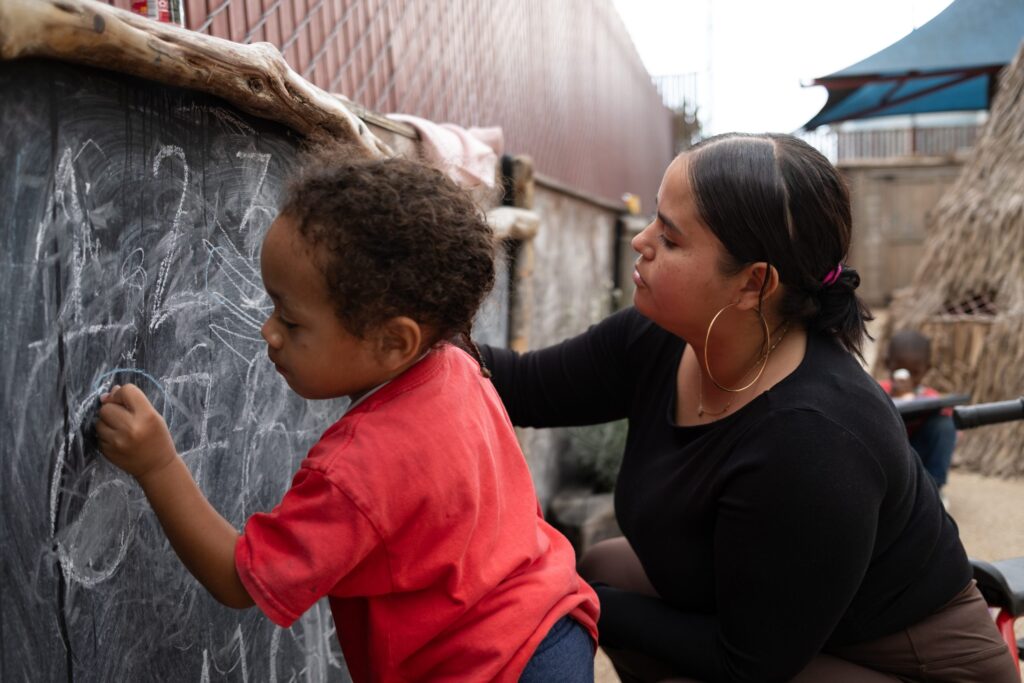

SAN FRANCISCO — At a YMCA playground, Mayra Aguilar introduced toddlers to sharing and communication using purple modeling dough. She assisted Wynter, a nearly 3-year-old girl, in unclasping her bicycle helmet after a tricycle ride.
Aguilar, with her large gold hoop earrings catching the sunlight, encouraged Wynter to say, “Thank you, teacher.” Surrounded by other toddlers, Aguilar used this as a teaching moment, urging Wynter to share and ask, “Can you pass it to me?”
For both Aguilar and Wynter, this experience is new. Wynter joined the child care center in mid-August, while Aguilar began her part-time preschool teaching role in February.
This experience is transformative for them. Wynter, an only child, learns social skills, while Aguilar earns her first college credits and income by working with children.
Early educators face a shortage and low pay compared to fast food jobs, yet require education beyond high school. Advancement often demands a degree.
Aguilar stands out by being an apprentice, a role usually linked with trades like welding. Apprenticeship programs in early childhood education have been around for a decade, but San Francisco’s program is distinct. It is funded by a real estate tax approved in 2018, supporting training and increasing teacher pay for long-term retention.
Related: Young children have unique needs and providing the right care can be a challenge. Our free early childhood education newsletter tracks the issues.

Policy experts regard apprenticeships as transformative for early educators, providing essential support and cost-free coursework. “We want it to be a position people want to go into as opposed to one that puts you in poverty,” said Cheryl Horney, who supervises the Early Learning Program at Wu Yee Children’s Services in San Francisco, where Aguilar is employed.
Aguilar, 32, works 20 hours weekly at the Wu Yee Children’s Services’ Bayview Early Learning Center, mentored by a teacher. Her apprenticeship includes online courses from City College of San Francisco, where she learns with other apprentices. Provided with necessary tools, she balances coursework with her role as a mother.
After high school, Aguilar tried a medical assistant program but left it unfinished over a decade ago. Upon seeing a flyer about the apprenticeship while enrolling her daughter, she applied, finding it a better fit. “This — I think I can do it. This, I like it.”
The demand for early educators is ongoing, with recent pushes for higher education to enhance child development and salary prospects. For example, a 2007 federal law change required half of Head Start teachers to earn bachelor’s degrees by 2013, a goal achieved.
Despite these efforts, early childhood educator wages remain low. In 2022, Head Start lead teachers averaged $37,685 annually, with 87% of U.S. jobs offering more pay than preschool teaching roles.
Apprenticeships offer a solution, allowing aspiring teachers to earn while gaining entry-level or advanced qualifications. A June 2023 Bipartisan Policy Center report states that 35 states have early childhood educator apprenticeship programs, with more in development. The U.S. Department of Labor notes over 1,000 apprentices have completed programs since fiscal 2021. Early Care & Educator Pathways to Success, supported by Labor Department grants, estimates larger numbers with its hundreds of apprentices across 21 states, including Alaska, California, Connecticut, and Nebraska.
However, establishing these programs can be challenging. They require collaboration with colleges to offer locally compliant coursework and suitable hours for apprentices balancing classroom duties and personal childcare. Funding is needed to pay apprentices beyond standard childcare center costs. Apprentices often require coaching, technology, and childcare or meals for their children.
In San Francisco, Horney advocated for an apprenticeship program before tax funding. Teacher retention issues arose as educators left for higher-paying retail jobs. With five years of experience and a bachelor’s degree, she earned $15 an hour. “Now the lowest salary we pay is $28.67 for any sort of educator,” she said. Wages and apprenticeships attract candidates from other regions, stabilizing the local workforce. “It has helped immensely.”
Similar programs have succeeded elsewhere. The YWCA Metro St. Louis in Missouri reports no teacher vacancies in two years, attributing it to its apprenticeship initiative. In Guilford County, North Carolina, staffing issues were resolved with an early educator apprenticeship program.

In Oklahoma City, an apprenticeship program launched in 2023 produced its first graduate after two years of childcare center experience and 288 hours of training. Program creator Curtiss Mays hopes it marks the beginning of substantial progress. Mays collaborated with the Oklahoma Department of Labor to establish the apprenticeship, pulling one participant out of homelessness and attracting more aspiring teachers. The program offers education funding through a bachelor’s degree to committed apprentices.
Apprenticeship programs can be expensive, and federal legislation to support them has failed to advance. However, advocates argue they are more affordable than four-year college degrees. Labor Department funding for apprenticeship development boosted early educator apprentice numbers in validated programs, but some grants were cut by the Trump administration in May.
In San Francisco, the 2018 real estate tax provides funding for apprenticeships, allowing Aguilar and others to earn at least 12 college credits this year. In two semesters, Aguilar will qualify as an associate teacher in California. Apprentices across San Francisco can pursue associate or bachelor’s degrees with tax-funded support.

Over a decade ago, Pamm Shaw initiated an early educator apprenticeship program at the YMCA East Bay due to staffing challenges. Her approach involved recruiting parents of children in YMCA Head Start programs, offering them the chance to earn college credits and become early educators.
Shaw’s initiative provided education as a significant incentive, particularly for parents working towards degrees over many years. The opportunity to earn degrees in manageable increments while receiving pay and raises quickly became a powerful recruitment tool. “It changed their lives,” Shaw noted. The program demonstrated that early education was more than babysitting, offering valuable lessons for parents and their children.
The program’s success inspired other apprenticeship initiatives nationwide. By Shaw’s retirement, over 500 people in the Berkeley area completed the program, reflecting the diverse early educator workforce.
Erica Davis, a single mom, exemplifies the program’s success. Initially relying on public assistance and childcare jobs, Davis joined the apprenticeship program in 2020. By spring, she will earn her bachelor’s degree from Cal State East Bay. Employed full-time at a Richmond Head Start center, she balances work, education, and family responsibilities.
Davis’ success story includes achieving financial independence, maintaining academic excellence, and even coaching new apprentices. The program’s supportive network and sense of family contribute to many apprentices’ success. “I have a sad story, but it turned into something beautiful,” Davis shared.
Related: The dark future of American child care

Davis prefers the flexibility of self-paced classes, but other apprentices thrive in live classes like Aguilar’s, which start with mindfulness exercises. EDvance College in San Francisco uses a similar approach for early childhood apprentices, as explained by its president and CEO, Lygia Stebbing.
The college offers general education courses in reading, math, and science, tailored for early childhood apprentices, making it relevant and applicable. Apprentices apply lessons in real-time, unlike traditional degree paths requiring in-person teaching after many classes.
Before classes, apprentices receive technology training, from identifying devices to using Google Docs and Zoom, ensuring they start smoothly. A writing coach and support staff assist apprentices during evenings for coursework and assignments. Many apprentices are older and may have exhausted federal aid without earning degrees. The college partners with foundations and government agencies to offset course costs, preventing graduates from accruing debt.
“We’ve really put the student at the center,” Stebbing affirmed.

Mayra Aguilar finds her mentor teacher Jetoria Washington invaluable for guidance in her apprenticeship, both in classes and classroom work. Online courses allow her to be at home with her children in the evenings, while earning money for classroom hours keeps her from incurring debt for the credential needed for a full-time job. The comprehensive support system helped Aguilar transition from feeling overwhelmed to progressing toward a college degree.
Aguilar enjoys her work. On the playground, children decided to trace others with chalk, improving pencil grip while having fun. They even traced Aguilar, leaving colorful lines on her clothes, which she didn’t mind.
“I love the kids,” she said. “They always make me laugh.”
Aguilar has acquired skills to use with her own children, a common experience for apprentices.
At home and at work, Aguilar uses the phrase “Catch a bubble,” preschool language for “Be quiet,” to gain children’s attention. It often leads to brief silence, followed by attentive listening.
—
Read More Kitchen Table News