Article Summary –
Martin County, NC, has been without a hospital since 2023. ECU Health plans to reopen the facility as a Rural Emergency Hospital, requiring $220 million in state funding. The closure impacted the local economy and healthcare access. The REH model aims to maintain emergency services in rural areas.
A rural NC community in Martin County has been without a local hospital for three years now. But ECU Health has a plan to reopen it as a “Rural Emergency” hospital.
Dexter “Drew” Batts, government manager for Martin County, reflects on the night his childhood friend suffered a heart attack in 2025.
The friend, a 39-year-old woman and Batts’ high school peer, resided just nine miles from Martin General Hospital. Local families had depended on this rural hospital for emergency care since 1950.
Yet, Martin General was unavailable that night. The 43-bed facility had closed in August 2023 due to financial strains linked to declining population and usage.
Batts’ friend was transported to an emergency department about 30 minutes away in Bertie County. Unable to address her needs, doctors transferred her 40 miles to ECU Health Medical Center in Pitt County.
She passed away after three days on life support.
“Who’s to say if that 30- to 40-minute transport, instead of nine, would have been pivotal,” Batts remarked at an event by the NC Rural Center, which supports rural communities statewide.
Such concerns have grown in Martin County, marking its third year without a local hospital. However, officials remain hopeful about a plan to resurrect the closed facility as North Carolina’s first Rural Emergency Hospital.
Reviving Martin General
The Rural Emergency Hospital (REH) designation was created by the Consolidated Appropriations Act of 2021 to help financially struggling rural hospitals.
Hospitals converting to REH status must offer 24/7 emergency care and outpatient services, without inpatient services. They must have agreements with trauma centers for patient transfers. In return, they receive a 5% Medicare boost and $285,625 monthly federal payments.
The program began in January 2023, with over 40 facilities converting. However, unlike others, Martin General was closed before conversion.
After regulatory discussions, CMS confirmed in 2024 that Martin General could reopen as an REH. By 2025, proposals from potential operators were requested, and the building was being updated to meet requirements.
Waiting for funding
In May 2025, ECU Health, associated with East Carolina University’s Brody School of Medicine, proposed plans to take over and convert Martin General.
ECU Health’s proposal requires $220 million from state lawmakers. About $70 million would develop the Rural Emergency Hospital site, with the rest funding a new inpatient tower at ECU Beaufort Hospital.
Brian Floyd, ECU Health COO, discussed the plan at the NC Rural Center’s annual summit in March.
Floyd noted that ECU Health’s plan could take years, requiring investments beyond physical infrastructure. The funding request stalled amid a budget standoff, leaving North Carolina as the only state without an adopted budget.
Study tests model’s promise
A study in Annals of Emergency Medicine examined the REH program’s effectiveness. The study assessed financial data of closed hospitals, those that converted, and those that remained open without conversion.
Findings showed converting and closed hospitals had similar poor financial health before 2023, with worse outcomes compared to non-converting hospitals. However, the authors noted limitations due to the program’s early stages and small sample size.
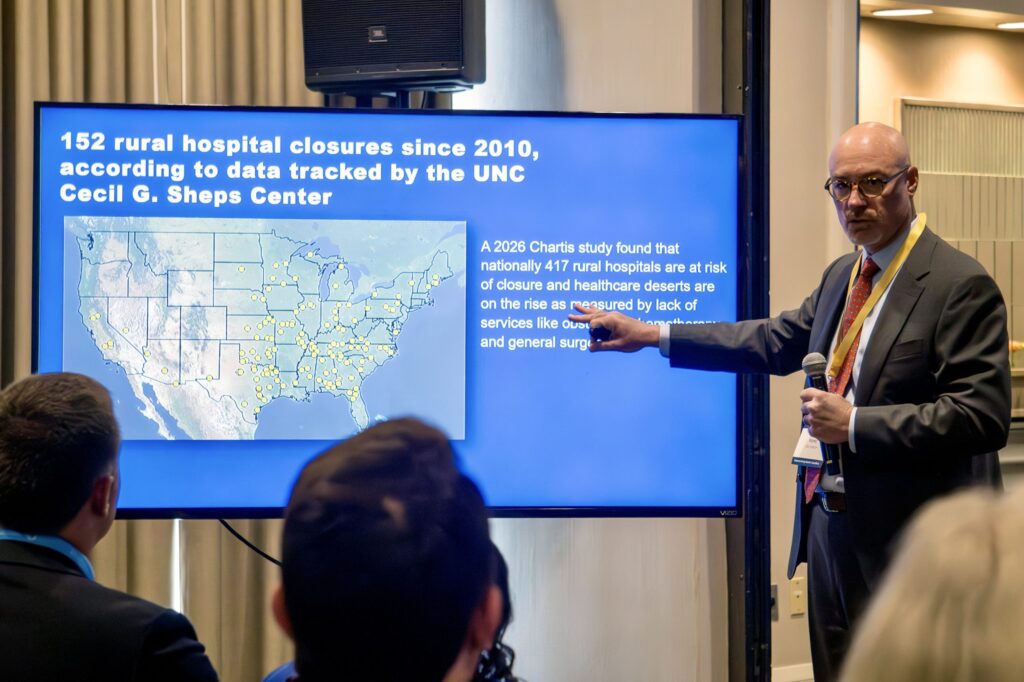
At least 12 rural NC hospitals closed or reduced services since 2005, with Martin General being the latest, according to data from UNC Chapel Hill’s Sheps Center.
Cost of closure
Batts, who became manager in May 2025, said Martin General’s closure had a “halo effect” on the county’s fragile economy.
The county, with a population of 21,500, is marked as a Tier 1 area, with 20% of residents living in poverty.
Over 8,400 residents, or 39% of the population, depend on Medicaid, and nearly 4,900 are enrolled in SNAP.
“Losing that hospital impacted both health and economic development,” Batts said. The closure led to a $12 million loss in “labor income alone,” with a total economic loss of $33.1 million.
Martin General’s closure was personal for Batts. His wife, displaced from her nursing manager role, now works at ECU Health Chowan Hospital in Edenton, a 90-minute drive from their home.
The closure also increased the county’s emergency medical services costs from $550,000 to $1.4 million annually.
Previously, Martin General recorded over 10,000 emergency visits yearly, providing access to 100,000 diagnostic procedures.
For Floyd and those advocating Martin General’s return, these figures emphasize what’s at stake.
—
Read More North Carolina News