Article Summary –
The U.S. Supreme Court ruled in favor of the Trump administration, allowing it to proceed with mass layoffs at the Department of Education without congressional authorization, despite dissent from liberal justices who argued that this action undermines the Constitution’s separation of powers. Education Secretary Linda McMahon emphasized the president’s authority over federal agency operations, framing the decision as a victory for students and families, while critics, including Justice Sonia Sotomayor, warned that the layoffs are an attempt to dismantle the department without legislative approval. The administration’s actions align with Project 2025’s agenda, aiming to reduce federal involvement in education, with further steps taken to limit the department’s effectiveness, such as freezing grants and proposing significant budget cuts.
The U.S. Supreme Court on July 14 allowed President Donald Trump’s administration to proceed with mass layoffs at the Department of Education without needing congressional approval.
In an unsigned decision, the court granted a stay on a previous injunction that had ordered nearly 1,400 Education Department employees reinstated.
The court’s three liberal justices dissented, with Justice Sonia Sotomayor asserting: “The President must ensure laws are faithfully executed, not dismantled. This principle supports our Constitution’s separation of powers. Today, the majority rewards defiance of this principle with emergency relief.”
Education Secretary Linda McMahon promised to implement the layoffs previously blocked.
“The Supreme Court confirmed the President’s authority over federal staffing and administrative organization,” McMahon stated. “This ruling benefits students and families, allowing President Trump to enact reforms using powers granted by the U.S. Constitution.”
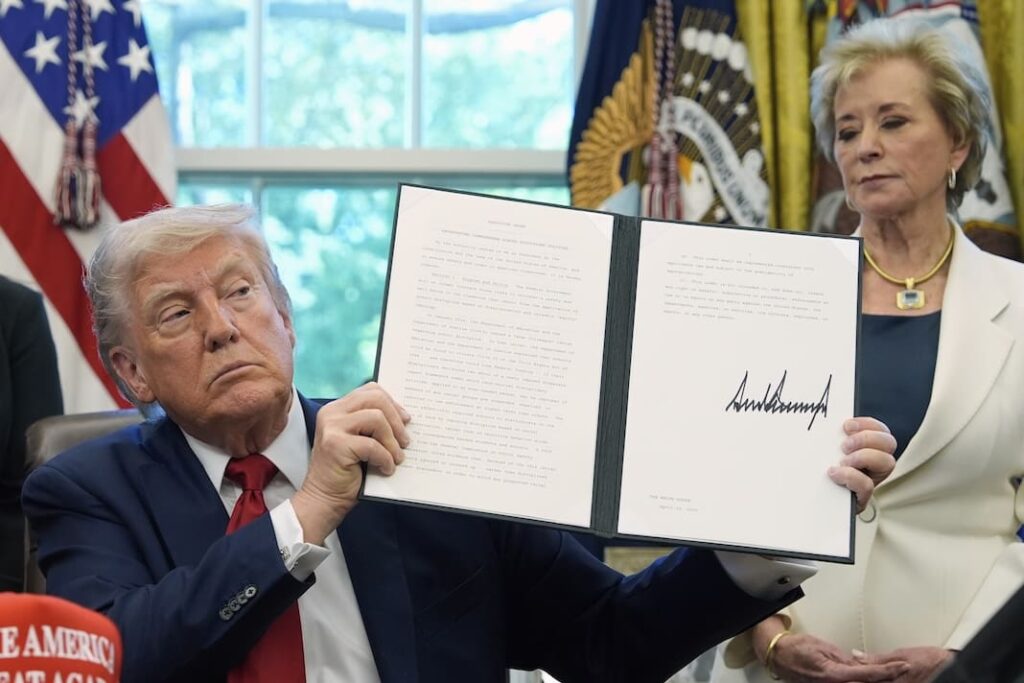
The Trump administration initiated a reduction at the Department of Education targeting over 1,300 employees on March 11. On March 20, Trump directed McMahon to close the Department of Education.
The executive order aimed to cut the workforce, originally 4,133 employees, in half. This included 600 employees who took voluntary resignation or retirement.
“Closing the Department provides children and families a chance to escape a failing system,” Trump stated. “The federal education bureaucracy is ineffective.”
In May, a federal judge blocked the order, which was upheld in June by the U.S. Court of Appeals for the 1st Circuit.
Because Congress created the Department of Education, the Trump administration can’t legally dissolve it alone. Congress would need to pass a bill, but Republicans lack the Senate votes to overcome a filibuster without rule changes.
Sotomayor argued the firings aimed to circumvent Congress to dismantle the department.
“Rather than wait for legislation, McMahon halved the workforce without considering effects on statutory functions,” Sotomayor wrote. “The District Court found the Department is unable to fulfill its functions due to mass terminations.”
The decision, she argued, grants the president unchecked power under the law.
“When the Executive announces intent to break the law and acts on it, the Judiciary must check this, not expedite it,” Sotomayor wrote. “Two lower courts enjoined the firings, yet this Court lifts the injunction, enabling the Department’s dismantling. This decision grants the Executive power to repeal laws by firing necessary personnel, threatening our separation of powers.”
Eliminating the Department has been an administration goal, aligning with Project 2025, a right-wing blueprint from the Heritage Foundation for Trump’s second term.
Experts note that despite Trump’s claims of no connection to Project 2025, his education actions align with its agenda. The document states, “Federal education policy should be limited, and ultimately, the Department of Education should be eliminated.”
Other administration actions include freezing teacher-training grants and proposing a $12 billion cut from programs assisting low-income students, training teachers, and more.
—
Read More Pennsylvania News