Modern warfare is evolving rapidly, with drones now playing a pivotal role on the battlefield. Since Russia’s incursion into Ukraine in 2022, drones have taken center stage, superseding traditional artillery as the weapon of choice for inflicting mass casualties.
Russian FPV drone footage uploaded online starkly illustrates this shift. These drones, operating with an eerie hum, target civilians trapped in the conflict. Former Navy pilot Ken Harbaugh highlighted the grim reality, noting, “They’re talking about hunting humans… it’s not collateral damage. Civilians are the targets. Little old ladies walking back from the market with shopping bags under their arms. They’re the targets.”
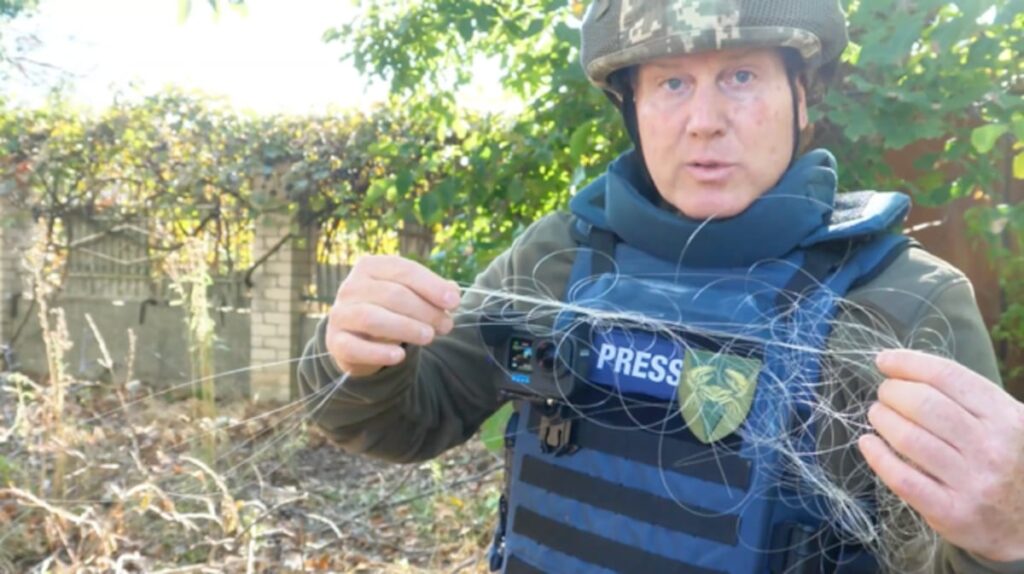
The short documentary “Drone Hunters of Kherson,” lasting just 17 minutes, captures the ongoing struggle as Ukrainian counter-drone teams patrol Kherson and Odessa to fend off Russian assaults. Harbaugh—embedded as the first American with the 11th “M. Hrushevskyi” Brigade among others—describes the scenario as “a blend of trench warfare and the Terminator.”
Ukraine has become a focal point for 21st-century drone warfare, with Russia rewriting modern combat rules. Harbaugh and former U.S. representative Denver Riggleman, the film’s executive producer, stress that the U.S. is inadequately prepared for this technological shift, highlighting issues in procurement and adaptability. Harbaugh states, “We don’t have an answer for it,” and emphasizes the need for awareness about drones’ offensive capabilities.
Both Harbaugh and Riggleman have observed what Harbaugh calls the “compressed innovation cycle” on the front lines in Ukraine. Innovations occur in mere hours, such as “3-D printed” warhead triggering mechanisms due to urgent battlefield demands.
The innovation pace in Ukraine contrasts starkly with the years-long processes in the U.S. Riggleman adds, “Even with the biggest military budget in the world, we’re trying to catch up.”
Discussed in the documentary, these issues take on greater urgency as the U.S. enters another conflict, this time with Iran. The U.S.-Israel offensive initiated on February 28, named Operation Epic Fury, has already seen 13 American service members killed and nearly 300 wounded.
Recently, a missile and drone attack at Prince Sultan Airbase in Saudi Arabia, attributed to Iran, injured 12 U.S. troops, two seriously. Riggleman points to this as evidence of unpreparedness, stating, “I think the lack of preparedness was evident that the first U.S. service members killed was by a Shahed [drone].”
In Ukraine, drones not only fulfill specific Russian missions but also control front lines through surveillance and targeting. Riggleman describes it as “1916” warfare underground, while drone technologies like fiber optic and radio-controlled drones operate above.
Ukraine has adapted by dispatching foot patrols to intercept fiber optic drones, which elude detection and jamming. “You have to have people between the drone operator and the civilian targets,” notes Harbaugh.
Current methods to counter drones involve using weapons like a Kalashnikov or a .50 caliber, though Riggleman admits hitting drones is a challenging task even when simulated. The documentary ultimately serves as a cautionary tale, stressing the need for adaptation in modern warfare.